


Aerospace is more than flight—it is the frontier of extreme technology. Through high-performance composites, automation, and intelligent processes, we deliver the perfect balance of lightweight efficiency and structural strength.


What is an aerospace?
Aerospace is the branch of engineering and industry that covers both atmospheric and space flight, combining aeronautics and astronautics into one unified field. It is not confined to the skies above us but extends beyond the atmosphere, encompassing the design, production, and operation of aircraft, rockets, satellites, and space stations. What makes aerospace unique is the integration of multiple scientific disciplines—materials science, propulsion, aerodynamics, guidance systems, and advanced manufacturing—into a single technological ecosystem.
In practical terms, aerospace includes the design of a commercial airliner just as much as the development of a reusable space launch vehicle. It reaches from passenger transport and defense aircraft to orbital communications satellites and interplanetary exploration. The industry has become a driver of innovation, advancing the use of high-performance materials like carbon fiber composites, titanium alloys, and high-temperature ceramics. At the same time, it shapes national security, global communications, weather monitoring, and space exploration. Aerospace is therefore not only a technological frontier but also a strategic cornerstone for global progress, linking Earth’s atmosphere to outer space in one continuous chain of innovation.


What is an aviation?
Aviation, by contrast, is a specialized part of aerospace that focuses solely on flight within the Earth’s atmosphere. It covers everything from commercial passenger airlines and cargo carriers to military jets, helicopters, and smaller private or business aircraft. While aerospace stretches into orbit and beyond, aviation is firmly tied to the skies above us, ensuring the safe and efficient movement of people and goods across continents.
This field emphasizes aircraft design, propulsion, navigation, and the complex systems of airports and air traffic control that make global flight possible. Aviation has always been a driver of connectivity and economic growth, linking societies in ways that were unimaginable a century ago. The modern aviation industry is now defined not only by safety and reliability but also by its push toward sustainability, with innovations such as composite airframes, digital flight systems, and the introduction of electric and hybrid propulsion. In this way, aviation is simultaneously a mature industry and one that is still evolving, continuously improving efficiency, reducing environmental impact, and strengthening its role as the backbone of international transport and commerce.
Future-Ready Aerospace Materials
Modern aircraft are no longer built on aluminum alone. Today, advanced composites make up over 50% of structures like the Boeing 787, combining carbon laminates, sandwich composites, and hybrid alloys. These materials reduce weight, improve fuel efficiency, and enhance structural strength, allowing aerospace engineers to achieve unprecedented performance and sustainability. By leveraging the next generation of composites, the industry continues to redefine what is possible in aviation and beyond.


The aerospace industry has moved far beyond traditional aluminum structures. In the early 1990s, aircraft like the Boeing 777 still relied heavily on metals, with only limited use of toughened graphite, hybrids, and fiberglass. By the mid-2000s, the Boeing 787 revolutionized design, replacing metal with advanced carbon laminates, carbon sandwich structures, and high-performance composites. This transformation reduced weight, improved fuel efficiency, and extended aircraft lifespan, setting a new benchmark for modern aviation.
High-Performance Roving for Composite Reinforcement
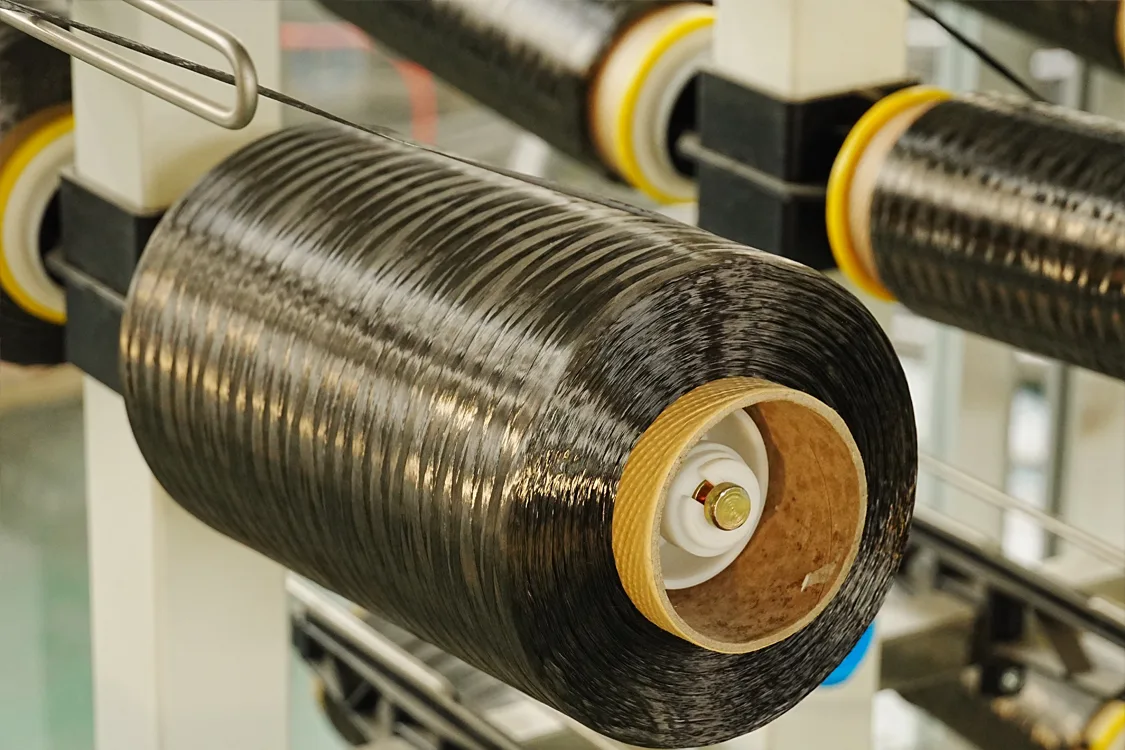
Carbon Fiber
Carbon fiber rovings deliver exceptional strength-to-weight performance, making them the preferred reinforcement in aerospace, automotive, and sporting goods. Their high stiffness, fatigue resistance, and thermal stability provide unmatched structural efficiency.

Glass Fibers
Glass fiber rovings offer excellent versatility, cost-effectiveness, and durability. With good tensile strength, impact resistance, and chemical stability, they are widely used in wind energy, construction, and transportation composites.

Aramid Fibers
Aramid fiber rovings are known for their outstanding impact resistance and toughness. Commonly used in aerospace, defense, and ballistic applications, they provide lightweight reinforcement with superior energy absorption.

Basalt Fibers
Basalt fiber rovings are produced from natural volcanic rock, combining high strength, temperature resistance, and environmental sustainability. They are used in civil engineering, automotive, and marine composites as an eco-friendly alternative to glass fiber.
Various Matrices for Reinforcement


Honeycomb Sandwich Composites

Lightweight Strength
Honeycomb sandwich composites are among the most widely used lightweight structural materials in aerospace, valued for their exceptional stiffness-to-weight ratio and energy absorption capacity. Constructed by bonding thin, high-strength face sheets to a lightweight honeycomb core, these panels provide outstanding structural efficiency while keeping overall weight to a minimum. In aircraft, they are used in flooring panels, bulkheads, control surfaces, and interior partitions, where strength, durability, and fire resistance are essential but weight must be tightly controlled. In spacecraft, honeycomb structures offer high dimensional stability in extreme environments, making them ideal for satellite panels, payload adapters, and fairings. Their geometry distributes loads evenly and resists bending, allowing engineers to design large, rigid structures that remain light enough for flight. As aerospace pushes toward higher performance and sustainability, honeycomb sandwich composites continue to play a critical role in balancing structural integrity, weight reduction, and cost efficiency.
The solution jota machinery supply for aersoapce

Prepreg
Prepregs are fiber reinforcements—typically carbon, glass, or aramid—that are pre-impregnated with a carefully measured amount of resin. This precise resin distribution ensures consistent material quality, eliminates the variability of manual impregnation, and allows engineers to achieve optimal fiber alignment. In aerospace, prepregs are indispensable for highly loaded structures such as fuselages, wings, empennages, and engine nacelles, where strength, stiffness, and fatigue resistance are critical. Their controlled properties provide predictable performance, enabling aircraft manufacturers to meet strict safety standards while simultaneously reducing weight and improving fuel efficiency. Although prepregs require autoclave or oven curing, their reliability and structural integrity have made them the benchmark for primary aerospace components.
Uni-directional Tape
Thermoplastic unidirectional (UD) tapes represent a new generation of composite materials that combine continuous fiber reinforcement with a thermoplastic polymer matrix. Unlike thermoset prepregs, which require long curing cycles, thermoplastic tapes can be rapidly consolidated, welded, or reshaped, offering significant advantages for high-rate production. Their compatibility with automated fiber placement (AFP) and automated tape laying (ATL) makes them ideal for manufacturing complex structures with fewer joints and reduced assembly time. In addition, thermoplastic UD tapes are tougher, more damage-tolerant, and recyclable, aligning with the aerospace industry’s shift toward sustainable manufacturing. Applications include wing skins, fuselage panels, stiffeners, and interior components, where their balance of lightweight performance and manufacturing efficiency is particularly valuable.

Continuous Fiber Reinforced Technology
Roving itself cannot be directly applied in aerospace structures, as dry fibers alone lack the strength and stability required in demanding environments. To be used in aircraft and spacecraft, rovings are typically impregnated with advanced resin systems—such as epoxy, phenolic, BMI, or thermoplastic matrices—to create prepregs and composite laminates. This combination of fibers and resin transforms the material into a high-performance composite, capable of withstanding extreme loads, temperatures, and fatigue conditions. Through this process, raw roving becomes the foundation for the lightweight, durable structures that define modern aerospace engineering.

Thermoset Prepreg
Thermoset prepregs are fiber reinforcements pre-impregnated with resins such as epoxy, phenolic, or BMI, ensuring precise resin content and uniform fiber distribution. Once cured under heat and pressure, they provide outstanding mechanical strength, fatigue resistance, and dimensional stability, making them the standard choice for primary aerospace structures such as fuselages, wings, and engine components.

Thermoplastic UD Tape
Thermoplastic unidirectional (UD) tapes combine continuous fibers with a thermoplastic matrix, offering rapid processing, high impact resistance, and recyclability. Unlike thermosets, they can be reheated and reshaped, enabling automated fiber placement and welding of complex parts. Their toughness and efficiency make them ideal for fuselage panels, stiffeners, and interior applications in next-generation aerospace programs.


We Are Born for advanced Composite Materials

AFP Prepreg
We provide advanced slitter rewinder machines specifically designed for AFP prepreg production, capable of slitting tows in 1/8”, 1/4”, and 1/2” widths with ±0.125 mm tolerance. This ensures consistent tape quality and precision required for automated fiber placement in aerospace applications.

ATL Prepreg & UD Tape
We supply cassette rewinding systems designed for both thermoset and thermoplastic prepreg and UD tape, ensuring smooth compatibility with ATL processes. Our precision-engineered cassettes guarantee stable feeding, accurate placement, and high reliability for aerospace composite manufacturing.
Children’s Dream in Aerospace
From the moment we first gaze at the sky as children, the dream of flight and exploration begins to take shape. Aerospace is where those dreams find direction—transforming imagination into science, effort into progress, and wonder into innovation. Every great achievement in aviation and space once lived in the heart of a dreamer who refused to give up. Today, that same spirit drives a new generation to look beyond boundaries, to study, to build, and to dedicate their efforts to the endless possibilities above. In this way, the dream of a child becomes the foundation for humanity’s journey into the future of aerospace.
