
topic : What Are Advanced Composite Materials
Author: Bruce Zhou
Introduction
If you look at modern airplanes, electric cars, wind turbine blades, or even a carbon-fiber bicycle frame, you’ll find one thing in common: they all rely on advanced composite materials. These engineered materials are the backbone of lightweight design, helping industries achieve more strength with less weight, better durability, and greater efficiency.
But what exactly are advanced composites, and why are they called “advanced”? To answer that, we need to look at what they’re made of, how they’re produced, and why they outperform metals and conventional plastics in so many fields.
Definition of Advanced Composite Materials
Advanced composite materials (sometimes shortened to advanced composites or high-performance composites) are engineered by combining two distinct components:
- Reinforcing fibers – usually high-strength, high-stiffness materials like carbon fiber, glass fiber, or aramid (Kevlar).
- Matrix resins – polymers such as epoxy, polyester, vinyl ester, or thermoplastics, which bind the fibers together and protect them.
When combined, the fibers carry most of the load, while the matrix transfers stresses and provides shape. The result is a fiber-reinforced polymer (FRP) with an exceptional strength-to-weight ratio, fatigue resistance, and durability far beyond that of metals.
Unlike steel or aluminum, composites are anisotropic – their strength and stiffness depend on fiber orientation. This allows engineers to design materials that are tailored to specific performance requirements, a unique advantage in aerospace, automotive, and energy industries.
Components of Advanced Composites
Reinforcing Fibers
The fibers are the backbone of advanced composites. Common types include:
- Carbon Fiber (CF)
- Extremely high tensile strength and stiffness
- Low density (~1.7 g/cm³)
- Excellent fatigue resistance
- Widely used in aerospace, motorsport, and wind energy
- Weakness: brittle under compression or impact
- Glass Fiber (GF)
- The most widely used reinforcement due to low cost
- Good strength and corrosion resistance
- Types include E-glass (electrical), C-glass (chemical resistant), and S-glass (high strength)
- Used in marine vessels, automotive parts, wind blades
- Aramid Fiber (Kevlar, Twaron)
- Exceptional impact and abrasion resistance
- Very strong in tension but weaker in compression
- Common in ballistic armor, protective gear, sporting goods
- Hybrid Fibers
- Combine carbon, glass, and aramid in one laminate
- Balance cost, toughness, and stiffness
Specialty fibers like basalt, UHMWPE (Dyneema), and ceramic fibers (SiC, alumina) are also used for niche applications such as high-temperature parts or extreme toughness.
Matrix Resins
The matrix binds the fibers, protects them, and transfers stresses. Two broad categories dominate:
- Thermosetting Resins (epoxy, polyester, vinyl ester)
- Cure into a rigid, cross-linked structure
- Cannot be remelted once cured
- High thermal and chemical resistance
- Epoxy is most common in aerospace due to superior bonding and toughness
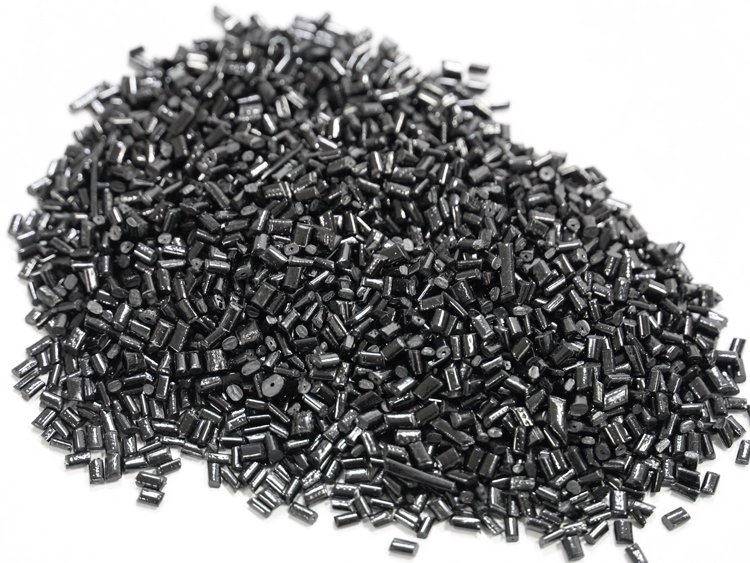
- Thermoplastic Resins (PEEK, PPS, PEI, nylon, polypropylene)
- Soften and remelt when heated
- More impact-resistant and recyclable than thermosets
- Allow faster processing and welding of parts
- Increasingly used in automotive and high-volume manufacturing
Manufacturing Processes
Advanced composites are made through various processes, each chosen for the part’s size, complexity, and performance requirements.
- Prepreg Layup
- Fibers are pre-impregnated with resin, then laid in layers.
- Cured in an autoclave or press for aerospace-grade laminates.
- Resin Transfer Molding (RTM/VARTM)
- Dry fibers are placed in a mold, and resin is injected or drawn in by vacuum.
- Produces complex shapes with smooth surfaces.
- Filament Winding
- Continuous fibers are wound around a rotating mandrel, then cured.
- Ideal for pressure vessels, tanks, and rocket casings.
- Automated Fiber Placement (AFP) & Automated Tape Laying (ATL)
- Robotic systems place narrow tows (AFP) or wide tapes (ATL) with precision.
- Used for aircraft wings, fuselages, and large wind blades.
- Pultrusion
- Fibers are pulled through resin and a heated die to make continuous profiles like rods and beams.
- Compression Molding & Double-Belt Presses
- Fiber mats and resins are compressed into panels under heat and pressure.
- Suitable for automotive parts and structural laminates.
Each method balances cost, cycle time, and mechanical performance. High-end aerospace applications rely on prepregs and AFP/ATL, while automotive and energy industries favor RTM and compression molding for volume efficiency.
Properties of Advanced Composites
- High Strength and Stiffness – Carbon composites reach tensile strengths up to 7 GPa and modulus values approaching 900 GPa.
- Low Weight – Typically 50–70% lighter than steel and ~30% lighter than aluminum.
- Fatigue Resistance – Withstand millions of load cycles without significant degradation.
- Corrosion Resistance – Do not rust or degrade in marine or chemical environments.
- Tailorability – Fiber orientation and hybridization allow properties to be engineered.
- Thermal Stability – High temperature resistance, especially with advanced resins.
- Electrical Properties – Can be insulating (glass composites) or conductive (carbon composites).
Applications Across Industries
- Aerospace & Defense – Aircraft fuselages, wings, rotor blades, rocket casings, ballistic armor.
- Automotive & Transport – EV battery enclosures, chassis components, crash structures, driveshafts.
- Energy – Wind turbine blades, hydrogen storage tanks, composite pipelines.
- Marine – Boat hulls, masts, offshore structures.
- Construction – Bridge reinforcements, composite rebar, strengthening of concrete.
- Sports & Leisure – Bicycles, skis, golf clubs, helmets, tennis rackets.
- Medical – Prosthetics, surgical tools, imaging tables.
- Consumer Electronics – Laptops, phone cases, camera tripods.
Wherever weight savings, strength, and durability matter, advanced composites are the go-to solution.
Advantages
- High strength-to-weight ratio
- Excellent stiffness
- Corrosion and fatigue resistance
- Design flexibility
- Lower maintenance over service life
- Good vibration damping
Disadvantages
- High raw material and processing costs
- Brittle failure under impact
- Complex fabrication and repair
- Recycling challenges, especially for thermoset composites
- Anisotropic properties requiring careful design
Innovations and Trends
The field is moving fast. Recent trends include:
- Sustainable Precursors – Lignin-based and bio-derived fibers to cut costs and carbon footprint.
- Advanced Recycling – Pyrolysis and chemical recovery for reclaiming carbon fibers.
- Automation – AFP/ATL robotics and Industry 4.0 digital twins to improve speed and quality.
- AI in Manufacturing – Machine learning to optimize curing, detect defects, and predict performance.
- Thermoplastic Composites – Faster processing, better toughness, and recyclability.
- New Applications – From eVTOL aircraft to 3D-printed composite parts and next-gen hydrogen tanks.
Conclusion
Advanced composite materials are more than just a replacement for metals – they’re enablers of entire industries, from clean energy to modern transportation. Their combination of strength, lightness, and durability ensures they will remain central to 21st-century innovation.
But designing with composites also requires the right equipment. Jota Machinery provides complete roll-to-roll solutions for producing advanced composites, including prepreg lines, UD tape slitters, and double-belt presses. These machines help manufacturers achieve the precision, consistency, and efficiency demanded by today’s applications.
👉 Ask Jota Machinery for the solution that fits your composite production needs.
About Jota Machinery
Composite machinery manufacturer
At Jota Machinery, we bring decades of hands-on experience in advanced composite materials, supporting industries from aerospace and automotive to renewable energy. Our journey has been built on trust—delivering reliable machinery and solutions that global partners depend on. With a commitment to transparency, we share our technical expertise openly, guiding clients through every stage of composite processing, from prepreg impregnation to precision slitting and double-belt press consolidation.
What sets us apart is our authority in roll-to-roll composite machinery. Backed by a dedicated R&D team and proven installations worldwide, Jota Machinery provides not only equipment but also the knowledge and support to help manufacturers innovate, scale, and succeed in the highly competitive composites market.
👉 Partner with Jota Machinery Composites — where expertise meets reliability, and innovation drives your growth.

Aerospace Industry
Our carbon fiber prepreg solutions are designed to meet the demanding standards of the aerospace sector. With high strength-to-weight performance, excellent fatigue resistance, and precise processing, we help manufacturers produce structural components that deliver reliability, efficiency, and long-term value in flight-critical applications.

Automotive Industy
For the automotive industry, we focus on thermoplastic fiberglass UD tape that combines lightweight design with impact resistance and recyclability. These advanced materials enable faster production cycles, reduced vehicle weight, and improved fuel efficiency, making them ideal for next-generation electric and performance vehicles.