

Written by Bruce Zhou
Founder & Managing Director | JOTA Machinery
Paper converting machinery specialist since 2002.
Connect with me on LinkedIn
Published: 29,October, 2026
Last Updated: 29,October, 2026 15:59:30 PM GMT+8
A thermal paper slitter rewinder has just completed a production cycle.
The jumbo thermal paper has been cut into narrow strips and rewound into finished POS receipt rolls.
The rolls have reached their required length or winding diameter, but one operation remains before they are ready for packaging.
The loose paper tail must be cut and secured to the outside of each finished roll.
If the tail is left unsecured, the outer paper layer may unwind during unloading, transportation, or packaging.
Some manufacturers perform this operation manually. An operator cuts the paper tail, applies adhesive, and presses the end against the roll.
However, thermal paper converting equipment can also use an automatic tail cutter and gluer.
On applicable JOTA Machinery slitter rewinders, the system combines a cutting mechanism with a pneumatic adhesive dispensing arrangement.
The adhesive is stored in a tank. Compressed air provides the pressure needed to deliver the adhesive through a hose and dispensing nozzle.
A sensor-controlled sequence coordinates the cutting position and glue application so that the paper tail can be secured during the finishing operation.
This article explains how an automatic tail cutter and gluer works, how pneumatic adhesive dispensing operates, why sensor positioning matters, and what manufacturers should check when the finished thermal receipt rolls are not properly sealed.
1. What Is an Automatic Tail Cutter and Gluer?
An automatic tail cutter and gluer is a finishing mechanism used on certain paper slitting and rewinding machines.
Its purpose is to cut the remaining paper tail and apply adhesive so the final outer layer stays secured to the finished roll.
The system combines two related operations:
Tail cutting: Separating the remaining paper web or terminal strip at the required finishing position.
Tail gluing: Applying a controlled quantity of adhesive so the terminal edge can be secured to the roll.
Depending on the slitter rewinder configuration, the operation can take place at the winding station or at a designated finished-roll processing position.
Why Does the Paper Tail Need to Be Sealed?
Once a roll has been rewound, the final paper layer is not automatically attached to the underlying layer.
Without a suitable finishing method, the loose end may move during subsequent handling.
This can make the roll difficult to pack and may affect its appearance.
A properly applied tail seal helps maintain the finished roll in a stable condition until it is used.
However, the adhesive should not prevent the customer from opening the roll normally.
The purpose is to secure the outer end, not permanently bond multiple layers together.
2. What Are the Main Components of the Tail Cutting and Gluing System?
The exact assembly depends on the machine model, but the main functions can be grouped into several parts.
Cutting Mechanism
The cutting mechanism separates the paper tail at the intended position.
Some designs use a circular blade, while other designs may use a different cutting arrangement.
The cutting mechanism must be coordinated with the position of the finished rolls and the paper web.
Adhesive Storage Tank
The adhesive is held in a tank or suitable reservoir.
The tank supplies the glue required for the finishing operation.
The selected tank must be compatible with the adhesive and intended pneumatic delivery method.
Pneumatic Adhesive Delivery
Compressed air is used to generate the pressure required to move adhesive through the delivery system.
The system may include a pressure regulator, air valve, adhesive hose, and other control components.
Glue Dispensing Nozzle
The nozzle applies adhesive at the designated position.
The nozzle arrangement determines where the glue leaves the dispensing system and reaches the paper.
Position Sensor
The sensor provides position or timing information needed to coordinate the finishing operation.
Depending on the machine design, it may be used to detect an actuator position, a product position, or another reference within the sequence.
Machine Controller
The control system coordinates the cutting and adhesive dispensing actions.
The precise control logic depends on the installed machine.
3. How Does the Automatic Tail Cutting and Gluing Process Work?
The operation takes place near the end of a rewinding cycle.
A typical process can be understood as a sequence of coordinated mechanical and pneumatic actions.
Step 1: The Thermal Paper Roll Reaches Its Finishing Stage
The slitter rewinder produces the required finished rolls.
Once the target winding condition has been reached, the machine initiates the applicable roll-finishing sequence.
The selected winding target may be based on length, diameter, or another approved machine setting.
Step 2: The Cutting Mechanism Moves Into Position
The machine positions the tail cutting mechanism according to its programmed sequence.
The cutter must operate at the correct position to separate the paper tail cleanly.
The movement may be controlled by the machine’s pneumatic or other mechanical actuators.
Step 3: The Sensor Provides Position Feedback
The sensor helps determine when the relevant mechanism has reached the required position.
The controller uses this information to coordinate the next operation.
This reduces reliance on the operator manually judging where cutting or gluing should occur.
Step 4: Adhesive Is Dispensed Through the Nozzle
The adhesive is supplied from the storage tank.
Compressed air generates the pressure needed to deliver it through the adhesive line.
When the relevant valve opens, glue is dispensed through the nozzle onto the designated paper area.
Step 5: The Tail Is Cut and Glued
The cutting and gluing operations are coordinated within the same finishing sequence.
The paper tail is cut, and adhesive is applied at the appropriate location.
The exact order and overlap of the mechanical actions depend on the equipment configuration.
Step 6: The Paper Tail Is Secured
On suitable designs, a support or contact roller can help bring the glued tail into contact with the outer paper layer.
The end becomes secured to the finished roll.
The machine can then proceed according to its unloading or next-cycle sequence.
The important point is that cutting, adhesive dispensing, and tail sealing are coordinated rather than performed as independent manual operations.
4. How Does Pneumatic Glue Delivery Work?
JOTA’s tail gluing arrangement uses compressed air to deliver adhesive from the storage tank to the dispensing nozzle.
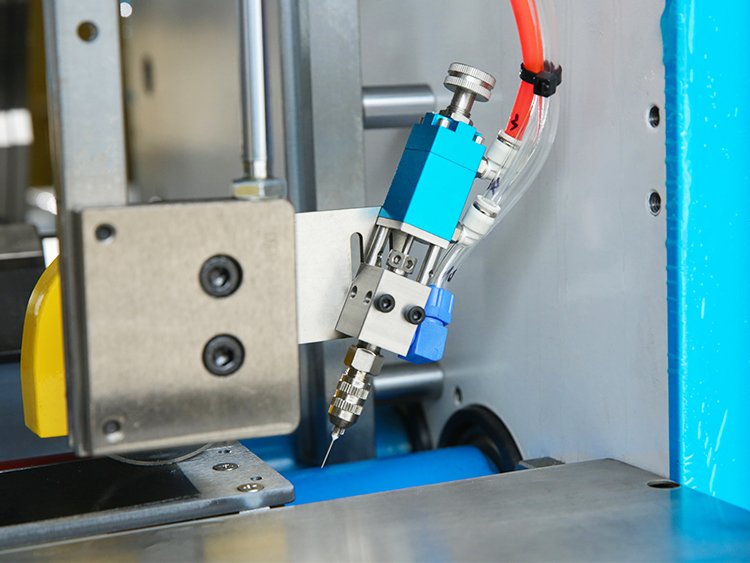
This is different from manually applying glue using a brush or squeeze bottle.
Adhesive Storage
The glue remains in a suitable tank until required.
The tank is connected to the dispensing system through the appropriate hose and fittings.
Air Pressure
Compressed air provides the driving pressure for adhesive delivery.
When the pneumatic system is activated, the pressure forces the adhesive toward the dispensing nozzle.
The actual pressure and delivery characteristics depend on the tank, valves, hose, nozzle, and adhesive properties.
Valve Control
An air valve or dispensing control arrangement regulates when adhesive can flow.
The controller coordinates this operation with the cutting sequence.
Nozzle Dispensing
The adhesive reaches the dispensing point and is deposited onto the selected paper area.
Depending on the nozzle arrangement, it may form a small drop or another controlled deposit.
The delivered amount must be suitable for holding the paper tail without creating excessive adhesive contamination.
Is Higher Air Pressure Better?
Not necessarily.
If the pressure is too low for the system, adhesive delivery may be inconsistent.
If it is excessive, the nozzle may dispense too much glue or create unwanted splashing.
The correct operating pressure should follow the machine and adhesive system specifications.
Operators should not increase pressure without checking the cause of the problem.
5. How Does the Sensor Control the Glue Position?
One of the most important elements of automatic tail gluing is the timing between the cutting mechanism and the glue nozzle.
The adhesive must be applied at the correct location.
If the timing or mechanical position is incorrect, the glue may miss the intended paper area.
Position Detection
The installed sensor provides information about a relevant mechanical or product position.
The controller uses this information within the finishing sequence.
Glue Dispensing Trigger
Once the required conditions have been met, the controller activates the appropriate adhesive dispensing function.
The pneumatic valve opens according to the control sequence.
Coordination With Cutting
The cutting mechanism must operate at the intended position relative to the paper tail.
The controller coordinates the cutting action with adhesive dispensing.
This allows the machine to carry out the two finishing functions during one automated cycle.
Can the Sensor Measure the Actual Glue Drop?
Not necessarily.
A position sensor may confirm that the relevant mechanism has reached its operating position without detecting whether adhesive physically left the nozzle.
Direct confirmation of glue presence or quantity requires suitable additional sensing or inspection equipment.
This distinction is important when troubleshooting a machine that appears to complete its cycle but produces unsealed rolls.
6. Why Is Glue Position Important?
The location of the adhesive influences how successfully the paper tail is secured.
If the glue is applied too far from the intended contact area, the terminal edge may not adhere correctly.
If it is deposited beyond the required area, it may contaminate other parts of the roll or machine.
Glue Too Close to an Unintended Area
Incorrect application may leave adhesive on surfaces that should remain clean.
This can create unwanted sticking or handling problems.
Glue Misses the Paper Tail
If the nozzle does not deliver glue to the intended location, the roll may leave the finishing station with a loose paper end.
Glue Is Applied Unevenly
Inconsistent adhesive deposition can produce variation between finished rolls.
Some may be sealed securely, while others may open during normal handling.
How to Verify Glue Position
Run representative finishing cycles and inspect the completed rolls.
Check where the adhesive has been applied.
Confirm that the tail is secured without excessive bonding or visible contamination.
The correct position should be established according to the machine’s design and approved product requirements.
7. What Type of Glue Is Suitable for Thermal Paper Tail Sealing?
The adhesive must be suitable for the paper surface and the application system.
JOTA’s published inline printing and slitting equipment descriptions identify water-based glue as an option for its automatic tail gluing arrangement.
However, the term water-based glue covers many different formulations.
The actual adhesive must be selected according to the paper grade and dispensing requirements.
Adhesion to Thermal Paper
The glue must provide enough adhesion to hold the tail in place.
However, it should not damage the thermal-sensitive coating or create unacceptable marks.
Viscosity
The viscosity affects how the adhesive travels through the hose and nozzle.
An unsuitable formulation may dispense inconsistently or block the nozzle.
Drying and Setting Behaviour
The adhesive should establish sufficient bond strength for downstream handling.
The setting time depends on the formulation, application quantity, and operating conditions.
Compatibility With the Delivery System
The tank, hose, valves, seals, and nozzle must be compatible with the selected adhesive.
Can Ordinary Paper Glue Be Used?
Not every general-purpose paper adhesive will be suitable.
Before adopting a new glue, confirm its compatibility with the thermal paper and the pneumatic dispensing system.
A controlled trial should verify adhesion, dispensing consistency, and the condition of the finished roll.
8. How Much Glue Should Be Applied?
The correct adhesive quantity depends on the paper grade, roll dimensions, nozzle arrangement, and glue formulation.
Applying too little adhesive may leave the tail unsecured.
Applying too much may cause unwanted bonding or contamination.
What Happens When Too Little Glue Is Dispensed?
The paper tail may lift away from the roll.
The end may open during unloading or packaging.
Some rolls may remain sealed while others fail.
What Happens When Too Much Glue Is Dispensed?
Excess adhesive may spread beyond the intended area.
It may cause adjacent layers to stick together.
The finished roll may become difficult to open.
How to Control the Glue Quantity
Depending on the dispensing system, the delivered quantity may be influenced by air pressure, valve opening duration, nozzle characteristics, and adhesive viscosity.
The operator should follow the approved settings and verify the actual result.
There is no universal glue volume suitable for every thermal paper roll.
9. What Happens If the Glue Nozzle Becomes Blocked?
Nozzle blockage is a practical issue in adhesive dispensing systems.
Adhesive residue may accumulate at the outlet or within the delivery path.
This can reduce the amount of glue reaching the paper.
Possible Symptoms
The nozzle may produce smaller or irregular deposits.
Some finishing cycles may receive no adhesive.
The glue may emerge in an unintended direction.
The pressure system may appear active even though the finished rolls are not properly sealed.
What Should Operators Check?
Inspect the adhesive supply.
Confirm that the tank contains a suitable amount of glue.
Review the pneumatic pressure and valve operation.
Check the nozzle and hose according to the approved maintenance procedure.
How to Prevent Blockage
Use the specified adhesive.
Follow the equipment manufacturer’s cleaning and flushing procedure.
Avoid allowing incompatible glue formulations to mix in the system.
Do not use sharp tools or uncontrolled pressure to clear a nozzle.
Before opening the delivery system, isolate and safely release stored pressure according to the equipment instructions.
10. Why Does the Tail Cutter Sometimes Leave an Uneven End?
The cutting and gluing functions are related, but a poor cut is not necessarily caused by the adhesive system.
Blade Condition
A worn or damaged cutting blade may produce an irregular paper edge.
Incorrect Cutter Position
If the cutting mechanism does not reach its intended position, the paper may not be separated correctly.
Actuator Problems
A pneumatic or other actuator may fail to complete its prescribed movement.
Sensor Position
If position feedback is incorrect, the controller may not coordinate the cutting action properly.
Paper Movement
Unstable paper positioning during the finishing operation can also affect the result.
What Should Be Inspected?
Check the cutting edge, relevant actuator, position sensor, and approved sequence settings.
Do not increase adhesive pressure to compensate for a mechanical cutting problem.
11. Common Automatic Tail Cutter and Gluer Problems
The following table provides a practical troubleshooting reference.
| Problem | Possible Cause | Recommended Investigation |
|---|---|---|
| Tail is cut but not glued | No adhesive delivery or incorrect dispensing trigger | Tank, pressure, valve and nozzle |
| Glue is applied but tail remains loose | Incorrect glue position or inadequate bond | Nozzle position, glue formulation and contact |
| Excessive glue on finished rolls | Incorrect dispensing quantity | Pressure, valve timing and nozzle |
| Glue deposits are inconsistent | Adhesive supply or viscosity variation | Tank, hose and adhesive condition |
| Paper tail is uneven | Cutting mechanism or positioning issue | Blade condition and actuator movement |
| Glue nozzle drips between cycles | Valve leakage or unsuitable dispensing conditions | Valve, pressure and nozzle condition |
| Tail sealing varies between rolls | Timing, mechanical contact or adhesive variation | Sensor sequence and finished-roll inspection |
| Sensor signal is present but no glue appears | Position feedback without actual dispensing | Pneumatic valve and adhesive delivery |
A single symptom can have more than one cause.
For example, an unsecured tail may result from missing adhesive, incorrect placement, or insufficient contact after dispensing.
Operators should identify the affected function before changing multiple machine settings.
12. How Does Automatic Tail Gluing Affect Production Efficiency?
Manual tail finishing involves repeated operator actions.
The operator must locate the loose paper end, cut it, apply adhesive, and secure the tail.
When a production line produces many small thermal receipt rolls, these actions can become repetitive.
An automatic tail cutter and gluer combines the relevant finishing operations within the machine cycle.
Reduced Manual Finishing
The machine can perform cutting and adhesive application without requiring an operator to finish every tail individually.
The actual labour reduction depends on the production-line configuration.
More Repeatable Glue Position
Sensor-controlled positioning and a consistent mechanical sequence can help reduce variation associated with manual placement.
However, accuracy still depends on correct settings and maintenance.
Better Integration With Downstream Handling
When the roll tail is properly sealed, the finished product can proceed toward unloading and packaging in a more controlled condition.
Why Cycle Time Matters
The cutting and gluing operation occupies part of the overall production cycle.
Its duration may influence production capacity, particularly on machines that stop or index during finishing.
A faster gluing action is not automatically beneficial if it compromises the adhesive bond.
The important measure is the number of finished rolls that meet the required quality standard.
13. Tail Cutting and Gluing on Semi-Automatic vs Fully Automatic Lines
Automatic tail cutting and gluing can be used with different levels of overall machine automation.
The presence of an automatic gluer does not mean the entire production line is fully automatic.
Semi-Automatic Thermal Paper Slitter Rewinder
On an applicable semi-automatic machine, the tail cutting and gluing function can operate automatically while other tasks still require operator involvement.
The exact responsibilities depend on the installed equipment.
Fully Automatic Thermal Paper Production Line
In a more integrated configuration, tail cutting and gluing can be coordinated with other operations such as core handling, finished-roll transfer, and downstream packaging.
However, the exact transfer sequence and automation scope vary between models.
Why Buyers Should Confirm the Configuration
When comparing thermal paper slitter rewinders, ask whether the tail cutter and gluer is installed as standard equipment or offered as an optional module.
Also confirm how the finishing station interacts with roll unloading and the next winding cycle.
The correct comparison should be based on the complete production sequence rather than the name of one accessory.
14. How to Check Tail Sealing Quality
A finished roll should not be accepted solely because the cutting and gluing mechanism has completed its programmed cycle.
The actual paper tail should be inspected.
Visual Appearance
Check that the loose end is positioned correctly and the roll has a clean appearance.
Adhesive Placement
Confirm that the adhesive is deposited in the intended location.
Bond Strength
The tail should remain secured under the intended handling conditions.
At the same time, it should be possible to open the roll normally without unacceptable paper damage.
Paper Surface Condition
Inspect for unwanted adhesive marks, coating discoloration, or contamination.
Repeatability
Check representative rolls produced during different parts of the operating cycle.
If several slit lanes are processed simultaneously, inspect samples across the working width.
Packaging Readiness
Before the rolls enter the packaging process, confirm that the tails are sufficiently secured for the intended transfer and handling arrangement.
The factory should establish practical acceptance criteria based on the finished product specification.
15. JOTA Machinery’s Automatic Tail Cutter and Gluer
At JOTA Machinery, we manufacture thermal paper slitting and rewinding equipment for POS receipt rolls, cash register rolls, and other thermal paper converting applications.
Our equipment range includes configurations equipped with automatic tail cutting and gluing mechanisms.
The system is designed to combine the final paper cutting and adhesive application functions within a coordinated finishing sequence.
Pneumatic Adhesive Supply
Adhesive is stored in a suitable tank and delivered through the dispensing system using compressed air.
The air-controlled arrangement supplies glue through a hose toward the nozzle.
Sensor-Controlled Positioning
The finishing mechanism uses sensor feedback to coordinate the designated cutting and gluing positions.
The actual sensor and actuator arrangement depends on the machine model.
Automatic Paper Tail Sealing
After cutting and adhesive application, the paper tail is brought into contact with the finished roll according to the machine’s finishing arrangement.
This helps secure the outer paper end before subsequent handling.
Suitable Equipment Configurations
JOTA provides different thermal paper slitter rewinder configurations, including semi-automatic and fully automatic production solutions.
The availability and arrangement of the automatic tail cutter and gluer should be confirmed for the selected machine.
What Should Customers Provide?
If you are evaluating an automatic tail cutting and gluing system, share the jumbo paper width, finished paper roll sizes, production requirements, and intended automation level.
It is also useful to explain whether the machine will operate independently or connect with downstream packaging equipment.
Our engineering team can review the appropriate finishing arrangement for the proposed production line.
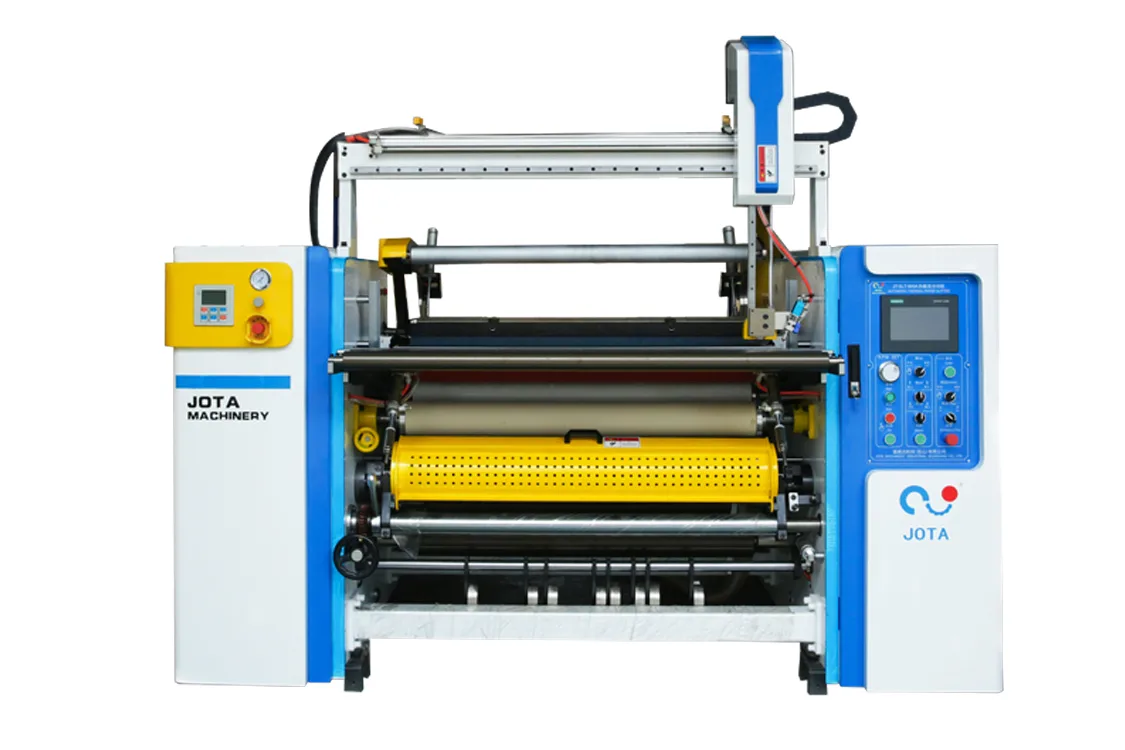
For standard POS and receipt-roll production, thermal paper jumbo rolls are slit and rewound into the required finished widths, diameters and core specifications.
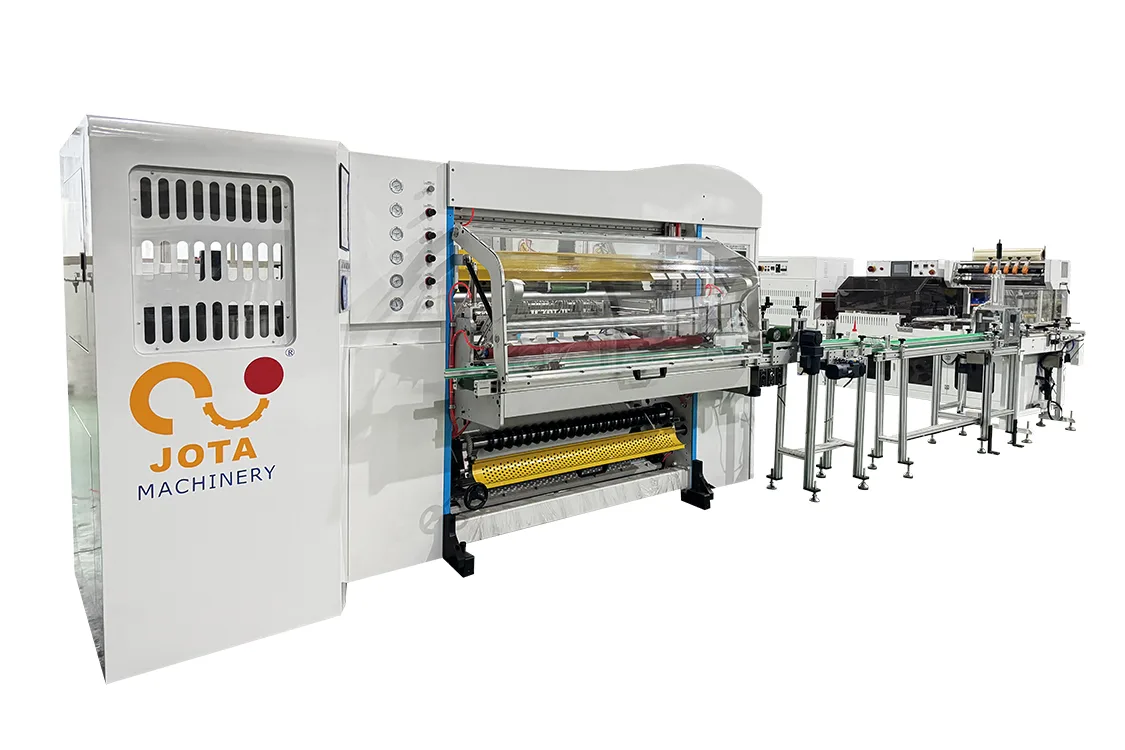
For higher production output, a fully automatic configuration can reduce manual handling and integrate additional roll finishing, packaging or palletizing processes.
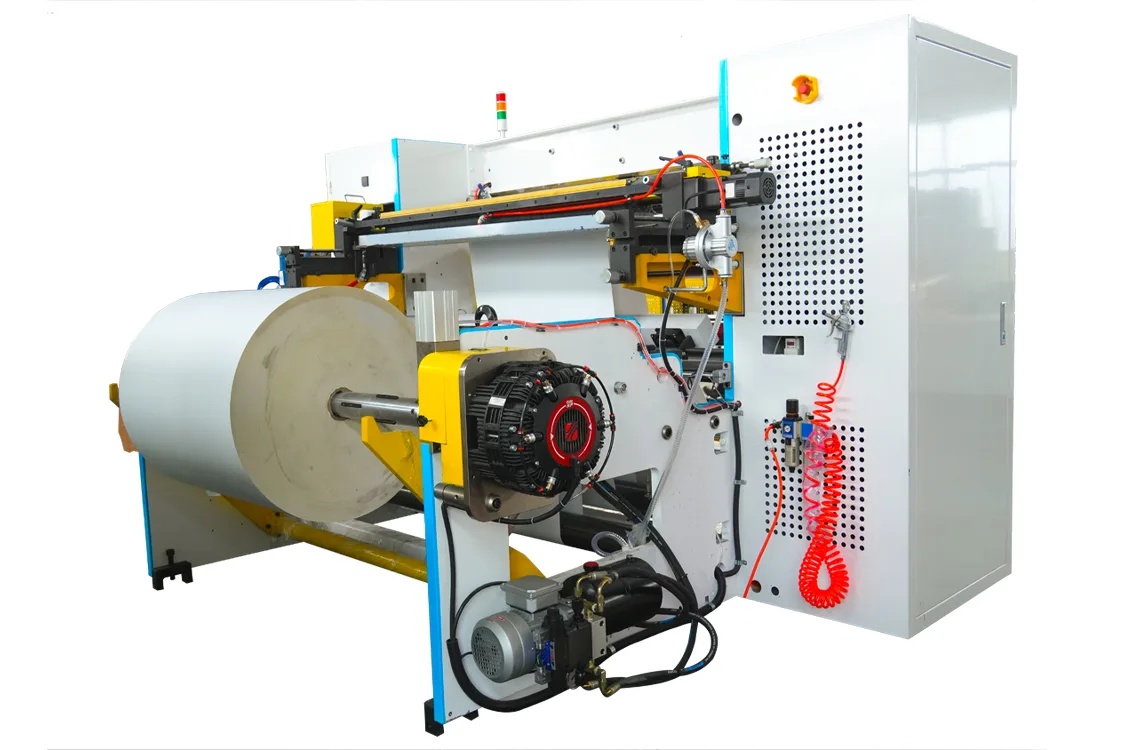
If your rolls require logos or promotional information, inline flexographic printing can be combined with slitting and rewinding in one production process.
Explore JOTA Thermal Paper Slitting and Rewinding Machines
Conclusion: Cutting and Gluing Must Work as One Finishing Sequence
An automatic tail cutter and gluer is used to secure the loose paper ends of finished thermal receipt rolls.
The cutting mechanism separates the paper tail.
The adhesive system supplies glue from a tank through a pneumatic dispensing arrangement.
A sensor-controlled sequence coordinates the required positions and timing.
The deposited adhesive helps secure the terminal paper layer to the finished roll.
However, the quality of the result depends on several factors.
The cutting mechanism must operate correctly.
The adhesive must be compatible with the paper and dispensing equipment.
The nozzle must deliver an appropriate quantity at the intended location.
The control system must coordinate the relevant mechanical actions consistently.
A successful automatic tail finishing system does more than cut paper and dispense glue. It produces a neatly sealed thermal receipt roll that can be handled, packaged, and opened as intended.
Looking for a Thermal Paper Slitter Rewinder With Automatic Tail Cutting and Gluing?
JOTA Machinery provides thermal paper converting equipment with different winding and finishing configurations.
If you want to reduce manual tail sealing or integrate the finishing process into a thermal receipt roll production line, share your finished roll sizes and production requirements.
Our engineering team can discuss a suitable machine configuration and automatic tail cutting and gluing arrangement.
Contact JOTA Machinery About Automatic Thermal Paper Roll Finishing
Last Updated on 29/10/2026 by Jota Machinery