
Published on MAY 21, 2026 by Jota Machinery | 10:45:08 | Bruce Zhou

For many paper converters entering the receipt roll, POS roll, ATM paper, cash register paper, or lottery ticket roll business, one practical question always comes first: how does a fully automatic thermal paper slitting machine work?
The simple answer is that it converts a large thermal paper jumbo roll into small finished rolls through a continuous roll-to-roll process. But in a modern fully automatic production line, the process is much more than unwinding, slitting, and rewinding.
A fully automatic thermal paper slitting machine can complete a full production sequence:
jumbo roll unwinding → web feeding → automatic core vacuum sucking and loading → slitting → rewinding → terminal gluing → roll conveying → wrapping → cartoning → warehouse transfer
Behind these steps, servo motors, PLC control, HMI operation, tension control, web guiding, automatic mechanical handling, and data monitoring work together. The machine is designed not only to cut paper, but also to reduce labor, improve roll consistency, control waste, and help the paper converter build stable mass production.
For factories producing thermal receipt rolls every day, the real value of a fully automatic thermal paper slitter rewinder machine is not only speed. It is stable roll quality, accurate length, clean cutting edges, neat roll appearance, reliable packing, and fewer production interruptions.
What Is a Fully Automatic Thermal Paper Slitting Machine?
A fully automatic thermal paper slitting machine is a high-efficiency roll-to-roll converting system used to process wide thermal paper parent rolls into small finished rolls.
These finished rolls are widely used in:
- POS terminals
- cash registers
- ATM machines
- credit card terminals
- self-service kiosks
- lottery ticket printers
- queue management systems
- parking ticket machines
- medical thermal printers
Thermal paper usually arrives at the converter’s factory in large jumbo rolls. These rolls may be 500 mm, 900 mm, 1200 mm, 1400 mm, or wider. The machine slits the wide roll into smaller widths such as 57 mm, 58 mm, 76 mm, 80 mm, or customized sizes required by different printers and markets.
Compared with a semi-automatic thermal paper slitter rewinder machine, a fully automatic model can handle more steps with minimal manual operation. Depending on the machine configuration, it may include:
- automatic jumbo roll feeding support
- automatic tension control
- automatic web guiding
- automatic core feeding
- core vacuum sucking
- automatic core loading
- automatic slitting
- servo-controlled rewinding
- automatic tail gluing
- automatic roll discharge
- conveying system
- shrink wrapping or film packing
- automatic cartoning
- production data monitoring
This makes the machine suitable for paper converters who need higher output, lower labor dependence, and more consistent finished roll quality.
Why Fully Automatic Slitting Is Important for Thermal Paper Converters
Thermal paper converting is a high-volume business. A converter may need to produce thousands or even hundreds of thousands of rolls for supermarkets, banks, retail chains, logistics companies, fuel stations, and POS paper distributors.
In this kind of production, manual work creates several limits.
Operators may load cores at different speeds.
Tail sealing may not be consistent.
Roll unloading may slow down the machine.
Packaging may become a bottleneck.
Length control may vary if the machine is not stable.
Roll appearance may differ between operators.
A fully automatic thermal paper slitting machine is designed to solve these problems. It standardizes the whole process from jumbo roll to finished roll packing.
For a paper converter, this means:
- higher daily production capacity
- fewer operators required
- more consistent roll tightness
- better finished roll appearance
- reduced paper waste
- cleaner slitting edges
- more stable delivery schedule
- easier production management
This is why many mature receipt roll manufacturers choose fully automatic lines when order volume grows.
Step 1: Jumbo Roll Loading and Unwinding
The working process begins with jumbo roll loading.
A large parent roll of thermal paper is placed on the unwind stand. Depending on machine design and roll weight, the machine may use an air shaft unwind system or a hydraulic shaftless unwind stand.
For heavy jumbo rolls, hydraulic shaftless unwinding is often preferred because it reduces manual handling and improves loading safety. The operator does not need to push a long shaft through the heavy paper roll. Instead, the hydraulic arms clamp the roll from both sides and lift it into the correct working position.
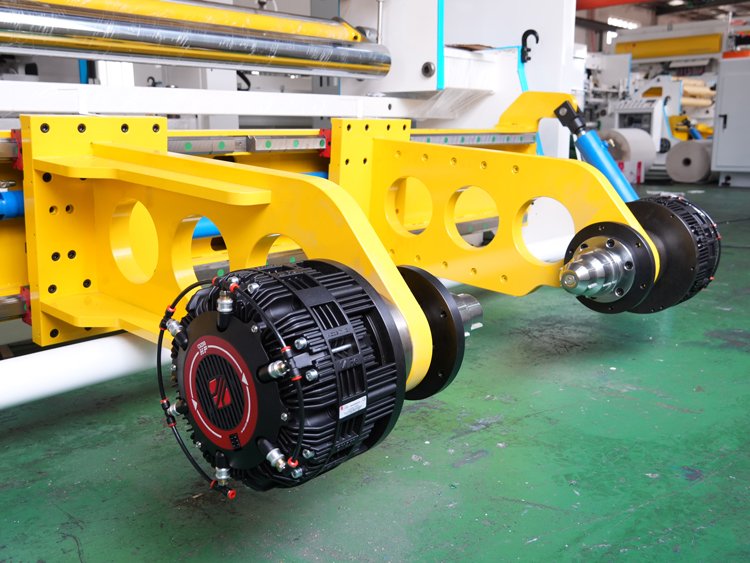
During unwinding, the machine must feed the thermal paper web smoothly into the production line.
This section controls:
- jumbo roll holding stability
- unwind brake or motor torque
- paper web tension
- roll diameter change
- web flatness
- coating side direction
- paper break prevention
Thermal paper is sensitive because its surface has a heat-reactive coating. Excessive friction, pressure, or unstable tension may affect the coating or create defects during converting.
That is why stable, low-tension unwinding is very important. The paper should run smoothly, without sudden pulling, wrinkling, or side shifting.
As the jumbo roll diameter becomes smaller, the unwinding condition changes. A professional fully automatic slitting machine uses tension control systems to adjust this change automatically.
Common tension control components include:
- dancer rollers
- load cells
- magnetic powder brakes
- servo motors
- closed-loop tension systems
Good unwinding is the first foundation of good finished rolls.
Step 2: Web Feeding and Tension Zone Control
After unwinding, the thermal paper web enters the feeding section.
This part may include guide rollers, traction rollers, nip rollers, tension rollers, and web guiding units. In some production lines, an inline flexographic printing station can also be added before slitting.
The feeding section has one main job: keep the paper moving forward at a stable speed and under proper tension.
In a fully automatic thermal paper slitting machine, feeding is usually servo-controlled. Servo-driven traction rollers help synchronize the web speed with the whole machine line.
This matters because thermal paper is thin and sensitive. If one section pulls too fast while another section slows down, the paper web may become unstable.
Poor feeding control can cause:
- wrinkles
- paper breakage
- inaccurate length counting
- web drifting
- unstable slitting width
- poor rewinding quality
- uneven roll end face
A well-designed feeding section divides the machine into different tension zones. Each zone controls the paper web according to the process requirement.
For example, the unwind section may use lower tension to protect the jumbo roll surface. The slitting section may require more stable tension for cutting accuracy. The rewinding section may need controlled torque to form rolls with proper tightness.
This is the real meaning of roll-to-roll processing. It is not one simple pulling action. It is a coordinated web movement system.
Step 3: Web Guiding for Straight Paper Alignment
Before the paper reaches the slitting blades, it must stay aligned.
Automatic web guiding systems are used to detect and correct the paper edge position. These systems often use ultrasonic sensors, infrared sensors, or edge detection sensors.
When the paper web shifts left or right, the guiding system sends a signal to the correction unit. The machine then adjusts the web position automatically.
This helps keep the paper web centered and straight before slitting.
Good web guiding improves:
- slitting width accuracy
- roll edge quality
- rewinding alignment
- finished roll appearance
- material utilization
- production stability
For narrow receipt rolls, even a small alignment error can become visible in the finished product. A roll that looks slightly uneven may still cause problems during printer use or packing.
That is why professional paper converters pay close attention to web guiding, especially when producing 57 mm, 58 mm, or 80 mm POS rolls at high speed.
Step 4: Automatic Core Vacuum Sucking and Core Loading
Automatic core loading is one of the most important features of a fully automatic thermal paper slitting machine.
For cored thermal paper rolls, each roll needs a paper or plastic core before rewinding. In semi-automatic production, workers usually place these cores manually. This slows down production and creates variation.
In a fully automatic machine, the core loading system completes this step automatically.
A typical automatic core loading process includes:
- cores are stored in a core hopper
- the machine separates cores one by one
- a vacuum sucking device picks up the cores
- the cores are transferred into position
- a pushing or scraping mechanism loads them onto the rewinding shaft
- the machine checks or confirms the loading position
- rewinding begins automatically
The vacuum sucking system helps pick and position cores quickly. The scraping or pushing mechanism ensures the cores are inserted correctly and aligned with the rewinding shaft.
This step has a direct effect on finished roll quality.
If the core is not loaded straight, the finished roll may have:
- uneven winding
- poor roll end face
- unstable diameter
- loose layers
- appearance defects
- packing difficulty
For high-speed receipt roll production, automatic core loading saves labor and keeps the machine cycle consistent.
Some fully automatic thermal paper slitting machines can also support coreless roll production. Coreless production removes the paper or plastic core, but it requires a special rewinding structure and better control of the starting layers.
Step 5: Slitting the Thermal Paper Web
After core preparation and web feeding, the paper enters the slitting section.
This is where the wide jumbo roll is cut into multiple narrow lanes.
Common finished roll widths include:
- 57 mm
- 58 mm
- 76 mm
- 80 mm
- customized widths for specific printers
The slitting system may use rotary shear knives, razor blades, or crush-cut systems. For thermal paper roll production, clean edge quality is especially important because poor cutting creates dust, burrs, and rough edges.
Among different slitting methods, rotary shear slitting is commonly used when the converter needs cleaner edges and better roll appearance.
A high-quality slitting section should provide:
- accurate width control
- clean cutting edges
- low paper dust
- stable blade contact
- easy blade adjustment
- low vibration
- smooth high-speed running
The blade system must be adjusted carefully. Blade overlap, blade pressure, blade angle, blade sharpness, and knife holder stability all affect cutting quality.
If the blade setup is wrong, the finished rolls may show:
- fuzzy edges
- burrs
- excessive paper dust
- uneven width
- edge cracking
- coating damage
- poor printer compatibility
For a paper converter, slitting quality is not only a factory issue. It also affects the end user. If paper dust enters a POS printer or cash register printer, the printer head may become dirty and printing quality may decline.
This is why experienced converters do not only ask about machine speed. They also ask about blade structure, adjustment convenience, roller precision, and long-term cutting stability.
Step 6: Waste Edge Trim Removal
During slitting, the two sides of the jumbo roll often produce waste edge trims. These trims must be removed continuously.
The machine may use air suction, waste rewinding, or trim collection systems.
Stable edge trim removal prevents waste strips from interfering with the main paper web. If trim waste breaks, twists, or wraps around rollers, the machine may need to stop.
For high-speed fully automatic production, trim handling must be reliable. A small waste strip can cause a large production interruption if it is not controlled properly.
Good trim removal helps improve:
- machine uptime
- workshop cleanliness
- slitting stability
- operator safety
- finished roll quality
This is a small section, but in real factory production, it matters.
Step 7: Servo-Controlled Rewinding
After slitting, each narrow paper lane is rewound onto the prepared core.
This is where the machine forms finished thermal paper rolls.
The rewinding section must control:
- roll length
- roll diameter
- winding tightness
- roll density
- core alignment
- end-face quality
- surface smoothness
- paper layer stability
Fully automatic thermal paper slitting machines may use center rewinding, surface rewinding, or a combined winding design.
Center Rewinding
Center rewinding drives the core or rewinding shaft directly. It is widely used for small thermal paper rolls such as POS rolls and cash register rolls.
Surface Rewinding
Surface rewinding uses a roller to drive or support the outer surface of the growing roll. It can help control roll density and improve winding uniformity in certain applications.
In a servo-controlled system, the rewinding shaft can adjust speed and torque according to the roll diameter and tension requirement. As the roll grows larger, the machine changes its control logic to keep winding stable.
Good rewinding produces rolls with:
- neat end face
- correct diameter
- accurate length
- proper tightness
- smooth outer surface
- stable printer unwinding
If rewinding is too loose, the roll may telescope or deform. If rewinding is too tight, the paper may be stressed or difficult to unwind inside the printer. If rewinding tension changes suddenly, the roll end face may become uneven.
For thermal paper converters, rewinding quality is one of the most visible signs of machine quality.
Step 8: Length Counting and Automatic Cycle Control
Finished thermal paper rolls must meet the required length. A buyer may order 57 mm x 40 m rolls, 80 mm x 80 m rolls, or another custom specification.
The machine uses meter counting, encoder signals, PLC control, and servo synchronization to control roll length.
When the preset length is reached, the machine prepares for the next actions:
- deceleration
- cutting
- tail positioning
- gluing
- roll discharge
- next core loading
- next cycle start
Accurate length control protects the converter’s profit.
If the roll is too short, customers may complain.
If the roll is too long, the factory gives away extra paper.
If the length varies too much, product consistency suffers.
In high-volume production, even a small length error can become expensive when repeated across thousands of rolls.
That is why servo control, stable tension, and reliable meter counting are important in a fully automatic thermal paper roll production line.
Step 9: Terminal Gluing and Tail Sealing
When the finished roll reaches the target length, the tail end must be sealed.
This step is called terminal gluing or tail sealing.
The machine applies a small glue dot or glue strip to hold the paper tail on the roll. This prevents the roll from opening during conveying, wrapping, boxing, storage, and transportation.
A good terminal gluing system must control:
- glue position
- glue amount
- glue timing
- tail length
- roll rotation position
- cycle synchronization
If the glue amount is too high, the roll may look messy. If the glue amount is too low, the tail may open. If the position is inaccurate, packaging becomes less neat.
Servo timing is important because gluing must match the exact position of the roll. In a fully automatic line, tail sealing must be fast, repeatable, and clean.
Although gluing looks like a small step, it strongly affects product appearance and packing efficiency.
Step 10: Finished Roll Discharge and Conveying
After gluing, the machine automatically removes the finished rolls from the rewinding position.
This may be done by pushers, roll stripping devices, transfer arms, or automatic unloading mechanisms.
The finished rolls are then moved onto a conveyor belt.
The conveying system may send rolls to:
- roll alignment
- inspection
- counting
- wrapping
- labeling
- shrink packing
- cartoning
A good conveying system keeps the production rhythm smooth. If finished rolls cannot move away quickly, the rewinding section may need to wait. This reduces the benefit of full automation.
In a complete thermal paper roll production line, every section must match the speed of the next section. Otherwise, the bottleneck simply moves from manual labor to machine transfer.
Step 11: Wrapping and Packaging
After conveying, finished rolls enter the wrapping or packaging section.
Packaging may include:
- single roll film wrapping
- multi-roll shrink wrapping
- printed film wrapping
- paper banding
- label application
- automatic counting
- bundle packing
The packaging method depends on the converter’s market and customer requirements.
For retail and wholesale receipt rolls, packaging is not only protection. It is also part of the product image. Clean wrapping, accurate quantity, neat arrangement, and clear labels help the buyer trust the product.
A fully automatic wrapping system can reduce manual handling and make the finished rolls more consistent before boxing.
Step 12: Automatic Cartoning and AGV Transfer
For larger production plants, the thermal paper slitting and wrapping line can connect with an automatic cartoning machine.
The cartoning system can:
- open cartons
- arrange packed rolls
- insert rolls into boxes
- seal cartons
- apply labels
- count finished boxes
- send cartons to the next station
Some factories may also connect the production line with conveyors or AGV systems. AGV means Automated Guided Vehicle. It can move finished cartons from the production area to the warehouse or storage zone.
This reduces manual transfer and supports more advanced factory management.
When combined with Industry 4.0 functions, the production line can also record data such as:
- order number
- production quantity
- machine speed
- running time
- downtime reason
- fault alarm
- material batch
- operator record
- packing count
- maintenance reminder
For a modern paper converter, these data records help improve traceability, quality management, and production planning.
How PLC and HMI Make Operation Easier
A fully automatic thermal paper slitting machine usually uses PLC and HMI control.
PLC is the machine’s control center. It processes signals and controls machine actions. HMI is the touch screen interface where the operator sets parameters and monitors machine status.
Through the HMI, operators can manage:
- production speed
- roll length
- roll diameter
- tension settings
- core loading parameters
- gluing settings
- alarm information
- production counts
- recipe storage
- fault diagnostics
This makes operation more convenient and reduces dependence on manual adjustment.
For factories that produce many roll sizes, recipe storage is very useful. Operators can save parameters for different products and recall them when needed.
For example, one recipe may be used for 57 mm POS rolls, while another recipe may be used for 80 mm cash register rolls.
This shortens changeover time and reduces setup mistakes.
Key Advantages of Servo Motor Control
Servo control is one of the biggest advantages of a fully automatic thermal paper slitting machine.
It improves the machine in several ways.
1. Better Positioning Accuracy
Servo motors help control core loading, feeding length, cutting position, gluing position, and roll transfer timing more accurately.
2. More Stable Tension
Servo control helps synchronize different machine sections and reduce sudden tension changes.
3. Faster Production Cycle
Because each movement is controlled precisely, the machine can run faster while keeping stable motion.
4. Easier Size Changeover
Different product recipes can be saved in the HMI, making roll size changes easier and faster.
5. Lower Waste Rate
Stable control reduces misalignment, poor winding, inaccurate length, and defective rolls.
6. Better Long-Term Repeatability
Once parameters are set properly, servo control helps the machine repeat the same motion consistently.
This is why servo-controlled slitting rewinding machines are preferred for high-volume thermal paper roll production.
Common Problems a Fully Automatic Machine Helps Reduce
A well-designed fully automatic thermal paper slitter rewinder machine can help reduce many production problems.
Loose Rolls
Stable rewinding tension helps avoid loose rolls and poor roll density.
Telescoping Rolls
Better web alignment, core positioning, and rewinding control help prevent telescoping.
Dusty Edges
Proper blade design and stable slitting reduce paper dust and burrs.
Inaccurate Length
Servo feeding and reliable meter counting improve roll length accuracy.
Poor Tail Sealing
Automatic terminal gluing improves tail position and appearance.
High Labor Cost
Automatic core loading, roll discharge, conveying, wrapping, and cartoning reduce manual work.
Packing Bottlenecks
Inline wrapping and cartoning help match packing speed with production speed.
For a converter, solving these problems means fewer rejected rolls, fewer complaints, and better delivery performance.
Semi-Automatic vs Fully Automatic Thermal Paper Slitting Machine
Not every factory needs the same level of automation. The right choice depends on production volume, labor cost, budget, and market demand.
Semi-Automatic Machine
A semi-automatic machine is suitable for smaller factories, new paper converters, or businesses with many short orders.
Its advantages include:
- lower investment cost
- easier operation
- flexible production
- simpler maintenance
- suitable for startup businesses
However, operators usually need to handle core loading, roll unloading, tail sealing, and packing manually.
Fully Automatic Machine
A fully automatic machine is suitable for medium and large factories with stable order volume.
Its advantages include:
- higher output
- less labor requirement
- automatic core loading
- automatic rewinding cycle
- automatic terminal gluing
- automatic roll conveying
- inline wrapping and packing
- more consistent roll quality
- better production management
For paper converters supplying supermarkets, banks, retail distributors, and POS paper wholesalers, full automation can create strong long-term value.
What Should a Paper Converter Check Before Buying?
Before buying a fully automatic thermal paper slitting machine, the buyer should check the whole production requirement carefully.
Important questions include:
- What jumbo roll width will be processed?
- What is the maximum jumbo roll diameter and weight?
- What finished roll widths are required?
- What roll lengths are most common?
- Is the market using paper cores, plastic cores, or coreless rolls?
- What production speed is needed?
- Is inline printing required?
- Is automatic wrapping required?
- Is automatic cartoning required?
- How many operators are available?
- What is the local labor cost?
- How often will the factory change roll sizes?
- Does the factory need data logging or remote diagnostics?
- What level of after-sales support is needed?
A good machine supplier should not only sell a machine model. The supplier should help the paper converter evaluate the real production flow.
The best solution should match the factory’s material, order structure, operator level, packaging style, and future expansion plan.
Manufacturer’s View: Full Automation Must Serve Real Production
From a thermal paper slitting machine manufacturer’s perspective, automation should not be added only to make the machine look advanced. Every automatic function should solve a real factory problem.
Automatic core loading reduces labor and cycle time.
Servo feeding improves length accuracy.
Web guiding improves roll edge quality.
Stable slitting reduces dust and waste.
Servo rewinding improves roll tightness.
Terminal gluing improves packing appearance.
Automatic conveying reduces manual handling.
Wrapping protects finished rolls.
Cartoning improves shipping efficiency.
Industry 4.0 data supports factory management.
A reliable fully automatic thermal paper slitting machine should be fast, but also stable. It should be advanced, but also easy to operate. It should reduce labor, but also reduce waste and quality variation.
For paper converters, the final goal is not just machine automation. The final goal is profitable, repeatable, and stable thermal paper roll production.
Conclusion: How Does a Fully Automatic Thermal Paper Slitting Machine Work?
So, how does a fully automatic thermal paper slitting machine work?
It starts with a large thermal paper jumbo roll. The machine unwinds the parent roll under controlled tension, feeds the paper web through a synchronized roll-to-roll system, aligns the web with automatic guiding, loads cores automatically through vacuum sucking and pushing mechanisms, slits the web into narrow lanes, rewinds each lane into finished rolls, seals the paper tail with glue, discharges the rolls onto conveyors, wraps them, and can even connect to automatic cartoning and warehouse transfer systems.
The whole process is controlled by servo motors, PLC logic, HMI operation, tension control, sensors, and synchronized mechanical systems.
For a paper converter, this machine is not simply a thermal paper cutter. It is a complete receipt roll production line designed for higher output, lower labor cost, cleaner roll quality, and more stable factory operation.
Build a More Efficient Thermal Paper Roll Production Line
If you are planning to upgrade your receipt roll, POS roll, ATM paper roll, or cash register paper roll production, Jota Machinery can help you select the right fully automatic thermal paper slitting machine based on your jumbo roll size, finished roll specification, production capacity, labor condition, and packing requirement.
From roll-to-roll slitting to automatic core loading, servo rewinding, terminal gluing, wrapping, cartoning, and Industry 4.0 integration, a well-designed machine can help your factory produce cleaner, tighter, and more consistent thermal paper rolls.
Contact Jota Machinery to discuss your fully automatic thermal paper slitting machine project and build a more stable production system for your receipt roll business.

paper converting machinery manufacturer based in China.
We specialize in flexible packaging and paper converting machinery, delivering reliable slitting, rewinding, and coating solutions for global clients.
Our mission is to help manufacturers improve productivity, quality, and sustainability through advanced roll-to-roll technology.

Subtitle for This Block
Title for This Block
Text for This Block


About Me – Bruce Zhou
Bruce Zhou is the founder and strategic leader of Jota Machinery, a global innovator in the thermal paper slitting machine industry. With over 23 years of experience in precision machinery and industrial automation, Bruce has grown Jota into a high-performance, export-driven enterprise serving markets across Europe, the Middle East, and beyond.
Since establishing the company in 2008 and relocating its factory to Kunshan in 2015, Bruce has consistently driven 30% annual growth by combining engineering excellence, customer-centric product development, and intelligent manufacturing. Under his leadership, Jota Machinery has become known for its advanced CNC production capabilities, robust quality control systems, and commitment to customized solutions.
Beyond his role as an industrialist, Bruce is a lifelong learner, deeply engaged in the YTT Decision-Making Executive Training Program. He applies the strategic wisdom of thinkers like Drucker, Inamori, and Wang Yangming in guiding Jota’s growth, while also nurturing a high-trust, results-oriented organizational culture.
A passionate marathoner, global traveler, and advocate for holistic leadership, Bruce brings a mind-body-spirit philosophy to entrepreneurship—building not only machines, but people, systems, and enduring value.