
Published on MAY 21, 2026 by Jota Machinery | 09:49:59 | Bruce Zhou

A thermal paper slitting machine converts a wide thermal paper jumbo roll into multiple narrower finished rolls used for POS receipts, ATM rolls, cash register rolls and other thermal printing applications.
The basic process is straightforward:
Thermal paper jumbo roll → Unwinding → Web guiding and tension control → Slitting → Rewinding → Finished thermal paper rolls
However, producing a usable finished roll requires more than cutting the paper to the correct width. Web tension, guiding, knife position and rewinding all affect the finished-roll quality.
This guide explains each stage of the thermal paper slitting and rewinding process.
What Is a Thermal Paper Slitting Machine?
A thermal paper slitting machine, also called a thermal paper slitter rewinder, processes a wider thermal paper jumbo roll into narrower finished rolls.
The machine unwinds the jumbo roll, controls and guides the web, slits it into the required widths and rewinds the narrower webs into finished rolls.
Depending on the production configuration, additional functions such as inline printing, automatic roll handling or downstream packaging can also be integrated.
Why Thermal Paper Needs Careful Roll-to-Roll Processing
Thermal paper is not ordinary printing paper. It has a heat-sensitive coating on the surface. This coating reacts when exposed to heat from a thermal printer head. That is why a receipt printer can print without ink or ribbon.
Because of this special coating, thermal paper requires more careful handling during converting.
If the machine pressure is too high, the coating may be damaged.
If blade cutting is poor, the roll edge may produce dust.
If tension is unstable, the roll may become loose, wrinkled, or telescoped.
If the winding hardness is uneven, the finished roll may not run smoothly in the printer.
If the coating side is scratched, the final receipt quality may be affected.
This is why a professional thermal paper slitter rewinder machine must combine mechanical precision, tension control, web guiding, blade stability, servo control, and operator-friendly adjustment.
For paper converters, the goal is not only to produce rolls quickly. The goal is to produce stable rolls that customers can use without printer jams, paper skewing, or poor printing results.
Main Working Sections of a Thermal Paper Slitting Machine
A standard thermal paper slitting machine usually includes three major sections: the unwind section, the slitting section, and the rewind section. Depending on the automation level, it may also include automatic core loading, tail sealing, roll unloading, conveying, shrink wrapping, labeling, and packing.
Step 1: Load and Unwind the Thermal Paper Jumbo Roll
Production begins with the wider thermal paper jumbo roll.
The jumbo roll is loaded onto the unwinding section and fed into the machine. During unwinding, the web needs to remain stable as the jumbo-roll diameter gradually decreases.

The unwind configuration depends on the size and weight of the jumbo roll being processed.
Step 2: Control Web Position and Tension
After unwinding, the thermal paper passes through the guiding and feeding sections before reaching the slitting knives.
Web guiding helps keep the material aligned with the intended machine path.

At the same time, tension control manages the web as it moves through the machine. Stable tension is important because the thermal paper must enter the slitting and rewinding sections consistently rather than becoming loose, unstable or wrinkled.
The operator therefore needs to consider web guiding and tension together rather than treating them as separate production issues.
Step 3: Slit the Wide Web Into the Required Widths
The thermal paper then enters the slitting section.
Circular knives are positioned according to the required finished-roll widths. As the web passes through the knife section, the wider thermal paper is divided into multiple narrower webs.
The knife positions therefore need to match the finished products being produced.

For example, a converter producing different POS, receipt or ATM roll formats may need to change the slitting setup when changing the finished-roll specification.
Step 4: Rewind the Slit Webs Into Finished Rolls
After slitting, the narrower thermal paper webs enter the rewinding section.
Each web is rewound into a finished roll according to the required diameter or length.

Rewinding is not simply about making the roll tight. The winding needs to remain stable and consistent so that the finished roll can be handled, packaged and used in the intended thermal printing equipment.
The required rewinding arrangement also depends on the finished product, including the core size or whether the roll is produced as a coreless roll.
Step 5: Remove Trim Waste
During slitting, edge trim may be generated from the sides of the jumbo roll.
The waste-removal system removes this trim from the production area so that it does not interfere with continuous slitting and rewinding.
The amount of trim depends on the jumbo-roll width, finished-roll widths and slitting arrangement.
Step 6: Finish and Prepare the Rolls for Packaging
After rewinding, the finished thermal paper rolls move to the next production stage.
Depending on the production line, this may involve roll separation, handling, inspection and packaging.
The final product should match the required width, diameter or length, core format and other customer specifications before it is packed for delivery.
What Actually Affects the Finished Thermal Paper Roll?
Maximum machine speed is only one part of thermal paper converting.
During actual production, the operator also needs to pay attention to:
- Jumbo-roll quality
- Web guiding
- Unwind tension
- Knife position
- Slitting condition
- Rewind tension
- Finished-roll diameter or length
- Core size
- Winding consistency
A machine may have a high rated speed, but stable production of the intended finished roll is the more important test.
For this reason, a machine trial should use thermal paper and finished-roll specifications that are close to the buyer’s actual production requirements.
Center Winding
In center winding, the shaft or core is driven from the center. This method is widely used for small and medium thermal paper rolls. It provides good control for receipt roll production and is suitable for many POS roll and cash register roll applications.
Surface Winding
In surface winding, the growing roll is driven by contact rollers. This method can help create more uniform roll density, especially for certain roll sizes and materials.
For thermal paper converting, the correct rewinding structure depends on roll diameter, paper grammage, production speed, roll hardness requirement, and automation level.
If winding tension is not properly controlled, finished rolls may become too loose, too tight, or uneven. A loose roll may telescope during transportation. A roll wound too tightly may create paper deformation or affect smooth unwinding inside the printer.
Good rewinding is not only about making a round roll. It is about making a roll that performs well after delivery.
Before Selecting a Thermal Paper Slitting Machine
Before comparing machine models, define the production requirements.
Prepare:
- Thermal paper jumbo-roll width
- Jumbo-roll diameter
- Paper GSM
- Finished-roll width
- Finished-roll diameter or length
- Core size or coreless requirement
- Printed or unprinted roll
- Expected production output
- Packaging requirements
These specifications determine the type and configuration of thermal paper slitter rewinder required for the project.
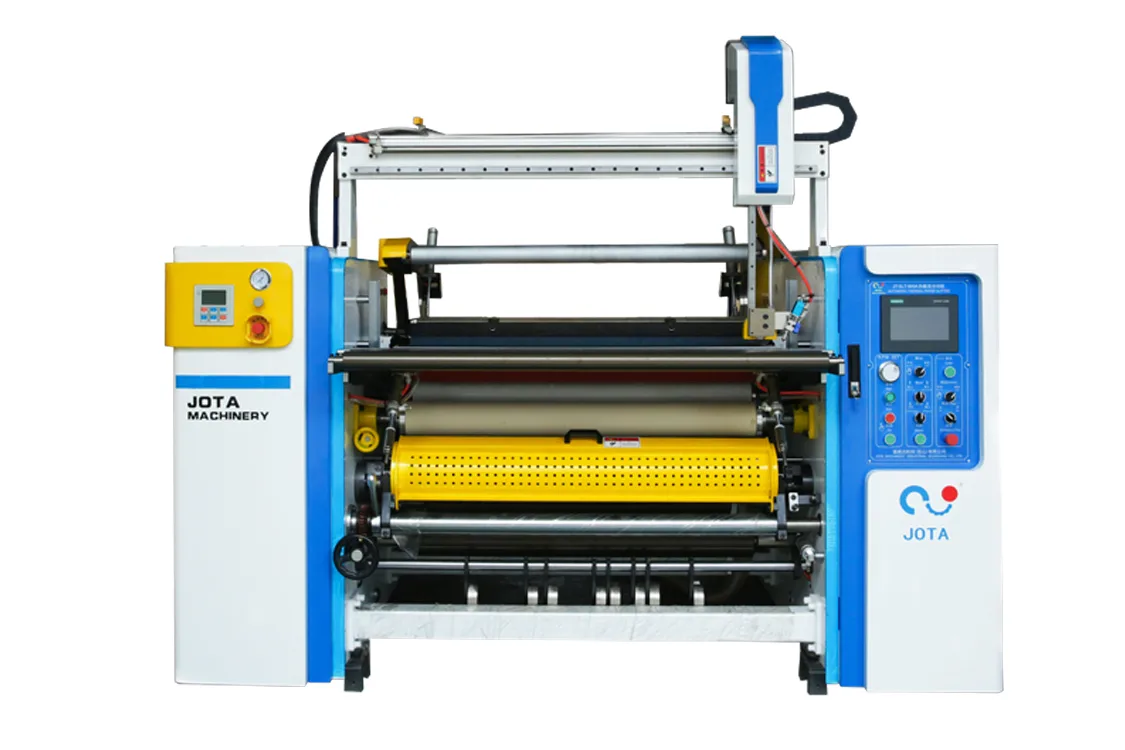
For standard POS and receipt-roll production, thermal paper jumbo rolls are slit and rewound into the required finished widths, diameters and core specifications.
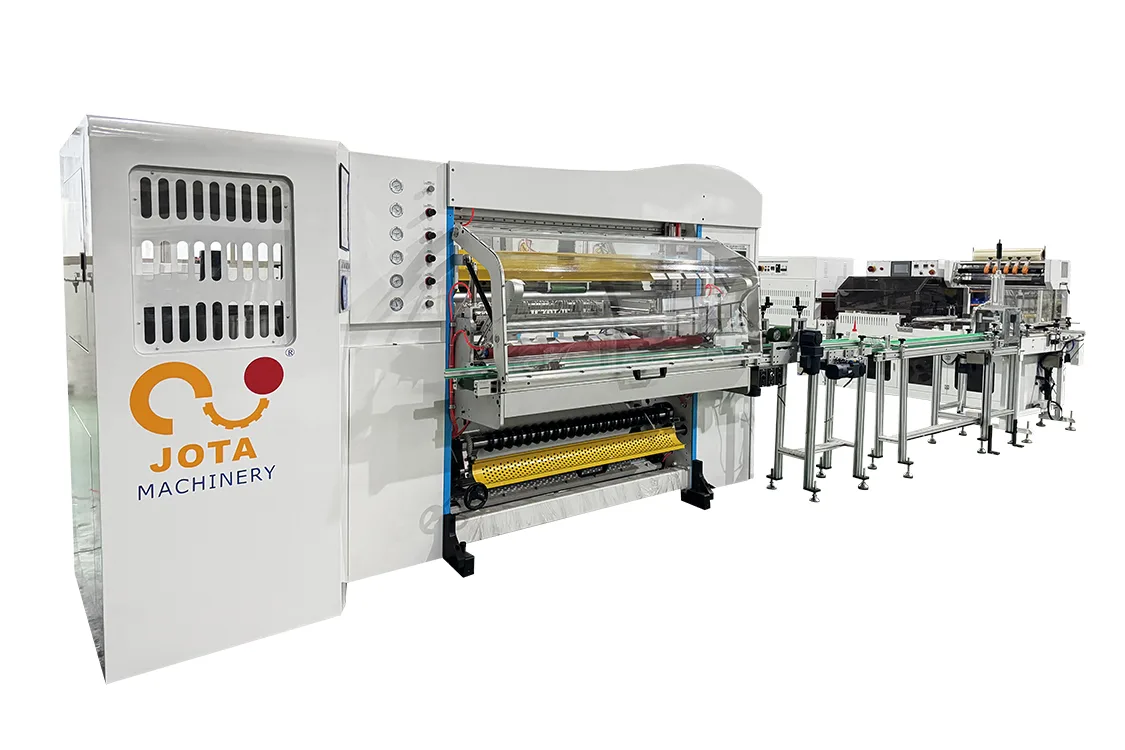
For higher production output, a fully automatic configuration can reduce manual handling and integrate additional roll finishing, packaging or palletizing processes.
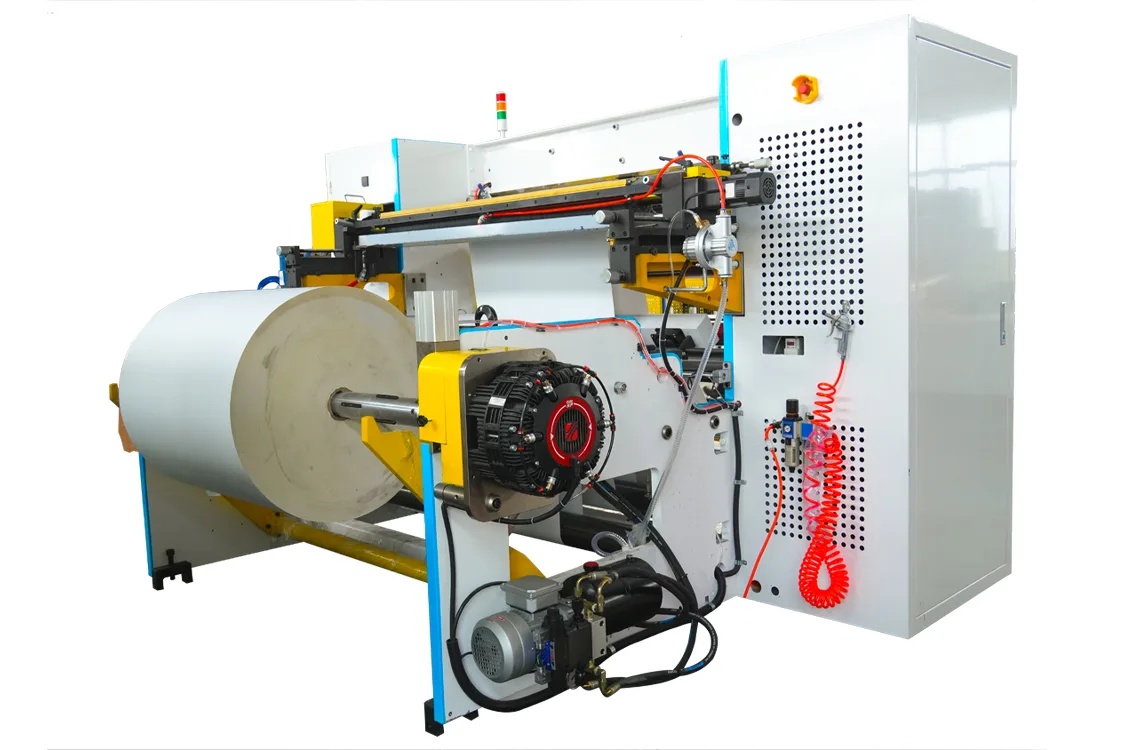
If your rolls require logos or promotional information, inline flexographic printing can be combined with slitting and rewinding in one production process.
6. Length Counting and Automatic Stop Control
Each finished roll must meet the required length. Common receipt roll lengths may vary by market, printer type, and buyer specification.
The machine uses counters, sensors, PLC control, and sometimes servo systems to calculate and control the roll length. When the preset length is reached, the machine stops, cuts, or transfers to the next action, depending on its automation design.
Length accuracy is important for commercial reasons.
If the roll is shorter than stated, customers may complain.
If the roll is longer than required, the paper converter loses material margin.
If length variation is too large, production cost becomes difficult to control.
For high-volume thermal paper roll production, even a small length error repeated thousands of times can create noticeable material loss.
This is why accurate meter counting and stable tension are closely connected. If the paper slips, stretches, or runs unevenly, length accuracy may be affected.
7. Finished Roll Handling: From Semi-Automatic to Fully Automatic Production
After rewinding, the finished rolls must be removed and prepared for packing.
In a semi-automatic thermal paper slitting machine, operators may manually load cores, unload finished rolls, apply tail sealing, and transfer rolls to packing.
In a fully automatic thermal paper roll production line, the machine can include:
automatic core feeding
automatic paper tail cutting
automatic tail gluing or sealing
automatic roll pushing
automatic roll unloading
automatic conveying
automatic shrink wrapping
automatic labeling
automatic counting and packing
The choice between semi-automatic and fully automatic machines depends on production capacity, labor cost, factory budget, order volume, and market positioning.
For a new paper converter, a semi-automatic machine may be easier to start with. For a mature receipt roll manufacturer serving supermarkets, banks, logistics companies, and POS distributors, a fully automatic line may reduce labor dependence and improve production consistency.
Key Controls That Decide Thermal Paper Roll Quality
A thermal paper slitting machine works through mechanical movement, but final quality depends heavily on control systems.
Tension Control
Tension control is one of the most important factors in roll-to-roll processing.
Thermal paper must stay flat, stable, and controlled from unwinding to rewinding. If tension changes suddenly, the paper may wrinkle, break, shift, or rewind unevenly.
Too little tension may cause:
loose rolls
telescoping
poor edge alignment
wrinkles
unstable feeding
Too much tension may cause:
paper breakage
core deformation
coating stress
over-tight rolls
printing problems
Professional machines use magnetic powder brakes, servo motors, load cells, dancer rollers, or closed-loop tension systems to control web tension throughout the process.
For a paper converter, tension control is often the difference between “the machine can run” and “the machine can produce sellable rolls every day.”
Slitting Accuracy
Thermal paper rolls must match printer requirements. A roll that is too wide may not fit the printer. A roll that is too narrow may shift during printing.
That is why slitting width accuracy matters.
A good machine should keep blade positioning stable, reduce vibration, and maintain clean cutting under continuous operation.
For high-speed production, slitting accuracy is affected by blade sharpness, bearing quality, roller parallelism, frame rigidity, web tension, and operator adjustment.
Rewinding Hardness
Finished roll hardness affects storage, transportation, and printer performance.
If rolls are too soft, they may deform during packing.
If rolls are too hard, they may create excessive tension during printer unwinding.
If hardness is uneven, the roll may look poor and perform inconsistently.
Good rewinding control creates rolls with stable diameter, smooth end face, and proper tightness.
Web Guiding
Web guiding keeps the paper web aligned during the entire converting process.
Without proper guiding, the web may drift. This can cause uneven slitting, waste, and poor roll appearance.
For narrow thermal paper rolls, web guiding is especially important because small alignment errors become visible quickly.
Dust and Static Control
Thermal paper converting may produce paper dust during slitting. Dust can affect roll cleanliness and cause printer problems for end users.
Static electricity may also appear during high-speed roll-to-roll processing, especially in dry environments. Static can cause paper sticking, dust attraction, and unstable handling.
Some machines use dust removal systems, static eliminators, and improved blade structures to reduce these problems.
Why Machine Speed Is Not the Only Standard
Many buyers ask one question first: “How fast can the machine run?”
Speed matters, but speed alone does not define a good thermal paper slitter rewinder machine.
A machine running at 500 meters per minute but producing loose rolls, dusty edges, or unstable length is not truly efficient. A well-designed machine must balance speed with stability.
Real production efficiency comes from:
less downtime
faster changeover
stable tension
easy blade adjustment
accurate length control
lower waste rate
less manual correction
fewer rejected rolls
smooth packing flow
For paper converters, the best machine is not always the one with the highest number on the brochure. It is the machine that can produce qualified rolls consistently under daily factory conditions.
Semi-Automatic vs Fully Automatic Thermal Paper Slitting Machine
Different factories need different automation levels.
Semi-Automatic Thermal Paper Slitting Machine
A semi-automatic machine is suitable for startups, small factories, or paper converters with varied order sizes.
Its advantages include:
lower investment cost
simpler operation
easier maintenance
flexible roll size changeover
suitable for small and medium production
However, it requires more manual work for core loading, roll unloading, tail handling, and packing.
Fully Automatic Thermal Paper Slitting Machine
A fully automatic thermal paper roll slitting and packing line is designed for high-volume production.
Its advantages include:
higher output
lower labor cost per roll
stable roll quality
automatic core loading
automatic sealing
automatic roll transfer
better production consistency
suitable for large receipt roll manufacturers
For factories supplying supermarkets, banks, retail chains, logistics companies, and POS paper distributors, full automation can improve competitiveness.
How a Paper Converter Should Choose the Right Machine
Before buying a thermal paper slitting machine, a paper converter should not only ask for the machine price. The better question is: what kind of production problem do you need the machine to solve?
Important points include:
jumbo roll width
finished roll width
finished roll diameter
core inner diameter
paper grammage
thermal coating side direction
daily production capacity
operator skill level
local labor cost
packing method
required automation level
future order growth
A reliable machine supplier should help you calculate production capacity, recommend suitable machine structure, test your material if needed, and explain the difference between machine models clearly.
For example, a beginner producing 57 mm and 80 mm POS rolls may not need the most complicated fully automatic line from the first day. But a factory already receiving large supermarket or banking orders may need automatic core loading, automatic tail sealing, and packing integration from the beginning.
Common Production Problems and Their Causes
In real thermal paper roll converting, several problems appear frequently.
Loose Finished Rolls
Possible causes include low rewinding tension, poor core grip, unstable speed, or incorrect winding parameter settings.
Telescoping Rolls
This often comes from uneven tension, poor web alignment, improper rewinding pressure, or unstable roll hardness.
Dusty Roll Edges
Dust usually relates to blade sharpness, blade type, blade pressure, cutting angle, or poor slitting setup.
Wrinkles During Running
Wrinkles may be caused by uneven web tension, roller alignment problems, poor jumbo roll quality, or incorrect web path design.
Inaccurate Roll Length
Length error may come from slippage, unstable tension, incorrect counter setting, sensor issue, or poor synchronization.
Poor End-Face Appearance
This can be caused by unstable slitting, web drifting, uneven rewinding, core misalignment, or machine vibration.
An experienced machine manufacturer does not treat these problems as isolated accidents. They are usually connected to the complete roll-to-roll system.
The Manufacturer’s View: A Slitting Machine Is a Production System
From a manufacturer’s point of view, a thermal paper slitting machine is not only a mechanical cutter. It is a complete paper converting system.
The machine must coordinate:
unwind tension
web path design
roller surface quality
blade cutting logic
waste trim handling
rewind torque
roll pressure
PLC control
servo synchronization
operator interface
safety protection
maintenance convenience
When these details are designed properly, the machine can run smoothly. When one detail is ignored, the operator may spend every day correcting problems by hand.
This is why machine structure, machining quality, electrical control, installation service, and after-sales support all matter.
Why Thermal Paper Slitting Machine Quality Matters to Your Customers
Your customers may never see your machine, but they will judge your production quality through every finished roll.
A good receipt roll should have:
clean edge
accurate width
correct length
smooth unwinding
proper tightness
clear thermal printing
good roll appearance
stable printer compatibility
If the finished roll jams inside a POS printer, the customer will not blame the jumbo roll supplier first. They will blame the paper converter.
That is why investing in a suitable slitter rewinder machine is not only a production decision. It is a market reputation decision.
Planning a Thermal Paper Slitting and Rewinding Project?
A thermal paper slitting machine works by controlling a wider jumbo roll through unwinding, web guiding, tension control, slitting and rewinding until it becomes the required finished thermal paper rolls.
If you are evaluating equipment, start with the products you intend to manufacture rather than machine speed alone.
Share your jumbo-roll specification, finished-roll sizes, core requirements, printing requirements and expected production output with JOTA Machinery.
Our team can use these production requirements to discuss the appropriate thermal paper slitting and rewinding configuration for your project.

paper converting machinery manufacturer based in China.
We specialize in flexible packaging and paper converting machinery, delivering reliable slitting, rewinding, and coating solutions for global clients.
Our mission is to help manufacturers improve productivity, quality, and sustainability through advanced roll-to-roll technology.


About Me – Bruce Zhou
Bruce Zhou is the founder and strategic leader of Jota Machinery, a global innovator in the thermal paper slitting machine industry. With over 23 years of experience in precision machinery and industrial automation, Bruce has grown Jota into a high-performance, export-driven enterprise serving markets across Europe, the Middle East, and beyond.
Since establishing the company in 2008 and relocating its factory to Kunshan in 2015, Bruce has consistently driven 30% annual growth by combining engineering excellence, customer-centric product development, and intelligent manufacturing. Under his leadership, Jota Machinery has become known for its advanced CNC production capabilities, robust quality control systems, and commitment to customized solutions.
Beyond his role as an industrialist, Bruce is a lifelong learner, deeply engaged in the YTT Decision-Making Executive Training Program. He applies the strategic wisdom of thinkers like Drucker, Inamori, and Wang Yangming in guiding Jota’s growth, while also nurturing a high-trust, results-oriented organizational culture.
A passionate marathoner, global traveler, and advocate for holistic leadership, Bruce brings a mind-body-spirit philosophy to entrepreneurship—building not only machines, but people, systems, and enduring value.