

Written by Bruce Zhou
Founder & Managing Director | JOTA Machinery
Paper converting machinery specialist since 2002.
Connect with me on LinkedIn
Published: 16,October, 2026
Last Updated: 16,October, 2026 13:21:31 PM GMT+8
Two factories may produce the same 80 mm thermal receipt rolls but require completely different slitting machines.
One may be starting its first thermal paper converting business, manufacturing standard POS and cash register rolls. Another may already supply printed receipt paper to retail chains and require inline flexographic printing. A larger manufacturer may be processing substantial daily orders and looking to reduce manual handling between production stages.
Although the finished products appear similar, the machinery requirements are not necessarily the same.
When customers ask us how to choose a thermal paper roll slitting machine, we first look at their finished roll specifications, production volume, printing requirements and current factory operations.
Machine speed is only one part of the discussion. Jumbo roll dimensions, paper thickness, rewinding quality, operator involvement and downstream packaging can all affect the production arrangement.
At JOTA Machinery, we manufacture different thermal paper slitting and rewinding configurations, including the JT-SLT-900A, JT-SLT-1400P and JT-SLT-1400FA.
This guide explains their different applications and the technical information involved in evaluating a thermal paper roll production line.
1. Understand What a Thermal Paper Slitting Machine Actually Does
Thermal paper is normally supplied to converting factories in large jumbo rolls. These reels contain heat-sensitive paper that has already been coated by the paper manufacturer.
The job of a thermal paper slitter rewinder is to convert the wide parent reel into smaller finished rolls suitable for receipt printers, payment terminals and other devices.
A conventional machine carries out three main operations.
Unwinding: The large thermal paper reel is supported and fed into the converting machine under controlled tension.
Slitting: Cutting knives divide the moving paper web into narrower strips according to the required finished roll widths.
Rewinding: Each slit strip is wound into a finished roll with the specified dimensions and winding characteristics.
Depending on the machine configuration, the production arrangement may include additional functions such as automatic core feeding, finished roll handling, flexographic printing or packaging.
These additional operations have different technical requirements and are not included in every thermal paper slitting machine.
The finished product may be a 57 mm credit card roll, an 80 mm POS receipt roll, an ATM receipt roll or another compatible paper product.
The dimensions of these finished rolls, rather than their general product names, are important when checking machinery compatibility.
2. Choosing a Machine When Starting a Thermal Paper Roll Business
A first-time thermal till roll manufacturer faces different operating requirements from an established converting factory.
In a new business, the initial production arrangement may involve a limited number of roll specifications, separate packaging equipment and operators performing some tasks manually.
A business plan generally records the intended finished products, raw material sourcing, machinery investment, labour requirements, factory costs and expected sales volume.
For this type of project, JOTA offers the JT-SLT-900A thermal paper slitting rewinding machine.
JT-SLT-900A: Thermal Paper Roll Production for New Converters
The JT-SLT-900A is designed to convert thermal paper jumbo rolls into smaller finished rolls.
It can be considered for applications involving POS receipt paper, cash register rolls and other compatible paper materials.
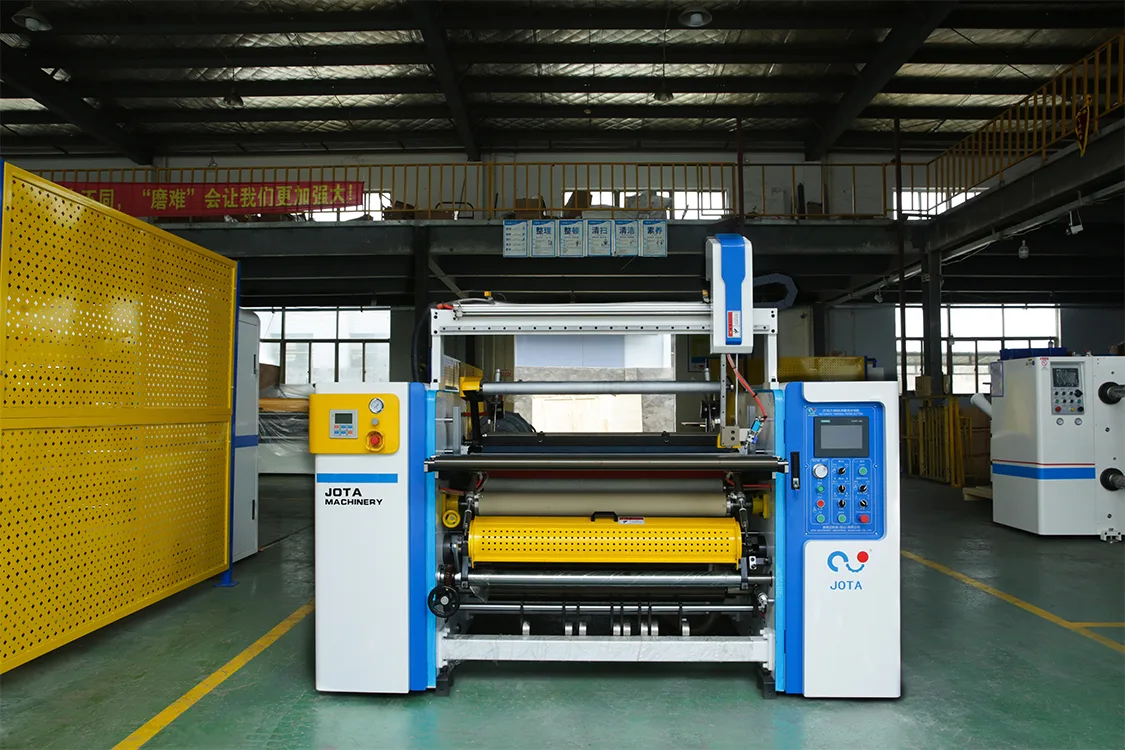
Planning to start a thermal paper roll manufacturing business? The JT-SLT-900A converts thermal paper jumbo rolls into finished POS, ATM, and cash register rolls in different sizes. It offers a practical entry point for new manufacturers looking to establish their own production facility. Whether you’re preparing a business plan or evaluating your first slitting machine, our team can help you review the equipment specifications and production requirements.
The machine incorporates a jumbo roll unwinding section, web-guiding components, slitting knives and a rewinding system.
Its published product specification includes a maximum unwinding width of 900 mm and a minimum slitting width of 25 mm.
The machine also uses tension control and web guiding to support consistent paper movement during converting.
What happens during production?
The operator prepares the paper jumbo roll and the required slitting and rewinding setup.
The jumbo roll is unwound, the paper passes through the cutting section, and the finished strips are rewound into smaller rolls.
The slitting knives are set according to the specified finished widths. The JT-SLT-900A does not have an automatic knife positioning function.
Depending on the factory arrangement, finished rolls may subsequently be transferred to separate packaging equipment.
What production information is required?
For a new thermal paper roll manufacturing project, the machinery specification can be established using the proposed finished roll dimensions, paper grammage, core dimensions and required production quantities.
For example, a business producing 57 × 40 mm credit card receipt rolls will have different finished roll diameter and winding requirements from one producing 80 × 80 mm till rolls.
The machine’s compatibility with those specifications must be checked rather than assumed from the product category alone.
JOTA equipment option: JT-SLT-900A Thermal Paper Slitting Rewinding Machine.
3. Choosing a Slitting Machine with Inline Flexographic Printing
Some thermal paper converters produce plain receipt rolls, while others supply rolls carrying pre-printed logos, promotional messages or advertising.
A standard thermal paper slitter rewinder cuts and rewinds paper. It does not necessarily print artwork.
For printed POS receipt rolls, an additional printing process is required.
JOTA offers the JT-SLT-1400P inline flexographic printing and slitting machine for applications involving printing and thermal paper converting.
JT-SLT-1400P: Printing and Slitting in One Production Arrangement
The JT-SLT-1400P combines flexographic printing with slitting and rewinding functions.
Flexographic printing uses a printing plate to transfer ink onto a moving paper web.

Looking to manufacture custom-printed thermal receipt rolls? The JT-SLT-1400P combines flexographic printing, slitting, and rewinding in one production line. It supports branded POS rolls with logos, advertising messages, and other printed artwork, subject to the printing configuration. For manufacturers planning to add printing capabilities to their converting operations, JOTA can help evaluate the required printing colours, finished roll dimensions, and production specifications.
For thermal receipt rolls, this process can apply fixed artwork before the paper is converted into finished products.
The customer’s thermal receipt printer subsequently produces variable transaction information during use.
These are two different printing processes.
What is inline printing used for?
Printed thermal receipt rolls may contain:
- Company logos and branding
- Advertising information
- Promotional messages
- Customer service information
- Other pre-printed artwork
For certain receipt paper applications, artwork is printed on the reverse side of the paper.
The printing orientation, ink compatibility and drying requirements must be suitable for the intended material.
How are printing and slitting connected?
A compatible inline production arrangement generally involves unwinding, flexographic printing, ink drying or setting, slitting and rewinding.
Instead of treating printing and converting as entirely separate production operations, an inline machine places these functions within one connected system.
This arrangement can reduce intermediate material handling between compatible printing and slitting processes.
However, production performance depends on the paper grade, printing colours, artwork, repeat length and drying requirements.
What specifications affect the printing machine?
The number of printing colours and the artwork dimensions influence the printing configuration.
For example, one-colour backside printing has different requirements from multi-colour artwork requiring precise registration.
Print width, repeat length and colour registration should be confirmed before the final machine configuration is established.
The slitting section must also correspond with the printed layout, so each finished roll contains the intended artwork.
The cutting knives are set for the required finished widths; automatic knife positioning is not a function of JOTA’s thermal paper slitting machines.
JOTA equipment option: JT-SLT-1400P Inline Flexo Printing and Slitting Machine.
4. Choosing a Fully Automatic Machine for Higher-Volume Production
For a manufacturer already operating a thermal paper converting business, another question often arises:
How can more finished rolls be produced while reducing manual handling between production stages?
A conventional slitter rewinder may require operators to participate in core handling, finished roll removal and other production activities.
As order volumes increase, these activities become part of the overall production cycle.
A faster slitting machine alone does not necessarily remove the need for manual work elsewhere in the factory.
For larger-scale converting applications, JOTA offers the JT-SLT-1400FA fully automatic thermal paper slitting and rewinding line.
JT-SLT-1400FA: Automatic Thermal Paper Roll Production
The JT-SLT-1400FA integrates more of the converting and downstream handling process.
Its published production arrangement includes automatic core feeding, slitting and rewinding, finished roll conveying and packaging functions.
The line is designed to reduce the need for repeated manual handling during the normal production cycle.

Need to increase thermal paper roll production while reducing manual handling? The JT-SLT-1400FA integrates automatic core feeding, slitting, rewinding, and finished roll handling into a connected production line. During normal operation, one operator can supervise and inspect the production process. For manufacturers handling large-volume POS and receipt roll orders, our team can discuss production capacity, automation requirements, and suitable downstream packaging configurations.
According to JOTA’s production arrangement, one operator can supervise and inspect the line during normal operation.
This refers to production supervision and inspection. It does not mean that the complete factory can operate without other personnel or that no human intervention will ever be required.
Operators are still involved in tasks such as quality checks, material replenishment, changeovers and responding to machine interruptions.
How is the automatic production process arranged?
The production line can include the following operations:
- Jumbo roll unwinding and paper feeding.
- Automatic paper core feeding.
- Slitting into specified finished widths.
- Rewinding and finished roll formation.
- Finished roll transfer or conveying.
- Packaging through the configured downstream equipment.
The exact process arrangement depends on the equipment supplied and the product specifications.
Why does downstream automation matter?
Consider a production line that rewinds receipt rolls quickly but requires frequent manual handling of every finished batch.
The effective factory output depends not only on the rewinding process but also on how the finished products are removed, transferred, inspected and packaged.
Integrating these operations can reduce manual transfer between production stages.
However, the resulting output depends on the complete production line rather than the slitter’s running speed alone.
What production requirements affect automation?
A higher-volume production line must be specified according to the jumbo roll dimensions, finished roll size, core type, packing format and intended operating schedule.
The JT-SLT-1400FA has published configurations for jumbo rolls up to 1400 mm wide, subject to the supplied machine specification.
The actual number of saleable rolls produced per shift depends on the finished length, slitting lane arrangement, cycle time, material handling and operating conditions.
JOTA equipment option: JT-SLT-1400FA Fully Automatic Thermal Paper Slitting and Rewinding Line.
5. JT-SLT-900A vs JT-SLT-1400P vs JT-SLT-1400FA
The three machine configurations address different requirements in thermal paper converting.
| Comparison | JT-SLT-900A | JT-SLT-1400P | JT-SLT-1400FA |
|---|---|---|---|
| Main application | Standard roll converting | Printing and converting | Automated bulk converting |
| Slitting and rewinding | Yes | Yes | Yes |
| Inline flexo printing | Not the standard function | Yes | Available as a separately specified option |
| Automatic core feeding | Not specified as standard | Configuration-dependent | Included in documented line |
| Integrated finished roll handling | Limited to supplied setup | Configuration-dependent | Automated line arrangement |
| Packaging integration | Separate or project-dependent | Project-dependent | Documented integrated option |
| Typical enquiry | New converting project | Printed receipt rolls | Higher production output |
The table compares the functions associated with the published equipment configurations. Final features depend on the machine quotation, and no model should be assumed to support every possible roll size or printing format.
The appropriate equipment is determined by the customer’s product requirements, budget, production arrangement and expected operating volume.
6. Check the Thermal Paper Jumbo Roll Specifications
Before reviewing machine speeds or automation functions, the raw material specifications need to be established.
Thermal paper jumbo rolls are supplied in different widths, diameters, grammages and core sizes.
These parameters influence the unwinding arrangement and the number of finished rolls that can be produced from the parent reel.
Jumbo roll width
The parent roll width determines how many narrow strips can fit across the usable paper web.
For example, a 790 mm wide thermal paper reel could theoretically provide:
- Thirteen 57 mm strips, leaving 49 mm of material.
- Nine 80 mm strips, leaving 70 mm of material.
These simple calculations exclude edge trim and other production allowances.
They are not confirmed machine production outputs.
Actual lane arrangements depend on the material, knife setup and usable paper width.
Jumbo roll diameter and weight
Larger parent reels require suitable unwinding and loading arrangements.
The unwind stand must support the reel’s weight, diameter and core dimensions.
Factories using heavy reels may also need additional material handling equipment or an appropriate hydraulic or shaftless loading arrangement.
These specifications should be checked against the machine’s rated capacity.
Thermal paper GSM and thickness
Thermal paper is supplied in different grammages, such as 48, 55 and 65 gsm.
GSM measures paper weight per unit area. It is not the same as paper thickness.
Paper caliper influences how much paper can be wound within a given finished roll diameter.
Material properties also affect web tension, slitting behaviour and rewinding conditions.
7. Check the Finished Roll Dimensions Before Selecting Equipment
A thermal paper converting machine may be used to produce several categories of finished rolls, but each product has its own dimensional requirements.
Common examples include:
| Finished product | Example specification |
|---|---|
| Credit card receipt roll | 57 × 40 mm |
| Compact payment terminal roll | 57 × 30 mm |
| POS thermal receipt roll | 80 × 80 mm |
| Larger POS receipt roll | 80 × 83 mm |
| ATM or kiosk paper roll | Customer-specific |
These examples describe market products, not guaranteed capabilities of every machine.
The finished roll specification must include more than paper width and outside diameter.
Core inside diameter
The paper core must match the intended printer or finished product requirements.
A core’s inside diameter should not be confused with its outside diameter.
Finished outer diameter
A receipt printer has a limited compartment size.
The finished roll diameter must be compatible with the equipment.
Paper length
Two rolls with the same outside diameter may contain different paper lengths because of paper thickness and core dimensions.
The required roll length should be confirmed separately when specified by the buyer.
Winding direction
Thermal-coated paper must be wound in the orientation required by the printer.
Incorrect orientation may prevent the printer from producing the intended image.
8. Why Is Rewinding Quality Important?
The finished roll is the product delivered to the customer.
Even when the paper is correctly slit, poor winding can affect its appearance and operation inside a receipt printer.
Several factors influence finished roll quality.
Stable web tension
Tension control helps maintain consistent paper movement during unwinding and rewinding.
Changes in web tension can affect the behaviour of narrow paper strips and the formation of the finished rolls.
Cutting quality
The condition and setup of the slitting knives affect finished roll edges.
Uneven cutting can produce irregular edges or unnecessary paper dust.
Knife maintenance and correct slitting setup are therefore part of the converting process.
Roll formation
The rewinding system must form rolls with suitable tension and alignment.
Loose winding, excessive tightness or uneven edges may affect subsequent handling or printer performance.
Material consistency
Paper thickness, surface properties and other material characteristics influence converting behaviour.
When changing between paper grades, production settings may need to be adjusted to suit the material.
9. Why Maximum Machine Speed Is Not the Same as Factory Output
Thermal paper slitting machines are often described by their maximum operating speed in metres per minute.
However, the actual number of finished rolls produced depends on additional factors.
For example, a machine processing short credit card rolls may complete more rewinding cycles than a machine producing longer rolls.
Each production arrangement has its own cycle time and handling requirements.
Factors affecting effective production output
- Number of simultaneous slitting lanes
- Finished roll paper length
- Rewinding and roll changeover cycles
- Jumbo roll loading time
- Core preparation and feeding
- Operator involvement
- Printing and drying requirements
- Finished roll transfer and packaging
- Quality checks and rejected products
These factors influence the difference between mechanical running speed and saleable output.
For a production line with inline printing, printing speed, registration and ink drying may also influence the operating conditions.
For a fully automatic line, the performance of connected equipment can affect the complete production cycle.
This is why production output is normally assessed using the actual paper grade and finished roll specifications rather than the advertised speed alone.
10. What About Inkjet Printing, Multi-Colour Printing and Other Requirements?
Not every converting project involves standard plain thermal rolls.
Some customers need additional printing, marking or downstream automation functions.
JOTA Machinery can discuss project-specific configurations according to the material and required production process.
Inkjet printing on thermal paper rolls
Inkjet printing may be required for certain variable-data marking applications.
Depending on the product, the required content may involve batch information, identification codes or other printed data.
Inkjet equipment must be evaluated according to the ink system, paper surface, required print resolution, line speed and print position.
The availability and integration of this function depend on the project configuration.
Multi-colour flexographic printing
Some receipt roll products contain artwork requiring more than one printing colour.
A multi-colour flexographic printing configuration must account for colour stations, artwork repeat length, registration and drying requirements.
The precise printing arrangement depends on the product.
Custom receipt paper dimensions
Specialised receipt paper applications may involve non-standard widths, core sizes or larger finished diameters.
The machine’s supported winding arrangement and available operating space must be checked against the order.
Robotic palletizing
For larger converting operations, handling finished cartons or packaged products may form part of a downstream automation project.
Robotic palletizing equipment can be considered for appropriately packaged products where the required handling conditions and line integration are established.

It is separate from the core slitting and rewinding process and must be specified as part of the broader production arrangement.
11. What Determines the Cost of a Thermal Paper Roll Slitting Machine?
The price of a thermal paper slitter rewinder depends on its operating specifications and supplied equipment.
Two machines used for thermal receipt roll production may have substantially different prices because they perform different functions.
The main factors include the working width, unwinding arrangement, level of automation, printing equipment and downstream handling requirements.
Machine configuration
A conventional slitter rewinder has a different equipment scope from a line that includes flexographic printing or automatic packaging.
Production requirements
Jumbo roll dimensions, required finished products and intended production output influence machine selection.
Additional equipment
Depending on the project, the equipment scope may include jumbo roll handling, core preparation, printing, packaging or palletizing systems.
Installation and factory requirements
Total project costs may also include shipping, customs charges, factory electrical work, installation, commissioning and operator training.
A machinery quotation should distinguish the supplied equipment from optional items and costs outside the machine manufacturer’s scope.
12. How to Prepare a Technical Enquiry for a Thermal Paper Slitting Machine
When reviewing a thermal paper converting project, JOTA Machinery needs information about both the raw material and the finished products.
The following details help establish the technical requirements.
| Item | Information to provide |
|---|---|
| Raw material | Thermal paper grade and GSM |
| Jumbo roll width | Maximum incoming paper width |
| Jumbo roll diameter | Parent reel outside diameter |
| Jumbo roll weight | Maximum reel weight |
| Finished roll width | Required receipt paper widths |
| Finished roll diameter | Required outside diameters |
| Paper core | Inside diameter and material |
| Paper length | Required length per finished roll |
| Printing | Plain, inkjet or flexographic printing |
| Artwork | Colours, print width and repeat length |
| Production volume | Planned output and operating shifts |
| Packaging | Required finished roll and carton format |
For customers already manufacturing receipt rolls, existing product samples and current machine specifications can also provide useful technical information.
For customers establishing a new factory, a proposed product range and production plan can be used as the starting point for equipment discussion.
13. JOTA Machinery Thermal Paper Slitting and Rewinding Solutions
JOTA Machinery manufactures thermal paper slitting and rewinding equipment for POS receipt rolls, cash register rolls, credit card rolls and other compatible paper converting applications.
We provide several machine configurations according to the required production process.
JT-SLT-900A — Thermal paper roll converting
A slitting and rewinding configuration that can be evaluated for new thermal paper manufacturing projects and standard finished roll production.
JT-SLT-1400P — Inline flexo printing and slitting
A configuration for projects requiring flexographic printing alongside thermal paper slitting and rewinding.
JT-SLT-1400FA — Fully automatic converting
A production line incorporating additional automation for core handling, slitting, rewinding and downstream processes.
For other requirements, including inkjet printing, multi-colour flexographic printing, customised roll dimensions and robotic palletizing, the equipment scope can be discussed with our engineering team.
Starting a Thermal Paper Roll Business or Planning an Equipment Upgrade?
Whether you are preparing a thermal receipt roll manufacturing business plan, adding printed receipt rolls to your product range or reviewing an existing converting line, JOTA Machinery can discuss available machinery configurations and production requirements.
If you are looking for a turnkey thermal paper roll manufacturing solution, you can contact our team online or send us an enquiry with the products you intend to manufacture.
Our engineers can review your raw material specifications, finished roll dimensions, printing requirements and intended production arrangement.
Explore JOTA’s thermal paper slitting machines or contact us for a technical quotation.
Last Updated on 16/10/2026 by Jota Machinery