
Published on AUGUST 19, 2026 by Jota Machinery | 13:43:55 PM | Bruce Zhou

When the paper jumbo roll becomes larger and heavier, unwinding is no longer just a tension-control problem.
The first headache often happens before the machine even starts running:
How do you load the jumbo roll onto the unwinder?
For smaller rolls, inserting an air shaft through the paper core and lifting the complete roll-and-shaft assembly may still be manageable with suitable handling equipment.
But as roll length, diameter and weight increase, the job becomes increasingly inconvenient.
A large paper jumbo roll may contain more than 1,000 meters of material. Depending on the paper specification and roll construction, the complete roll can become very heavy.
Now imagine having to insert a long shaft through the core, position the shaft correctly, lift the complete assembly and place both shaft ends into the unwind stand every time you change a roll.
For a paper mill or converting factory handling large jumbo rolls every day, this repeated process quickly becomes a production headache.
This is one reason Jota Machinery uses a hydraulic shaftless unwind stand for heavy paper jumbo-roll applications.
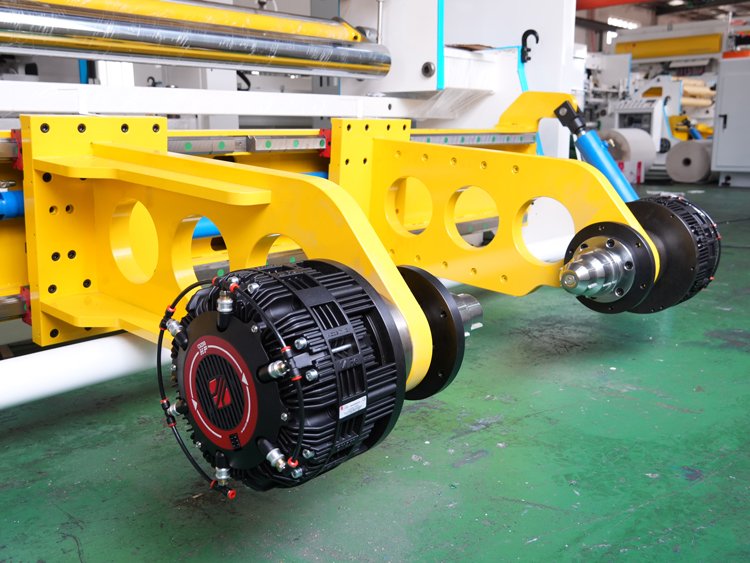
Instead of passing a complete shaft through the paper core, the shaftless unwinder grips the roll from both sides with chucks.
Hydraulic cylinders then provide the lifting and lowering movement.
For jumbo rolls weighing up to 1 ton, this makes loading and unwinding much more practical.
The Problem With a Shaft Becomes More Obvious as the Roll Gets Heavier
A conventional shafted unwinder is easy to understand.
The operator inserts an expanding shaft through the jumbo-roll core.
The shaft supports the roll.
The shaft and roll are then positioned in the unwind stand.
There is nothing wrong with this principle.
For many smaller paper rolls, it remains a practical solution.
The problem appears when the jumbo roll becomes large and heavy.
The shaft itself may already be long and heavy.
Once it is inserted into a large paper roll, the operator is no longer handling only the paper.
He is dealing with:
jumbo roll + unwind shaft + positioning of both shaft ends
This adds another handling step every time a roll is loaded or removed.
From an operator’s point of view, this is where a shaftless design starts making sense.
If the machine can support the jumbo roll directly from both sides, there is no reason to repeatedly insert and remove a full-length unwind shaft.
What Is a Hydraulic Shaftless Unwind Stand?
A hydraulic shaftless unwind stand supports the jumbo roll without using a traditional full-length shaft through the paper core.
Instead, the unwind stand has supporting arms on both sides of the roll.
Chuck modules are installed on these arms.
The chucks enter the paper core from the left and right sides and hold the jumbo roll for unwinding.
For Jota Machinery’s configuration, the chuck system can be adapted for common:
- 3-inch paper cores
- 6-inch paper cores
Once the roll is positioned for loading, the hydraulic system controls the movement of the unwind arms.
Hydraulic oil transfers power to the oil cylinders.
The cylinders then drive the lifting or lowering movement of the unwind stand.
In simple terms:
Hydraulic power → oil cylinder movement → unwind arm movement → jumbo roll lifted or lowered
This allows the unwinder itself to perform the controlled lifting movement required to bring the jumbo roll into its working position.
Why Hydraulic Lifting Matters for a 1-Ton Jumbo Roll
The difference becomes easy to understand when you consider roll weight.
Jota Machinery’s hydraulic shaftless unwind stand can support a paper jumbo roll weighing up to 1 ton.
At this weight, roll loading should not depend on an operator manually manipulating a shaft-and-roll assembly.
The hydraulic system takes over the vertical lifting and lowering movement of the unwind arms.
Once the jumbo roll has been positioned within the loading area, the operator can use the machine controls to move the unwind arms according to the loading requirement.
This changes the job from physically handling a shafted jumbo-roll assembly to controlling a powered loading mechanism.
That is particularly useful in paper converting operations where heavy jumbo rolls are changed repeatedly.
How the Jumbo Roll Is Loaded
The basic loading process can be understood in several stages.
1. Position the Paper Jumbo Roll
The new paper jumbo roll is first brought into the loading position of the unwind stand using the factory’s appropriate roll-handling method.
At this stage, the roll needs to be positioned so the chuck assemblies on both sides can align with the paper core.
The hydraulic unwind stand does not remove the need for proper factory material handling.
Its job is to make the final engagement, lifting and positioning of the roll much more convenient once the jumbo roll reaches the unwinder.
2. Align the Chucks With the Core
The unwind arms are positioned on both sides of the jumbo roll.
The chuck modules then align with the center of the paper core.
Depending on the roll specification, the unwind can be equipped to work with 3-inch or 6-inch cores.
This is an important point when specifying the machine.
The core size of your incoming jumbo roll should be confirmed before the unwind configuration is selected.
3. Engage the Jumbo Roll From Both Sides
Instead of pushing one long shaft completely through the paper roll, the shaftless system holds the roll from its two ends.
The left and right chuck modules engage with the jumbo-roll core.
Once correctly engaged, the roll can be supported by the unwind stand.
This is where the word shaftless becomes important.
The machine does not require a full-length shaft running through the entire paper core.
4. Lift the Jumbo Roll Hydraulically
The hydraulic system then provides the lifting force.
Hydraulic oil drives the cylinders, and the cylinders move the unwind arms upward.
The jumbo roll is raised into its unwinding position.
When the roll needs to be lowered, the hydraulic system controls the movement in the opposite direction.
For an operator working with heavy paper reels, this powered lifting function is one of the most practical differences between a basic unwind stand and a hydraulic shaftless unwinder.
You Do Not Have to Control Everything From One Fixed Position
Another practical problem during jumbo-roll loading is visibility.
When loading a large roll, the operator often needs to watch the relationship between:
- the jumbo roll,
- the paper core,
- the left chuck,
- the right chuck,
- and the unwind arms.
Standing at one fixed control cabinet is not always the most convenient position for observing all of these points.
For this reason, Jota Machinery’s hydraulic shaftless unwind stand can be operated through a separate remote controller as well as the side operating panel.
This gives the operator more flexibility during loading and adjustment.
When he needs to observe the jumbo roll more closely, he can use the remote control from an appropriate operating position.
When normal machine control is required, the functions can also be operated from the panel beside the machine.
For large-roll handling, this is not just about making the machine look more automated.
It solves a very practical operator problem:
being able to control the unwind movement while watching the jumbo roll itself.
Why 3-Inch and 6-Inch Chuck Options Matter
Paper mills and converting factories do not always receive jumbo rolls with the same core specification.
Two common industrial paper-core sizes are 3 inches and 6 inches.
The chuck module therefore needs to match the incoming roll.
If the chuck specification does not correspond to the core, the unwind system cannot properly support the roll.
This is why we ask customers about the jumbo-roll core before confirming the unwind configuration.
When discussing a hydraulic shaftless unwinder, do not only tell the machine supplier:
“My roll weighs 1 ton.”
We also need to know:
- Jumbo-roll width
- Maximum jumbo-roll diameter
- Maximum roll weight
- Paper core inside diameter
- Material type
- Paper GSM
- Required production speed
- Downstream converting process
The unwind stand has to match the roll you actually use.
Where a Hydraulic Shaftless Unwinder Makes the Most Sense
Not every paper roll requires this type of unwind stand.
If the rolls are small, light and easy to handle, a simpler shafted unwind may already be enough.
Adding a hydraulic shaftless stand when it provides no practical production benefit would only increase machine complexity.
The situation changes when the factory regularly handles large and heavy paper jumbo rolls.
For example, a paper mill or converting plant may be feeding a large master roll into a roll-to-roll process such as slitting and rewinding.
If the operator has to repeatedly load heavy jumbo rolls, the unwind section becomes an important part of production efficiency.
At that point, the question should not only be:
“How fast can the slitter rewinder run?”
You should also ask:
“How will we load the next 1-ton jumbo roll?”
A machine may have a high running speed, but if every roll change is difficult and inconvenient, the unwind section can still become a bottleneck in daily production.
A Slitter Rewinder Starts at the Unwinder
Buyers sometimes pay most of their attention to the slitting knives and rewinding section.
That is understandable.
Finished-roll quality is easy to see.
But after many years around roll-to-roll equipment, one lesson becomes very clear:
A slitter rewinder does not start at the knife. It starts at the jumbo roll.
Before the paper reaches the slitting section, the machine first has to:
accept the jumbo roll,
support its weight,
lift it into position,
hold the core correctly,
and allow it to unwind into the converting line.
If the incoming jumbo roll is already difficult to handle, that problem does not disappear because the downstream slitter is well designed.
The unwind system has to be selected according to the incoming material.
For large paper rolls, a hydraulic shaftless unwind stand provides a practical way to manage that first stage.
Shaftless Unwind vs. Shafted Unwind
The important difference can be summarized simply.
With a traditional shafted unwind:
Insert shaft → handle roll and shaft → position shaft on stand → unwind
With a hydraulic shaftless unwind:
Position jumbo roll → engage side chucks → hydraulically lift → unwind
The second process removes the need to insert and remove a full-length unwind shaft for every jumbo roll.
For factories processing heavy master rolls, this can make roll changes easier to organize and reduce unnecessary manual shaft handling.
The benefit does not come from the word “hydraulic.”
It comes from eliminating an inconvenient handling step.
What Result Does the Factory Get?
When a hydraulic shaftless unwind stand is correctly matched to the paper jumbo roll, the most immediate result is a simpler loading process.
Less Shaft Handling
There is no full-length unwind shaft that has to be inserted through and removed from every jumbo-roll core.
Powered Lifting and Lowering
Hydraulic cylinders provide the movement used to raise and lower the jumbo roll.
Easier Handling of Heavy Rolls
The system is designed for large rolls, with Jota Machinery’s configuration supporting jumbo rolls up to 1 ton.
Compatibility With Common Jumbo-Roll Cores
Chuck modules can be configured for 3-inch and 6-inch paper cores.
More Convenient Operator Control
Loading functions can be controlled using the separate remote controller or the side operating panel.
Better Fit for Heavy Roll-to-Roll Production
For paper mills and converters processing large master rolls, the unwind system is designed around the reality that the incoming roll itself is a heavy industrial product.
These are practical production benefits.
We do not need to claim that every factory will save a fixed percentage of labor or increase production by a fixed percentage.
The actual result depends on roll size, changeover frequency, factory layout, handling equipment and downstream production conditions.
What we can say is much simpler:
When the jumbo roll becomes heavy, removing the need to repeatedly handle a full-length shaft makes the roll-loading process more practical.
Do Not Select an Unwind Stand Only by Maximum Weight
A 1-ton capacity sounds like the most important specification.
It is important, but it is not enough.
Two jumbo rolls can have the same weight and still require different machine configurations.
One may be wider.
Another may have a larger diameter.
One may use a 3-inch core.
Another may use a 6-inch core.
The paper GSM and downstream process may also be different.
That is why Jota Machinery does not recommend selecting a shaftless unwind stand from roll weight alone.
The complete jumbo-roll specification should be checked first.
Handling Heavy Paper Jumbo Rolls?
If your current production team is struggling with inserting shafts, positioning large master rolls or repeatedly handling heavy paper jumbo rolls before slitting and rewinding, the unwind section may be the first place worth reviewing.
Jota Machinery can configure a hydraulic shaftless unwind stand for large paper jumbo rolls, with:
- Hydraulic lifting and lowering
- Oil-cylinder powered unwind arms
- Shaftless chuck-type roll holding
- 3-inch or 6-inch core options
- Remote-control operation
- Side-panel operation
- Jumbo-roll capacity up to 1 ton
Before choosing the machine, send us your actual jumbo-roll information:
Material + paper GSM + jumbo-roll width + maximum diameter + roll weight + 3-inch or 6-inch core + required converting process.
From those specifications, we can determine whether a hydraulic shaftless unwinder is appropriate and configure the unwind section around the paper roll you actually need to process.
Do not wait until a 1-ton jumbo roll reaches your factory to think about how you are going to load it.
Design the unwind system around the jumbo roll from the beginning.

paper converting machinery manufacturer based in China.
We specialize in flexible packaging and paper converting machinery, delivering reliable slitting, rewinding, and coating solutions for global clients.
Our mission is to help manufacturers improve productivity, quality, and sustainability through advanced roll-to-roll technology.

Subtitle for This Block
Title for This Block
Text for This Block


About Me – Bruce Zhou
Bruce Zhou is the founder and strategic leader of Jota Machinery, a global innovator in the thermal paper slitting machine industry. With over 23 years of experience in precision machinery and industrial automation, Bruce has grown Jota into a high-performance, export-driven enterprise serving markets across Europe, the Middle East, and beyond.
Since establishing the company in 2008 and relocating its factory to Kunshan in 2015, Bruce has consistently driven 30% annual growth by combining engineering excellence, customer-centric product development, and intelligent manufacturing. Under his leadership, Jota Machinery has become known for its advanced CNC production capabilities, robust quality control systems, and commitment to customized solutions.
Beyond his role as an industrialist, Bruce is a lifelong learner, deeply engaged in the YTT Decision-Making Executive Training Program. He applies the strategic wisdom of thinkers like Drucker, Inamori, and Wang Yangming in guiding Jota’s growth, while also nurturing a high-trust, results-oriented organizational culture.
A passionate marathoner, global traveler, and advocate for holistic leadership, Bruce brings a mind-body-spirit philosophy to entrepreneurship—building not only machines, but people, systems, and enduring value.