

Quick Answer:
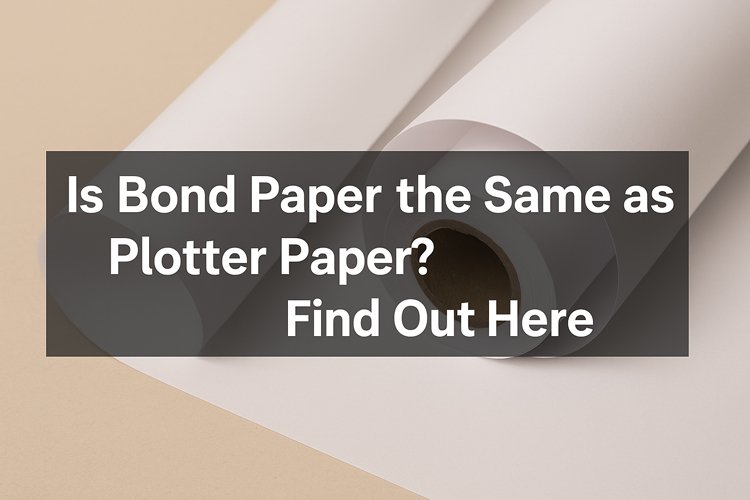
No, bond paper and plotter paper are not the same—but they are closely related. Bond paper is a type of high-quality paper, and engineering bond paper is a specific kind often used in plotters. However, not all bond paper is suitable for plotters, and plotter paper can include other specialized materials like vellum and Mylar depending on the application.
What’s the Difference Between Bond Paper and Plotter Paper?
🟤 Bond Paper: High-Quality Writing and Printing Stock
Bond paper is a durable writing paper with weights generally above 50 g/m². It’s commonly used in offices for letterheads, business reports, and inkjet printing. When labeled as “engineering bond,” it is specially manufactured to work with wide-format printers like plotters. Features include:
- Available in coated and uncoated varieties
- Suitable for inkjet or laser printers
- Typically used for monochrome line drawings, drafting, and mapping
- Comes in rolls or sheets, often sized for A1, A0, or B1 formats
Uncoated bond is used for fast-drying, black-and-white prints, while coated bond offers better resolution for color renderings.
🟢 Plotter Paper: A Functional Category
Plotter paper is not a material—it’s a category of papers used in large-format printers for CAD, architectural, and engineering drawings. It includes:
- Engineering bond paper (a bond-paper variant)
- Vellum (translucent paper for tracing and overlays)
- Mylar (polyester film for archival and durable records)
- Clear film for special graphic or overlay applications
Plotter paper must meet strict requirements for dimensional stability, surface quality, and moisture control to produce accurate technical drawings.
🧪 Practical Example: When Is Bond Paper Used in Plotters?
Let’s say an engineer needs to print a technical drawing. If it’s a simple black-and-white design, uncoated engineering bond paper (20 lb or 75gsm) is ideal. For a full-color site plan, a coated bond version gives better color sharpness. But if a client requests translucent overlays, vellum or Mylar would be necessary—both are plotter paper, but not bond paper.
This demonstrates that while bond paper can be plotter paper, not all plotter paper is bond paper.
✅ Summary Comparison
| Feature | Bond Paper | Plotter Paper |
|---|---|---|
| Definition | High-quality writing/printing paper | Paper/media used in large-format printers |
| Use in Plotters | Only if engineered for it | All types specifically made for plotters |
| Material Type | Mostly paper (with/without coating) | Includes paper, vellum, Mylar, clear film |
| Coating Options | Yes (coated/uncoated) | Varies by type and application |
| Best Use Case | Documents, CAD prints, black/white lines | CAD, GIS, architectural drawings |
💡 Buyer Tips: How to Choose the Right Paper for Plotting
- For line drawings: Use 20 lb. uncoated bond paper rolls.
- For colorful renderings: Use coated engineering bond.
- For overlays or tracings: Choose vellum plotter paper.
- For archival or tough conditions: Select Mylar plotter film.
Make sure to check if the bond paper is marketed as engineering bond. It should specify moisture control and dimensional stability—critical features for plotter compatibility.
📚 References
- Plotter Paper Guys: Understanding Engineering Roll Bond Paper
- Freedom Paper: Engineering Bond Paper – Coated vs. Uncoated
- HP Large Format Printers – Plotter Paper Types
Final Takeaway:
Bond paper can be plotter paper—but plotter paper is not limited to bond paper. The key is selecting the right type for your printer and project. For best results, look for engineering bond specifically formulated for large-format printing.
If you’re looking to stock high-quality engineering bond rolls or explore durable alternatives like Mylar, reach out to our experts. We’ll help you find the right plotter paper for your needs. to enhance their sustainability goals while maintaining operational efficiency, kraft paper tape is a powerful, future-ready solution.
NO, 68, Shaojing Rd, Economic Development Zone, Kunshan City, Jiangsu Province, China
We are available online from 8:30 AM to 11:00 PM (GMT) to assist with your inquiries.
We are seeking local agents to enhance our service delivery and align with our enterprise strategy.

Contact Our Team!
Thank you for visiting our website and taking an interest in the our products. We’re looking forward to connecting with you and discussing more about how we can help.

Company address
No 68, Shaojing Road, Economic Development Zone, Kunshan City, Suzhou, Jiangsu Province, China

Email Address

Contact Number
+86-13868814910
