

Written by Bruce Zhou
Founder & Managing Director | JOTA Machinery
Paper converting machinery specialist since 2002.
Connect with me on LinkedIn
Published: 16,October, 2026
Last Updated: 16,October, 2026 19:44:46 PM GMT+8
Receipt printer rolls are used throughout South Africa in supermarkets, restaurants, petrol stations, retail shops, pharmacies, and businesses operating point-of-sale (POS) systems.
For businesses purchasing receipt paper, the main concern is usually whether the rolls fit their printers and produce clear, reliable receipts.
For manufacturers, the requirements are more involved.
A paper roll may be advertised as an 80 mm thermal receipt roll, but that description alone does not guarantee compatibility with every 80 mm receipt printer.
The printer may require a particular paper width tolerance, maximum roll diameter, core specification, paper thickness, or thermal coating orientation.
These details also affect how receipt printer rolls should be manufactured.
For South African paper converters planning to supply POS consumables, understanding printer specifications is an important step before purchasing jumbo thermal paper or selecting a slitting rewinding machine.
1. What Are Receipt Printer Rolls?
Receipt printer rolls are continuous rolls of paper used to print transaction records, purchase details, and other information.
They are commonly found in retail and commercial printing equipment.

Most modern POS receipt printers use direct thermal paper, although some receipt printing systems still use plain bond paper or other printing technologies.
Thermal Receipt Printer Rolls
Thermal receipt printer rolls are made from paper with a heat-sensitive coating.
When the thermal printhead applies heat to selected areas, the coating produces the printed image.
This process does not require an ink ribbon.
Thermal rolls are commonly used in desktop POS printers, compact receipt printers, and payment terminals with built-in printing functions.
Bond Paper Receipt Rolls
Bond paper rolls are designed for printers that use an alternative printing method, such as impact printing.
The paper itself does not contain the same heat-sensitive coating found on direct thermal receipt paper.
These two products should not be treated as interchangeable.
A thermal printer generally requires paper that meets its thermal media specification.
Before accepting a receipt paper order, manufacturers should confirm the printing method used by the customer’s equipment.
2. What Sizes of Receipt Printer Rolls Are Used in South Africa?
Receipt printer rolls are available in several widths and diameters.
Among the commonly encountered specifications are 57 mm and 80 mm nominal paper widths, with different finished roll diameters depending on the printer.
| Receipt Paper Size | Typical Application |
|---|---|
| 57 × 40 mm | Card payment terminals and compact receipt printers |
| 57 × 50 mm | Selected portable and compact printers |
| 80 × 80 mm | Desktop POS receipt printers |
| 80 × 83 mm | Compatible retail POS receipt printers |
| Custom specifications | Kiosks, ticket printers and specialised equipment |
These are examples of possible product specifications, not a guarantee that every printer in an application category accepts the listed size.
The correct dimensions must be confirmed from the printer’s technical requirements.
Why Do Some 80 mm Receipt Printers Specify 79.5 mm Paper?
This is a detail that manufacturers should understand.
An 80 mm receipt printer may specify a paper width of 79.5 ± 0.5 mm.
Similarly, a printer marketed as supporting 58 mm paper may specify 57.5 ± 0.5 mm.
These tolerances allow the paper to feed through the printer’s designed paper path.
For manufacturers, the important point is that the commercial product name and the actual cutting specification are not always identical.
Producing paper at exactly 80.0 mm may be acceptable for some printers, but it should not be assumed to meet every customer’s requirements.
Always follow the actual paper width and tolerance stated for the intended printer.
3. How to Choose Receipt Printer Rolls for Different Printers
Choosing a receipt printer roll involves more than checking the paper width.
At least five specifications should be reviewed before purchasing or manufacturing a replacement roll.
Paper Width
The paper must fit the printer’s paper path.
A roll that is too wide may cause feeding problems. A roll that is too narrow may move sideways and affect printing alignment.
The permitted tolerance should be checked against the printer’s technical documentation.
Maximum Roll Diameter
The outside diameter determines whether the paper roll can fit inside the printer compartment.
Some compact receipt printers accept rolls with an outside diameter of approximately 40–50 mm.
Larger desktop POS printers may accept diameters up to approximately 83 mm, depending on the model.
A receipt roll with the correct width but excessive diameter may still be unusable.
Paper Core Dimensions
Core requirements vary between printers.
Some printers specify both the inner diameter and the outer diameter of the paper core.
Others may support different winding arrangements.
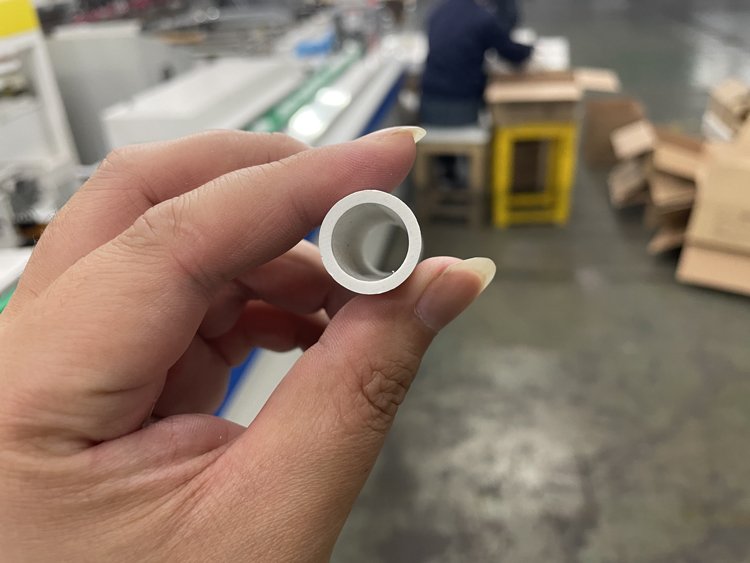
Manufacturers should confirm the core specification before selecting the rewinding setup.
Thermal Coating Orientation
Direct thermal paper has a coated printing surface.
Depending on the printer’s paper path, the thermal-sensitive side may need to face outward or inward on the finished roll.
Using the wrong winding orientation can prevent the printer from producing a proper image.
Before manufacturing a new receipt roll specification, verify the required printing-side orientation.
Paper Thickness and Print Quality
The printer manufacturer may specify a permitted paper thickness range.
Paper outside that range can affect feeding and printing performance.
Thermal coating sensitivity also matters because the paper must produce a readable image under the printer’s operating conditions.
When purchasing jumbo thermal paper, manufacturers should request a technical data sheet rather than relying on GSM alone.
4. Why Does Receipt Printer Paper Thickness Matter?
Receipt paper is commonly described using GSM, meaning grams per square metre.
For example, thermal paper may be supplied in 48 GSM, 55 GSM, or 65 GSM grades.
However, GSM measures paper mass per unit area rather than thickness.
Paper thickness is referred to as caliper and is normally measured in micrometres.
Two papers with different calipers may produce different finished roll lengths even when wound to the same outside diameter.
Example: Two Rolls With the Same Outside Diameter
Suppose two thermal receipt printer rolls both have:
- Paper width: 80 mm
- Finished outside diameter: 80 mm
- Core outside diameter: 18 mm
If one paper has a caliper of 60 micrometres and the other has a caliper of 70 micrometres, the theoretical paper lengths will be different.
Using an ideal geometric estimate:
Paper Length = π × (Roll Diameter² − Core Diameter²) ÷ (4 × Paper Thickness)
| Paper Caliper | Approximate Theoretical Length |
|---|---|
| 60 μm | 79.5 metres |
| 70 μm | 68.2 metres |
These figures assume the stated dimensions and ideal winding without gaps or compression.
Actual production results will vary with the paper and winding conditions.
This example illustrates why two receipt printer rolls with the same external dimensions may not contain the same length of paper.
For manufacturers supplying customers who specify the length in metres, actual caliper should be confirmed before production.
5. How Are Receipt Printer Rolls Manufactured?
Receipt printer roll manufacturing generally starts with a wide jumbo roll of thermal paper.
The material has already been coated for thermal printing.
The converting factory uses a slitting rewinding machine to process the jumbo paper into finished rolls.
Step 1: Load the Jumbo Paper Roll
The parent roll is positioned on the machine’s unwind stand.
Before starting production, the operator checks the paper width, jumbo roll diameter, core dimensions, and material condition.
The unwinding system must feed the paper under suitable tension.
Stable tension and correct web alignment help maintain consistent paper movement through the machine.
Step 2: Configure the Slitting Width
The cutting positions are set according to the required receipt printer roll widths.
On JOTA thermal paper slitting machines equipped with a lower blade and spacer arrangement, operators select and install the appropriate blades and spacers along the knife shaft.
For manufacturers producing nominal 57 mm or 80 mm receipt rolls, the actual cutting setup should follow the finished width and tolerance required by the customer.
The knife-edge positions must be verified after a width changeover.
Step 3: Slit the Thermal Paper
The moving jumbo paper passes through the cutting section.
The knives divide the wide web into narrower strips.
Correct knife positioning, blade condition, and web alignment influence the finished cutting quality.

Damaged knives or improper adjustments may result in rough edges, paper dust, or widths outside the specified tolerance.
Operators should inspect sample rolls during production.
Step 4: Rewind the Narrow Paper Webs
After slitting, the narrow webs are rewound into finished receipt printer rolls.
The rewinding system must support the required outside diameter, core dimensions, and paper length.
Winding tension is particularly important.
Excessive tension can create overly tight rolls, while insufficient tension can produce loose winding or uneven edges.
The thermal coating orientation should also be maintained according to the finished product specification.
Step 5: Inspect and Package the Finished Rolls
Before packaging, completed receipt printer rolls should be inspected.
Typical checks include paper width, outside diameter, core dimensions, winding quality, paper length, and thermal printing performance.
Finished rolls are then packaged according to customer requirements.
For wholesale orders, maintaining consistent specifications between cartons and production batches is important.
6. What Causes Receipt Printer Paper Jams?
When a receipt printer experiences repeated paper jams, the cause is not always a defective printer.
The paper itself may contribute to the problem.
Incorrect Paper Width
Paper that exceeds the printer’s permitted width can interfere with the internal paper path.
Excessive Roll Diameter
A roll that is too large may not rotate freely inside the compartment.
Poor Winding Quality
Uneven or telescoped rolls may feed inconsistently.
Damaged Paper Edges
Rough edges, paper dust, or damaged layers may interfere with reliable feeding.
Unsuitable Paper Thickness
Paper outside the printer’s supported thickness range can affect its transport system.
Incorrect Loading
Even a correctly manufactured paper roll can cause printing problems if it is loaded incorrectly.
When investigating printer complaints, manufacturers should request the exact printer model and inspect the finished paper against the stated specifications.
This is more reliable than assuming every paper-feed problem is caused by the slitting machine.
7. How Can Manufacturers Maintain Consistent Receipt Roll Quality?
A manufacturer supplying receipt printer rolls in volume needs a repeatable quality control process.
For example, a customer ordering several thousand 80 mm receipt rolls expects the same paper width, winding quality, and printing performance throughout the shipment.
Quality control should begin before the jumbo roll enters the slitter rewinder.
Incoming Paper Inspection
Check the jumbo roll for visible damage, inconsistent edges, and material specifications.
Confirm paper GSM, caliper, and thermal coating requirements against the purchase order.
Slitting Setup Inspection
After changing cutting widths, verify the actual finished dimensions.
Inspect knife condition and cutting-edge quality.
Rewinding Inspection
Check finished outside diameter, edge alignment, winding condition, and core placement.
Printing Tests
Use a suitable thermal printer to check whether the paper produces clear and consistent receipts.
Where required, test barcode readability and other customer-specific printing requirements.
Batch Records
Record the jumbo paper batch, machine settings, product specification, and inspection results.
These records make it easier to investigate quality problems and maintain consistency across repeat orders.
8. Can Receipt Printer Rolls Be Custom Printed?
Some businesses want their receipt printer rolls to carry printed logos, promotional messages, store information, or return policies.
For thermal receipt paper, these designs are commonly printed on the reverse side of the paper.
There are two main production approaches.
Pre-Printing Before Slitting
The jumbo thermal paper is first printed using a separate flexographic printing press.
The printed jumbo roll is then loaded onto the slitter rewinder and converted into the required finished receipt rolls.
This allows printing and converting to be handled as separate production operations.
Inline Flexo Printing and Slitting
A suitable inline flexographic printing and slitting machine can combine both operations within one production line.
The printing unit transfers the required artwork onto the paper web before it is slit and rewound.
Manufacturers should confirm ink compatibility, printing position, repeat length, drying conditions, and finished roll orientation.
JOTA Machinery provides inline flexo printing and slitting configurations for manufacturers producing customised thermal receipt paper rolls.
9. Choosing a Receipt Printer Roll Making Machine in South Africa
For manufacturers planning to produce thermal receipt printer rolls, the main equipment is a thermal paper slitting rewinding machine.
The correct machine depends on the customer’s paper specifications and expected production volume.
Before requesting a quotation, prepare the following details.
| Production Requirement | Information to Confirm |
|---|---|
| Jumbo Roll Width | Nominal and usable paper width |
| Jumbo Roll Diameter | Maximum outside diameter |
| Paper GSM | Paper grade and caliper |
| Finished Paper Width | Nominal width and required tolerance |
| Finished Roll Diameter | Maximum outside diameter |
| Paper Core | Inner and outer diameter |
| Thermal Coating | Required winding orientation |
| Daily Production | Target saleable rolls per shift |
| Printing | Plain or custom-printed receipt rolls |
| Packaging | Manual or automated packing requirements |
Automatic Thermal Paper Slitting Rewinding Machine
An automatic slitter rewinder can be suitable for businesses manufacturing standard receipt printer rolls in different widths and diameters.
The machine configuration should match the target finished products and production requirements.
Inline Flexo Printing Slitting Machine
For manufacturers handling branded receipt paper orders, an inline printing configuration may reduce the need to transfer jumbo rolls between separate printing and slitting equipment.
Fully Automatic Thermal Paper Roll Production Line
Higher-volume manufacturers may consider additional automation for roll handling, changing, and downstream production.
The suitable configuration depends on the required output, available operators, and factory layout.
A machine’s maximum mechanical speed should not be treated as its guaranteed finished roll production rate.
Actual output depends on the cutting layout, roll length, rewinding process, changeover time, and production interruptions.
Looking for a Receipt Printer Roll Production Solution?
If you’re planning to manufacture receipt printer rolls in South Africa, JOTA Machinery can help you review the required slitting and rewinding configuration.
Share your jumbo roll width, paper GSM, finished paper dimensions, core specifications, and expected production capacity.
Our engineering team can recommend a suitable machine configuration for your manufacturing requirements.
Explore JOTA Receipt Paper Slitting Machines

Need to increase thermal paper roll production while reducing manual handling? The JT-SLT-1400FA integrates automatic core feeding, slitting, rewinding, and finished roll handling into a connected production line. During normal operation, one operator can supervise and inspect the production process. For manufacturers handling large-volume POS and receipt roll orders, our team can discuss production capacity, automation requirements, and suitable downstream packaging configurations.
10. What Should Manufacturers Confirm Before Accepting Bulk Orders?
For receipt printer roll manufacturers, supplying a product that fits the customer’s equipment is more important than simply matching a catalogue description.
Two customers may both request 80 mm receipt paper but operate different printer models.
Their specifications may differ in paper thickness, core arrangement, outside diameter, or acceptable width tolerance.
Before accepting a large order, request a written specification covering all relevant dimensions.
If the customer cannot provide one, ask for the exact printer model and confirm its paper requirements.
For new products, producing and testing a sample before starting bulk conversion can reduce the risk of rejects and customer complaints.
Manufacturers should also agree on packaging quantity, product identification, quality requirements, and delivery schedule.
Conclusion
Receipt printer rolls are widely used by South African businesses operating POS systems, payment terminals, and other receipt printing equipment.
For buyers, the correct roll must fit the printer and produce reliable receipts.
For manufacturers, that means controlling more than the nominal paper width.
Finished roll diameter, paper caliper, core dimensions, thermal coating orientation, slitting accuracy, and winding quality all influence product compatibility.
Before selecting a receipt paper converting machine, manufacturers should confirm the printer specifications their customers require and the production volume they intend to achieve.
Planning to Manufacture Receipt Printer Rolls in South Africa?
JOTA Machinery supplies thermal paper slitting and rewinding equipment for manufacturers producing POS receipt rolls, card machine rolls, and customised thermal paper products.
Whether you’re establishing a new converting factory or expanding existing production, our engineering team can review your paper specifications and recommend a suitable machine configuration.
Send us your jumbo roll dimensions, target receipt roll sizes, paper GSM, and expected daily output to discuss machine specifications and pricing.
Request a Receipt Printer Roll Making Machine Quotation
Last Updated on 16/10/2026 by Jota Machinery