

Written by Bruce Zhou
Founder & Managing Director | JOTA Machinery
Paper converting machinery specialist since 2002.
Connect with me on LinkedIn
Published: 28,October, 2026
Last Updated: 28,October, 2026 17:26:12 PM GMT+8
The thermal receipt rolls have finished slitting and rewinding. The paper width is correct, the roll diameter meets the customer’s requirements, and the finished products are ready for packaging.
The operator places the rolls into shrink film and sends them through a heat shrink tunnel.

After the packages exit the machine, two different problems may occur.
Some packages remain loose, with wrinkles around the rolls.
Others look tightly wrapped, but the thermal paper underneath has developed grey or dark marks.
Both problems can be related to the shrink-wrapping process.
Shrink-wrapping temperature affects thermal receipt rolls in two ways: it determines how the packaging film shrinks, and it influences the heat exposure experienced by the paper inside.
For ordinary products, increasing the shrink tunnel temperature may be a straightforward way to improve film shrinkage.
Thermal receipt paper is different.
Its surface contains a heat-sensitive coating designed to produce visible images when exposed to heat from a thermal printer.
If the packaging process transfers excessive heat to the paper, the coating may react before the roll reaches the customer.
At JOTA Machinery, we manufacture thermal paper slitting and rewinding equipment and provide production-line solutions that can include downstream shrink-wrapping equipment.
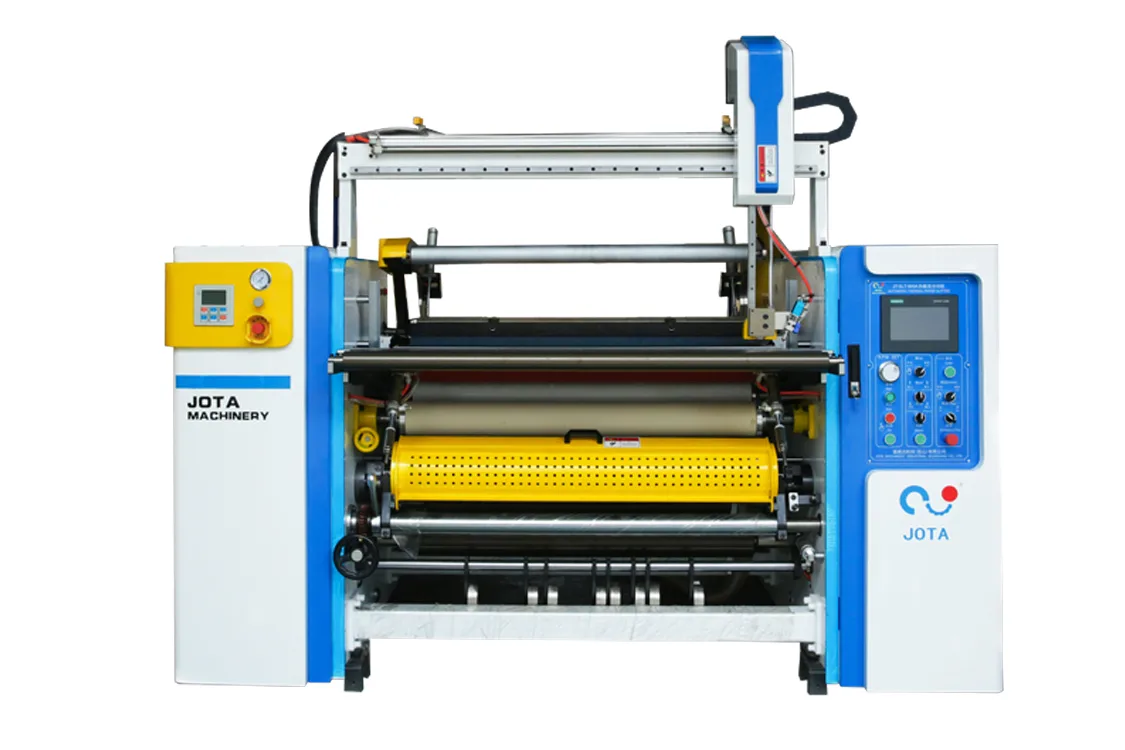
For standard POS and receipt-roll production, thermal paper jumbo rolls are slit and rewound into the required finished widths, diameters and core specifications.
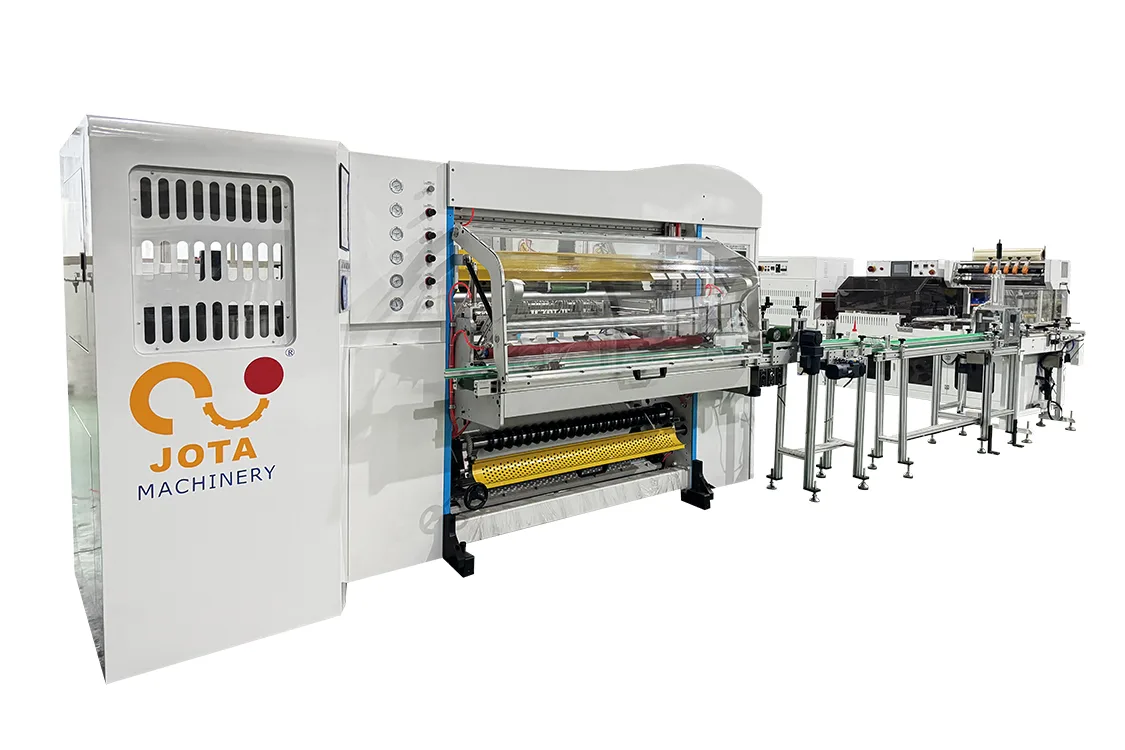
For higher production output, a fully automatic configuration can reduce manual handling and integrate additional roll finishing, packaging or palletizing processes.
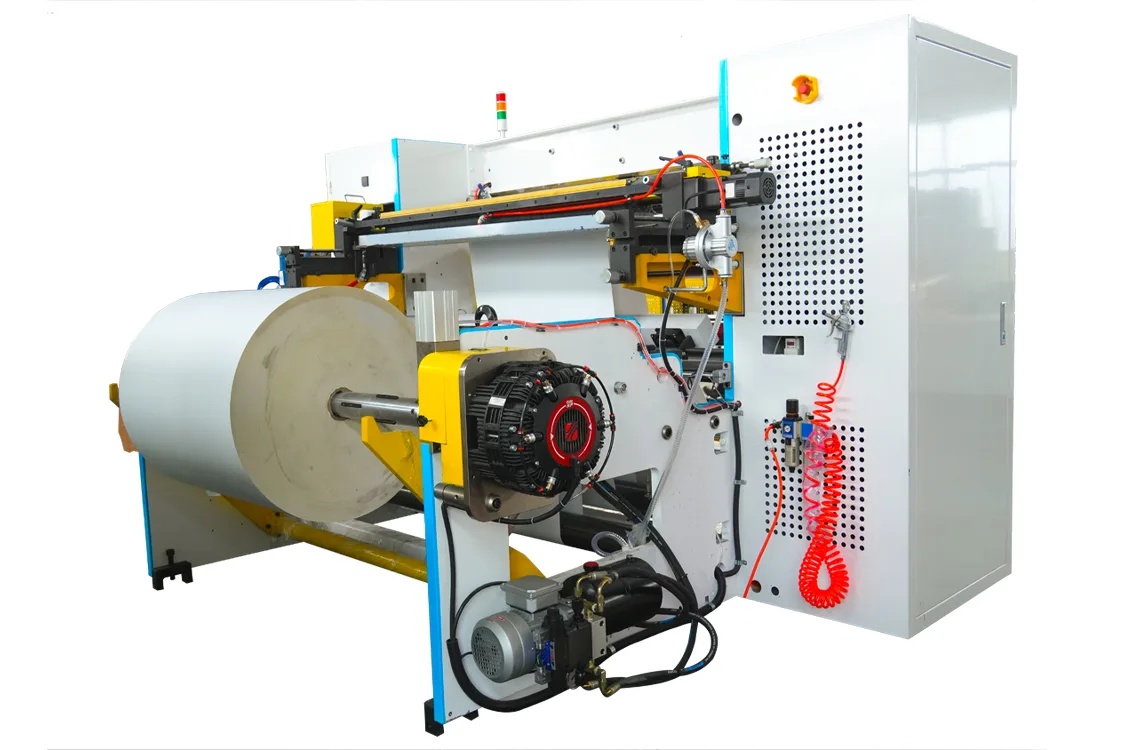
If your rolls require logos or promotional information, inline flexographic printing can be combined with slitting and rewinding in one production process.
For manufacturers packaging POS receipt rolls, the objective is not to use the highest possible tunnel temperature.
It is to identify a suitable combination of shrink film, temperature, conveyor speed, and airflow that produces secure packaging without damaging the thermal paper.
This guide explains how shrink-wrapping temperature affects finished thermal receipt rolls, what happens when the temperature is too high or too low, and how to establish appropriate packaging conditions for production.
1. Why Are Thermal Receipt Rolls Sensitive to Shrink-Wrapping Temperature?
Direct thermal paper contains a heat-sensitive coating.
During receipt printing, the printer’s thermal printhead applies controlled heat to selected areas of the paper.
The coating reacts and produces visible characters, numbers, barcodes, and other transaction information.
This process does not require conventional printing ink.
However, the thermal coating cannot distinguish between heat supplied by a printer and unwanted heat received from another source.
If sufficient heat reaches the coating during shrink wrapping, unwanted colour development may occur.
What Happens When Thermal Paper Is Overheated?
The exposed paper may turn grey or black.
The discoloration may appear around the outside of the roll, near the exposed edges, or in other areas receiving substantial heat.
The exact appearance depends on the thermal paper grade and how heat reaches the product.
A damaged roll may still have the correct width, diameter, and paper length, but it can fail the customer’s appearance or printing requirements.
Different Thermal Paper Grades React Differently
Not all thermal paper has the same sensitivity.
Coating formulations, paper construction, and thermal response characteristics vary between manufacturers and grades.
Consequently, a shrink-wrapping process that works with one jumbo paper grade may not be suitable for another.
This is why packaging conditions should be validated using the actual thermal paper selected for production.
2. Shrink Tunnel Temperature Is Not the Same as Thermal Paper Temperature
This is one of the most important distinctions in thermal paper packaging.
The temperature displayed on the shrink tunnel’s control panel generally refers to a controlled temperature within the equipment.
It does not necessarily represent the temperature reached by the thermal paper inside the package.
Tunnel Air Temperature
The shrink tunnel heats the surrounding air to activate shrinkage in the packaging film.
The temperature setting affects the heat available to the package.
However, actual air temperatures can vary within the tunnel.
Film Temperature
The shrink film receives heat from the surrounding air.
As it reaches suitable conditions, the film contracts around the thermal paper rolls.
The film’s response depends on its material formulation, thickness, and shrink characteristics.
Thermal Paper Temperature
Heat passes from the surrounding environment through the packaging film and into the paper rolls.
The paper’s temperature depends on heat transfer, exposure time, roll geometry, and other conditions.
A short exposure to hot air does not mean the entire paper roll instantly reaches the tunnel air temperature.
Likewise, a relatively moderate air temperature can still become damaging if the paper is exposed for too long.
The real concern is the thermal exposure experienced by the paper, not simply the number displayed on the shrink tunnel.
3. What Happens When Shrink-Wrapping Temperature Is Too Low?
If the selected shrink film does not receive enough thermal energy, it may not contract adequately around the finished rolls.
The packaging may appear loose or unfinished.
Common Symptoms
The film may retain visible wrinkles.
Corners or ends may not conform properly to the package.
The film may stand away from the roll surfaces.
Finished rolls may have more freedom to move inside the packaging than intended.
These symptoms can affect package appearance and handling stability.
Is Low Temperature Always the Cause?
No.
Poor shrinkage may also result from oversized film, incorrect bag dimensions, excessive conveyor speed, uneven airflow, or unsuitable film characteristics.
For example, if the wrapping machine produces a bag that is substantially too large for the grouped rolls, additional heat may not eliminate every fold.
The operator should therefore verify the packaging dimensions before increasing the shrink temperature.
Why This Matters for Thermal Paper
Increasing temperature may improve film shrinkage, but it also increases the potential heat exposure of the paper.
A better solution may involve correcting the film dimensions, improving the airflow distribution, or selecting a film that shrinks satisfactorily under lower-heat conditions.
4. What Happens When Shrink-Wrapping Temperature Is Too High?
Excessive temperature can create defects in both the packaging film and the thermal paper.
The film may shrink aggressively, deform, or develop damaged areas.
At the same time, the thermal receipt rolls may absorb enough heat to develop unwanted discoloration.
Thermal Paper Turns Grey or Black
This is one of the most serious potential consequences.
A finished thermal roll may enter the shrink tunnel with a clean white surface and emerge with visible darkening.

The affected area may initially be limited to exposed layers or edges.
More severe exposure can damage a greater portion of the product.
The factory may then need to reject otherwise acceptable finished rolls.
Film Becomes Damaged
Excessive heat may also create holes, distorted areas, or other problems in the shrink film.
The exact result depends on the film material, thickness, package geometry, and exposure conditions.
Package Appearance Becomes Uneven
A higher temperature does not guarantee better packaging.
If heat distribution is uneven, some regions may shrink excessively while other areas remain loose.
The result may be distorted or irregularly wrapped packages.
Why Higher Temperature Is Not the Best Productivity Strategy
An operator may increase tunnel temperature so that the conveyor can run faster.
However, the added heat may increase the risk of thermal paper discoloration or film damage.
The better approach is to determine whether the selected film and tunnel can achieve the necessary shrinkage at a suitable production rate.
5. Why Conveyor Speed Matters as Much as Temperature
Conveyor speed determines how long each package remains inside the shrink tunnel.
This exposure period is called dwell time.
If the conveyor moves slowly, the package spends more time in the heated area.
If it moves quickly, the exposure time decreases.
Calculating Approximate Dwell Time
For a conveyor moving at a constant speed:
Dwell Time = Effective Heated Length ÷ Conveyor Speed
For example, suppose the effective heated length is 1.2 metres and the conveyor speed is 12 metres per minute.
The approximate exposure time is:
1.2 ÷ 12 × 60 = 6 seconds
If the conveyor speed decreases to 6 metres per minute, the approximate exposure time increases to 12 seconds.
These are illustrative calculations rather than recommended production settings.
Actual heat exposure also depends on the tunnel’s airflow and temperature profile.
Why Slower Is Not Always Better
Reducing conveyor speed can improve shrinkage when a film has not received enough heat.
However, it can also increase the heat transferred to the thermal paper.
For heat-sensitive products, additional dwell time may cause the same type of damage as excessive temperature.
Why Faster Is Not Always Better
Increasing conveyor speed reduces exposure time, but the film may not shrink adequately.
The final packaging may remain loose or wrinkled.
The correct settings must balance film shrinkage against paper protection.
6. Airflow Distribution Can Change the Shrink-Wrapping Result
A shrink tunnel does not rely on temperature alone.
Hot air must reach the relevant surfaces of the package in a controlled manner.
Airflow direction and distribution influence the consistency of shrinkage.
Uneven Airflow
If one side of the package receives substantially more heat than another, the film may shrink unevenly.
One surface may become tight while another remains wrinkled.
The thermal paper may also experience unequal heating.
Insufficient Air Circulation
Poor circulation can make it difficult for the film to receive the intended heat exposure.
The operator may respond by increasing temperature, even though the underlying problem is inadequate airflow.
Excessively Aggressive Heating
High local airflow or inappropriate heating distribution may expose certain areas of the product to more heat than necessary.
This can be particularly important near exposed roll edges or other vulnerable areas.
What Should the Factory Check?
Review the shrink tunnel’s approved airflow settings and inspect the relevant circulating fans, air distribution components, and maintenance condition.
Check whether package defects repeatedly appear in the same location.
If one side is consistently over-shrunk while the other remains loose, investigate airflow and package positioning before raising the overall temperature.
7. Why Low-Temperature POF Shrink Film Can Be a Better Option
The type of shrink film determines the heat conditions required for packaging.
For thermal receipt rolls, JOTA recommends evaluating low-temperature POF shrink film where compatible with the packaging equipment and product requirements.
POF stands for polyolefin.
Suitable low-temperature grades are designed to achieve useful shrinkage under lower heat-exposure conditions than some conventional alternatives.
Why Film Selection Matters
If a shrink film requires more heat than the thermal paper can tolerate under the selected process conditions, the operator faces a difficult choice.
Insufficient heat leaves the film loose.
Additional heat may damage the paper.
Selecting a film designed to shrink under gentler processing conditions can help improve the available operating window.
Is All POF Film Low-Temperature?
No.
Different POF grades have different shrink characteristics.
A general-purpose POF film should not automatically be described as low-temperature shrink film.
Some low-temperature formulations are cross-linked, while others may use different material technologies.
The actual grade and shrink-performance data should be confirmed with the film supplier.
What About Film Thickness?
Film thickness affects packaging properties and heat transfer.
However, a thinner film is not automatically suitable for every application.
The correct selection should consider puncture resistance, sealing, shrink performance, product dimensions, and distribution requirements.
Low Shrink Force Is Not the Same as Low Shrink Temperature
These two properties should not be confused.
Low-temperature shrink film is designed for shrinkage under suitable lower-temperature processing conditions.
Low-shrink-force film is designed to limit the force applied as the film contracts.
A product may possess both characteristics, but one does not necessarily guarantee the other.
For thermal receipt rolls, request film data covering actual shrink behaviour, recommended processing conditions, and shrink force where relevant.
8. How Roll Size and Packaging Format Affect Heat Exposure
Not all thermal receipt roll packages behave the same way inside a shrink tunnel.
A single small POS roll may heat differently from a group of larger receipt rolls.
The total package dimensions, exposed surfaces, and arrangement affect the way heat is transferred.
Small Thermal Receipt Rolls
Compact receipt rolls have relatively little material mass.
Their outer surfaces may respond relatively quickly to changes in the surrounding thermal environment.
This makes exposure control important.
Larger Thermal Paper Rolls
Larger rolls have more material mass, but their exposed outer layers can still receive excessive heat.
A large roll should not automatically be considered safe simply because its interior heats more slowly.
Grouped Packages
When several rolls are wrapped together, their arrangement affects the air exposure and film shrinkage.
Corners, gaps, and contact points may influence how the film conforms to the products.
A package with inconsistent grouping may produce irregular shrink results even when the tunnel settings remain unchanged.
Why Packaging Recipes Should Be Product-Specific
A factory manufacturing different roll sizes should not assume that a single packaging recipe is suitable for every product.
The correct process may depend on roll diameter, number of rolls per pack, film dimensions, and film grade.
Verified settings should be recorded for the relevant packaging formats.
9. How Shrink Temperature Affects Film Tightness and Roll Stability
Shrink wrapping is used to hold finished thermal receipt rolls in a suitable package for subsequent handling and distribution.
The film should conform adequately to the product arrangement.
However, excessive shrinkage is not necessarily desirable.
Under-Shrinking
If the film does not contract sufficiently, the package may feel loose.
The rolls may move relative to one another, depending on the packaging arrangement.
Excessive Shrinking
If the film contracts too aggressively, it may apply unnecessary force to the packaged rolls.
The result depends on the film’s shrink force and the mechanical stability of the products.
For softer or less stable rolls, unsuitable packaging forces may contribute to deformation.
Winding Quality Still Matters
Shrink wrapping cannot correct a thermal paper roll that was wound incorrectly.
A loosely wound or telescoped roll may still be unsuitable even after a tight film has been applied.
The factory should inspect finished roll quality before packaging.
The objective is a stable package that protects the product—not a film that compensates for manufacturing defects.
10. How to Determine the Correct Shrink-Wrapping Temperature
There is no universal shrink tunnel temperature that is suitable for every thermal receipt roll.
The appropriate setting depends on the selected film, actual paper grade, tunnel design, conveyor speed, airflow, and packaging format.
A practical method is to establish the operating conditions through controlled production trials.
Step 1: Confirm the Thermal Paper Grade
Identify the paper supplier and grade used in production.
Review any relevant heat-sensitivity information.
If different grades are processed, do not automatically assume that they have the same thermal tolerance.
Step 2: Obtain the Shrink Film Technical Data
Ask the film supplier for its recommended processing conditions.
Confirm whether the film is specifically designed for low-temperature shrink applications.
Step 3: Verify the Package Dimensions
Check film width, bag length, sealing position, and roll grouping.
Incorrect package dimensions should be corrected before using additional heat to improve appearance.
Step 4: Establish a Controlled Starting Condition
Use an operating condition supported by the film and equipment manufacturers.
Avoid selecting an arbitrary temperature simply because it is commonly used for other products.
Step 5: Test Temperature and Conveyor Speed
Run a small number of representative packages.
Inspect film shrinkage and the condition of the thermal paper.
If adjustments are required, make controlled changes while recording the results.
Step 6: Inspect the Paper After Packaging
Do not judge the result only by the appearance of the film.
Open representative packages after the agreed cooling and conditioning period.
Inspect the paper for discoloration and other damage.
Step 7: Test Thermal Printing Performance
Load a representative packaged roll into a compatible thermal receipt printer.
Check whether it produces acceptable transaction text and images.
This helps verify that the packaging process has not compromised the paper’s intended function.
Step 8: Repeat the Test
Confirm that the process produces consistent results across several representative packages.
One acceptable sample is not enough to establish a reliable production setting.
11. A Practical Temperature Validation Record
When establishing shrink-wrapping settings, factories should record actual operating conditions instead of relying on memory.
A simple production trial record can include:
| Parameter | Information to Record |
|---|---|
| Thermal paper grade | Supplier and product identification |
| Finished roll size | Paper width and outside diameter |
| Packaging arrangement | Number of rolls and grouping |
| Shrink film | Material, grade and thickness |
| Tunnel temperature | Displayed settings and measured conditions where available |
| Conveyor speed | Actual operating speed |
| Approximate dwell time | Based on effective heated length |
| Airflow settings | Relevant fan or airflow configuration |
| Film appearance | Shrinkage, wrinkles and package consistency |
| Paper appearance | Background colour and visible heat damage |
| Printing test | Result using a compatible printer |
| Approval | Accepted or rejected trial condition |
This record makes future troubleshooting more efficient.
It also helps when operators change shifts, film batches, or product specifications.
What About Measuring Paper Temperature?
Where practical, a suitable temperature measurement method can provide useful information about the product’s thermal exposure.
However, measurement methods must be selected carefully.
For example, an infrared thermometer aimed at the shrink film may not provide an accurate measurement of the paper beneath it.
A representative temperature probe or other validated measurement approach may be needed.
The measurement method must not interfere with safe equipment operation.
12. Common Shrink-Wrapping Problems and Their Causes
The following table can help operators identify where to begin troubleshooting.
| Observed Problem | Possible Cause | Recommended Investigation |
|---|---|---|
| Film remains loose | Insufficient heat, short dwell time, or oversized film | Film dimensions, temperature and speed |
| Wrinkles appear on one side | Uneven airflow or package geometry | Air distribution and package positioning |
| Film develops holes | Excessive heat or unsuitable film conditions | Temperature, dwell time and film grade |
| Thermal paper turns grey | Unwanted thermal coating activation | Actual heat exposure and paper grade |
| Thermal paper turns black | More severe heat exposure | Temperature, dwell time and airflow |
| Film looks tight but rolls deform | Unsuitable shrink force or weak roll structure | Film characteristics and winding quality |
| Packaging varies during production | Unstable operating conditions | Temperature control, conveyor and film supply |
| Good film shrinkage but poor printer output | Heat damage or other material incompatibility | Thermal paper testing and process validation |
These symptoms can have more than one cause.
For example, loose film does not always mean that the tunnel temperature is too low.
The correct adjustment should follow the observed defect and the available production data.
13. Why Higher Shrink Tunnel Temperature Does Not Guarantee More Production
Manufacturers often want to increase packaging output.
If the slitter rewinder can produce finished thermal receipt rolls faster than the packaging section can process them, the factory may experience a downstream bottleneck.
Increasing shrink tunnel temperature to allow faster conveyor operation can appear attractive.
However, this approach has limits.
Shrink Film Needs Suitable Conditions
A film may require a particular combination of temperature and exposure time to achieve adequate shrinkage.
Reducing dwell time too much can leave the film loose.
Increasing temperature excessively can damage the film or packaged products.
Thermal Paper Has Additional Limitations
The thermal-sensitive coating must remain suitable for receipt printing.
A processing condition that produces attractive packaging but damages the paper is not acceptable.
Evaluate the Complete Packaging Cycle
Actual production capacity also depends on film feeding, sealing, product grouping, transfer, cooling, and handling.
The tunnel may not be the only bottleneck.
Before changing temperature aggressively, determine which operation limits the number of acceptable packages produced per hour.
The objective is higher saleable output, not simply a higher conveyor speed.
14. Should You Use Heat Shrink Wrapping for Every Thermal Receipt Roll?
Heat shrink wrapping can be suitable for thermal receipt rolls when the process is properly designed and validated.
However, it is not the only packaging method.
The appropriate choice depends on the customer’s product requirements, handling conditions, packaging presentation, and available equipment.
For some applications, alternative wrapping or packing methods may avoid exposing the product to a heat shrink tunnel.
The manufacturer should compare the complete packaging process, including product protection and production capacity.
When Heat Shrink Wrapping Makes Sense
A suitable shrink film can provide a close-fitting package and help maintain the intended arrangement of finished rolls.
It can also support a consistent presentation for distribution.
When Additional Caution Is Needed
If the selected thermal paper grade is particularly sensitive to heat, or the film requires aggressive shrinking conditions, the manufacturer should evaluate a different film or packaging approach.
A process should not be accepted merely because the finished package looks attractive.
The thermal receipt rolls must remain functional.
15. How JOTA Machinery Supports Thermal Paper Roll Packaging Lines
At JOTA Machinery, we manufacture thermal paper slitting and rewinding equipment for POS receipt rolls, cash register paper rolls, and other thermal converting applications.
Our equipment offerings include different machine configurations, including 900 mm and 1400 mm working-width platforms.
Depending on the project, downstream packaging equipment can also be considered as part of the production-line arrangement.
Slitting and Rewinding Come First
The jumbo thermal paper is converted into finished narrow rolls through the slitting and rewinding process.
Before packaging, the rolls should meet the required width, diameter, length, and winding-quality specifications.
Packaging Must Match the Finished Product
The packaging system should be selected according to the actual thermal receipt roll sizes, package grouping, required output, and packaging material.
For heat shrink applications, the film and tunnel conditions must be compatible with the thermal paper.
Why We Recommend Evaluating Low-Temperature POF Film
For suitable heat shrink packaging projects, we recommend considering low-temperature POF shrink film.
The objective is to achieve acceptable film shrinkage while reducing unnecessary heat exposure to the thermal receipt rolls.
However, the selected film must be tested with the actual packaging equipment and paper grade.
What Information Helps Us Review a Production Line?
Customers planning a thermal paper roll manufacturing or packaging line should provide the finished roll dimensions, expected production output, package arrangement, and intended packaging material.
If shrink wrapping is required, the relevant film specifications and packaging-quality requirements should also be reviewed.
The exact machinery and automation scope are determined by the project configuration.
Explore JOTA Thermal Paper Slitting and Packaging Solutions
Conclusion: Control Heat Exposure, Not Just Tunnel Temperature
Shrink-wrapping temperature has a direct influence on both the packaging film and the thermal receipt rolls inside.
If the thermal exposure is insufficient, the film may remain loose or wrinkled.
If it is excessive, the film may become damaged and the thermal paper coating may darken.
The correct operating condition depends on more than temperature alone.
Conveyor speed determines exposure time, airflow affects heating consistency, and the selected shrink film determines the conditions required for shrinkage.
The thermal paper grade and packaging arrangement also influence the result.
For manufacturers packaging heat-sensitive POS receipt rolls, suitable low-temperature POF shrink film may help reduce the required heat exposure.
However, film selection and machine settings must be validated together.
A successful packaging trial should demonstrate acceptable film tightness, consistent package appearance, intact seals, stable roll arrangement, and no unacceptable thermal paper damage.
The finished rolls must also retain their intended thermal printing performance.
The best shrink-wrapping temperature is not the highest or lowest possible setting. It is part of a validated process that protects the product while producing consistent, saleable packages.
Planning a Thermal Receipt Roll Production and Packaging Line?
JOTA Machinery supplies thermal paper slitting and rewinding equipment and can discuss suitable downstream packaging configurations according to your production requirements.
If you are establishing a new thermal paper converting factory or expanding an existing production line, share your finished roll specifications, packaging format, production capacity, and intended shrink film.
Our engineering team can review the equipment configuration and the production trials needed for your application.
Contact JOTA Machinery About Thermal Receipt Roll Production
Last Updated on 28/10/2026 by Jota Machinery