

Written by Bruce Zhou
Founder & Managing Director | JOTA Machinery
Paper converting machinery specialist since 2002.
Connect with me on LinkedIn
Published: 21,October, 2026
Last Updated: 21,October, 2026 16:14:29 PM GMT+8
A customer orders a carton of thermal paper rolls online. The package arrives, but after opening the box, the customer notices something unusual.
Several rolls have black streaks around their outer surfaces. Others have grey marks near the edges, even though the paper has never been used in a receipt printer.

The customer may assume the paper is defective, old, or poor quality.
For the seller, this can become a product complaint, a return request, or a negative review.
But what if the thermal paper rolls were perfectly white when they left the factory?
One possible explanation is friction damage during shipping.
When thermal paper rolls are packed loosely inside a carton without suitable protection, they can move against one another during transportation. Repeated rubbing, pressure, and movement may cause dark marks to develop on their heat-sensitive surfaces.
This is particularly relevant to thermal paper rolls because the paper is designed to produce a visible image in response to heat.
A roll does not have to pass through a receipt printer to develop black marks.
For manufacturers, wholesalers, and online sellers, the solution begins with understanding how thermal paper reacts to mechanical contact and how packaging can protect finished rolls during distribution.
1. Why Can Friction Make Thermal Paper Turn Black?
Thermal paper contains a heat-sensitive coating that develops colour when exposed to sufficient heat.
This is the basic principle of direct thermal printing.
Inside a receipt printer, the thermal printhead applies heat to selected areas of the coating, creating text, prices, transaction details, and barcodes.

However, the heat-sensitive coating can also respond to unintended thermal exposure.
One source is friction.
When the paper surface is rubbed or scratched under suitable conditions, frictional heating can cause localised colour development.
This is why dragging a fingernail across certain thermal paper surfaces can leave a dark line.
The same principle can become relevant during handling and transportation.
What Happens Inside a Shipping Carton?
Imagine a carton containing several dozen finished thermal paper rolls.
The rolls have been placed directly into the box without individual wrapping, separators, or sufficient restraint.
During transportation, the carton experiences vibrations, movement, changes in orientation, and occasional impacts.
If the rolls have room to move, their surfaces may rub against neighbouring rolls or the carton interior.
Depending on the thermal paper grade, contact pressure, friction, and movement, this may produce unwanted dark marks.
A small amount of movement does not necessarily cause damage. The risk increases when the packaging permits repeated contact under unfavourable conditions.
Is Friction the Only Explanation?
No.
Black marks may also result from excessive heat exposure, contact with incompatible materials, contamination, or damage that occurred before shipping.
The appearance of dark marks alone does not establish the cause.
The manufacturer should inspect the affected product and compare it with retained samples before concluding that transportation friction is responsible.
2. Why Loose Packing Increases the Risk of Damage
A shipping carton is intended to protect its contents.
However, placing finished thermal paper rolls directly into a cardboard box does not guarantee adequate protection.
The carton may prevent the rolls from falling out, but it may not prevent them from moving.
Movement Between Individual Rolls
When rolls are packed without suitable restraint, gaps may remain between them.
As the package moves during transportation, individual rolls can shift and rotate.
The exposed thermal paper surfaces may come into repeated contact.
If the sensitive coating is subjected to sufficient rubbing or local pressure, visible marking may occur.
Contact With the Carton
Rolls positioned next to the carton walls may also rub against the inner cardboard surfaces.
Depending on the pack arrangement, this can contribute to abrasion, edge damage, or unwanted marking.
Excessive Empty Space
Even when rolls are arranged neatly at the factory, large empty spaces can allow the products to move after the carton is handled.
The original arrangement may no longer be maintained.
A well-designed carton should therefore provide suitable internal restraint rather than simply enough space to hold the required number of rolls.
Why This Matters for Online Sellers
Thermal receipt rolls are often sold as repeat-purchase consumables.
Customers generally expect clean, white paper that can be loaded directly into a compatible receipt printer.
If the product arrives with visible marks, the customer may question its quality before testing it.
For an online seller, preventing shipping damage is part of delivering the product customers ordered.
It is not enough for the rolls to pass inspection at the factory if the packaging does not preserve their condition during distribution.
3. What Do Friction Marks Usually Look Like?
The pattern of the damage can provide useful clues.
For example, a roll that has experienced repeated surface rubbing may show dark streaks, scuffed areas, or irregular marks on the exposed thermal-sensitive layer.
However, different causes can produce similar appearances.
| Observed Condition | Possible Explanation | What to Check |
|---|---|---|
| Irregular dark streaks on outer paper | Friction or scratching | Contact surfaces, carton movement |
| Marks concentrated at roll edges | Edge contact or handling damage | Roll arrangement, separators, carton fit |
| Similar marks on multiple adjacent rolls | Repeated contact during handling or transit | Internal packaging and restraint |
| Broad, relatively uniform grey or black areas | Excessive heat exposure | Storage and transportation conditions |
| Black deposits that transfer when rubbed | Possible external contamination | Carton interior, dust, packaging materials |
| Discolouration where packaging touches the paper | Possible material incompatibility | Film, adhesives, inks, and contact materials |
These patterns help guide the investigation, but they should not be treated as conclusive evidence.
Thermal Colour Development vs Surface Contamination
This distinction is important.
If the heat-sensitive coating has undergone colour development, the black mark is associated with a change in the paper’s imaging layer.
If the surface is contaminated with ink, dirt, or another material, the dark appearance may result from an external substance.
The appropriate corrective action differs.
A contamination problem requires inspection of the packaging environment and contacting materials.
A friction-related thermal marking problem requires better protection against rubbing, pressure, and movement.
4. Why Individual Wrapping Can Help Protect Thermal Paper Rolls
One practical way to reduce direct paper-to-paper contact is to wrap the individual rolls before placing them into the shipping carton.
A suitable wrapper provides a physical barrier between the exposed thermal paper surface and neighbouring products.
Instead of paper rubbing directly against paper, the rolls are separated by the packaging material.
This may reduce contact damage during handling and transportation.
Individual Film Wrapping
Each finished thermal paper roll can be enclosed in a suitable protective film.
The film should provide enough coverage to protect the paper during the intended distribution process.
Depending on the wrapping method, the package may also help keep dust and other contaminants away from the paper.
However, the wrapping material must be compatible with thermal paper.
Some plastic films, adhesives, and additives can interact with heat-sensitive coatings.
The manufacturer should not assume that every transparent plastic film is suitable for direct contact with thermal receipt paper.
Heat Shrink Wrapping
Another option is to use suitable shrink film packaging.
The film is placed around the roll and exposed to controlled heat to form a close-fitting package.
This can help reduce loose material around the product and provide a consistent finished appearance.
For thermal paper, however, the heat shrink process introduces a separate risk.
Excessive heat can cause the thermal coating to darken before the rolls are even shipped.
Where heat shrink wrapping is selected, a suitable low-temperature polyolefin (POF) shrink film may help reduce the heating requirements.
The complete process still needs to be tested with the actual thermal paper grade.
Individual Wrapping Is Not Enough by Itself
Even properly wrapped rolls can be damaged if they move excessively inside an unsuitable carton.
The wrapper protects the roll surface, but the carton and internal packing arrangement still need to control product movement.
A successful packaging system combines compatible materials with adequate physical protection.
5. Individual Wrapping vs Bulk Packaging
Not every thermal paper roll manufacturer uses the same packaging method.
Some products are individually wrapped before being packed into cartons.
Others are grouped into multi-roll packs or placed into bulk containers.
The appropriate choice depends on product dimensions, customer requirements, distribution conditions, and production cost.
| Packaging Method | Main Consideration |
|---|---|
| Unwrapped rolls placed directly in cartons | Requires effective restraint and separation to prevent direct rubbing |
| Individually wrapped rolls | Provides an additional barrier around each roll |
| Multiple rolls wrapped together | Can reduce internal movement when the bundle is properly formed |
| Rolls separated by dividers or inserts | Helps prevent direct contact and maintain arrangement |
| Individually wrapped rolls with suitable carton inserts | Combines surface protection with movement control |
There is no requirement that every thermal paper roll must be individually shrink wrapped.
A properly designed bulk packaging arrangement may also provide adequate protection.
The important question is whether the finished rolls remain undamaged through the expected distribution process.
For online retail shipments, where cartons may be handled individually through several logistics stages, the packaging should be evaluated against those conditions rather than only against warehouse storage.
6. Why a Tight Package Is Not Necessarily a Better Package
Manufacturers sometimes assume that tighter packaging always provides better protection.
That is not necessarily true.
A protective film should keep the product secure without introducing excessive pressure or heat.
Excessive Shrink Force
Some shrink films generate substantial force as they contract.
If the film is unsuitable for the product, the package may place excessive pressure on the finished rolls.
This can affect package geometry or contribute to deformation under certain conditions.
Excessive Tunnel Temperature
A high tunnel temperature may produce visually tight shrink film.
However, thermal paper can darken if the sensitive coating absorbs excessive heat.
The manufacturer should therefore evaluate the paper after packaging, not just the appearance of the film.
Loose Film and Poor Restraint
The opposite problem also matters.
If the film is too large or has not shrunk sufficiently, the product may still move inside the package.
The desired result is a package that provides appropriate protection while preserving the original quality of the thermal paper rolls.
For heat shrink wrapping, the film grade, shrink force, tunnel temperature, airflow, and conveyor speed should be evaluated together.
7. How to Design Better Cartons for Thermal Paper Roll Shipping
Protective film is only one part of the packaging process.
The carton itself plays an important role in preventing movement, impact damage, and deformation.
Choose Suitable Carton Dimensions
The carton should match the quantity and dimensions of the finished rolls.
Excessive internal space can allow movement.
However, the carton should not be so tight that the products are compressed or damaged during packing.
The correct dimensions depend on the chosen roll arrangement and any internal protective materials.
Consider Internal Separators
Dividers, inserts, or other suitable protective arrangements can help keep individual rolls or groups of rolls in position.
These are particularly useful where rolls would otherwise rub against one another.
The separator material should be appropriate for contact with the packaged products.
Control Carton Loading
When cartons are stacked, the lower cartons carry loads from those above.
The carton strength and internal arrangement should be suitable for the intended stacking and distribution conditions.
Crushed cartons can place unwanted pressure on finished rolls.
Avoid Unnecessary Movement
A carton that allows the rolls to shift significantly during handling may increase the risk of surface damage.
The packaging design should restrain the products without applying excessive pressure.
Where additional void filling is needed, use material that does not introduce dust, contamination, or other compatibility problems.
Seal and Identify the Cartons
The completed cartons should be closed and labelled according to the customer’s requirements.
Product identification may include the roll specifications, quantity, batch information, and handling instructions where appropriate.
For manufacturers supplying repeat wholesale orders, accurate carton identification also helps with stock control and traceability.
8. How to Test Whether Packaging Protects Thermal Paper Rolls During Shipping
The most reliable way to evaluate a packaging method is to test it under conditions representative of its intended distribution.
A carton that looks secure on the factory floor may behave differently after repeated movement.
Manufacturers should therefore assess packaging performance before relying on it for large-volume shipments.
Step 1: Prepare a Reference Batch
Produce thermal paper rolls using the approved paper grade and converting specifications.
Inspect the rolls before packaging.
Confirm that their exposed surfaces are free from unwanted marks.
Take photographs or retain reference samples.
Step 2: Prepare Different Packaging Arrangements
For example, a factory may compare a carton with suitable internal dividers against another arrangement using individually wrapped rolls.
The comparison should use the same roll specifications and defined quantities.
The objective is to evaluate which arrangement provides adequate protection.
Step 3: Conduct Handling and Transport Tests
Depending on the distribution requirements, testing may include controlled vibration, impact, and compression conditions.
Appropriate recognised distribution testing methods can be considered when formal qualification is needed.
The test severity should be chosen for the expected shipping environment.
A manually shaken carton may reveal obvious movement, but it should not be treated as equivalent to a validated transport simulation.
Step 4: Inspect the Rolls After Testing
Open the cartons and compare the rolls with the original reference samples.
Check for:
- Dark marks on the thermal-sensitive surface
- Edge damage
- Scratches or scuffing
- Roll deformation
- Damaged protective wrapping
- Changes in carton condition
- Excessive movement within the packaging
Document the results for each packaging arrangement.
Step 5: Confirm Thermal Printing Performance
For representative samples, use a compatible receipt printer to check whether the paper still prints correctly.
Visible dark marks are an important quality concern, but the final product should also meet its functional printing requirements.
Step 6: Approve the Packaging Configuration
Once the arrangement performs satisfactorily under the agreed conditions, record the materials, carton dimensions, packing quantity, and relevant inspection requirements.
Changes to roll size, wrapping material, carton arrangement, or shipment method may require further evaluation.
9. Investigating a Customer Complaint About Black Marks
Suppose an online customer reports that several thermal paper rolls arrived with black marks.
The manufacturer or seller should not immediately assume the paper was defective or that transportation friction caused the damage.
A useful investigation begins with the condition of the finished product at each stage.
Check Production Inspection Records
Were the rolls white and free from marks after slitting and rewinding?
Were any abnormalities reported before packaging?
Review the Packaging Process
Were the rolls individually protected, grouped in packs, or placed directly into cartons?
Was the packaging arrangement consistent with the approved procedure?
If heat shrink wrapping was used, were the film and tunnel settings within the established operating range?
Inspect the Returned or Photographed Products
Where available, examine the location and appearance of the dark marks.
Check whether the marks are associated with paper-to-paper contact, carton contact, packaging materials, or another possible source.
Inspect the Carton
Look for crushed surfaces, damaged inserts, excessive empty space, and evidence of substantial movement.
Packaging damage can provide useful information about the conditions experienced during delivery.
Compare With Retained Samples
A retained sample from the same production batch can help identify whether the problem was present before dispatch.
If retained samples are clean but the delivered rolls are marked, handling, storage, and transportation deserve closer investigation.
However, a clean retained sample alone does not prove the exact cause of the customer’s damage.
Record the Corrective Action
If the packaging is found to be inadequate, the factory should update the approved packing method and verify the correction through testing.
Documenting the problem and corrective action is important for preventing similar complaints in later orders.
10. The Cost of Poor Packaging Can Be Greater Than the Packaging Material
For a thermal paper roll manufacturer, packaging is an operating cost.
Film, cartons, separators, labour, and packaging equipment all add to the cost of producing a finished saleable product.
It can be tempting to reduce these costs by removing protective packaging.
However, that decision should consider the risk of product damage.
What Happens When Customers Receive Damaged Rolls?
Possible consequences include replacement shipments, refunds, additional customer service work, discarded stock, and negative product feedback.
For online sellers, poor customer experiences can also affect repeat purchasing.
These are genuine commercial considerations, although their financial impact varies from business to business.
Compare Packaging Cost With Damage Cost
A useful evaluation is:
Total Distribution-Related Cost = Packaging Cost + Expected Damage and Complaint Costs
The comparison should also consider shipping weight, packing labour, storage, and any other relevant costs.
For example, adding individual wrapping increases material and processing cost.
But if it demonstrably reduces damage claims enough to offset those costs, it may provide an economic benefit.
That conclusion should be supported by actual production and customer complaint records, not by assuming a particular percentage reduction.
Packaging Is Part of Product Quality
A thermal paper roll that leaves the factory in acceptable condition but reaches the customer damaged has not been adequately protected through the delivery process.
The packaging method should therefore be evaluated as part of product quality assurance.
This is particularly important for manufacturers serving distributors, wholesalers, and online retail supply chains.
11. How Packaging Fits Into Thermal Paper Roll Manufacturing
Thermal paper roll production does not necessarily end when the slitter rewinder finishes winding.
Depending on the business, the completed rolls may need to be inspected, wrapped, grouped, packed into cartons, and prepared for shipment.
These activities should be considered when planning production capacity.
Slitting and Rewinding
The jumbo thermal paper is converted into the required finished widths and diameters.
The rolls should meet the agreed specifications before moving to packaging.
Finished Roll Handling
The completed rolls are transferred to the packaging section.
Their exposed thermal-sensitive surfaces should be protected from unnecessary scratching, rubbing, or unsuitable contact.
Protective Wrapping
Where required, individual or grouped protective wrapping is applied.
If heat shrink film is used, the process must be compatible with the thermal paper’s heat sensitivity.
Suitable low-temperature POF shrink film may be worth evaluating when ordinary shrinking conditions create unacceptable heat exposure.
Carton Packing
The rolls are arranged in cartons according to the approved packing specification.
The carton and internal protective materials should minimise damaging movement during distribution.
Final Inspection
The finished packages are checked before dispatch.
The inspection should confirm that the packaging is intact, the product is correctly identified, and representative rolls remain in acceptable condition.
For an integrated production line, the capacity of each downstream operation should also match the intended converting output.
12. What Should Manufacturers Consider Before Investing in Automated Packaging?
For manufacturers producing large quantities of thermal paper rolls, packaging can require considerable handling work.
An automated packaging arrangement may help reduce repetitive manual tasks and maintain a consistent pack format.
However, the equipment should be selected according to the actual packaging requirements.
Before considering automation, establish the finished roll dimensions, pack quantities, film type, carton arrangement, and target output.
If individual heat shrink wrapping is required, the packaging system must be suitable for the thermal paper grade and the intended film.
The factory should verify not only packaging appearance and throughput but also whether the packaged rolls remain protected during representative transportation conditions.
A machine that produces attractive packages at a high speed is not necessarily providing adequate transport protection if the products can still move or become damaged inside the cartons.
JOTA Thermal Paper Converting and Packaging Solutions
JOTA Machinery manufactures thermal paper slitting and rewinding equipment and provides production-line solutions for manufacturers producing POS receipt rolls, thermal till rolls, and other finished thermal paper products.
For businesses planning larger-scale production, downstream roll handling and packaging requirements should be discussed alongside the converting process.
If your distribution involves wholesale shipments or online retail supply chains, the proposed packaging format should be evaluated according to the protection required by the finished rolls.
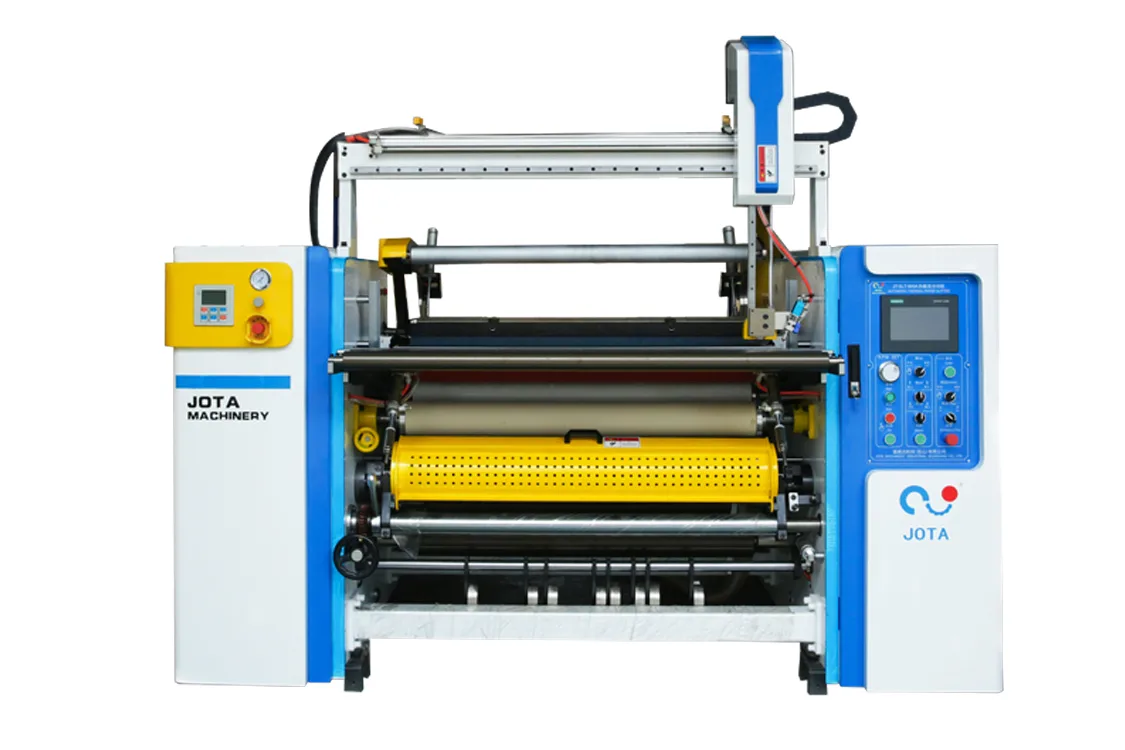
For standard POS and receipt-roll production, thermal paper jumbo rolls are slit and rewound into the required finished widths, diameters and core specifications.
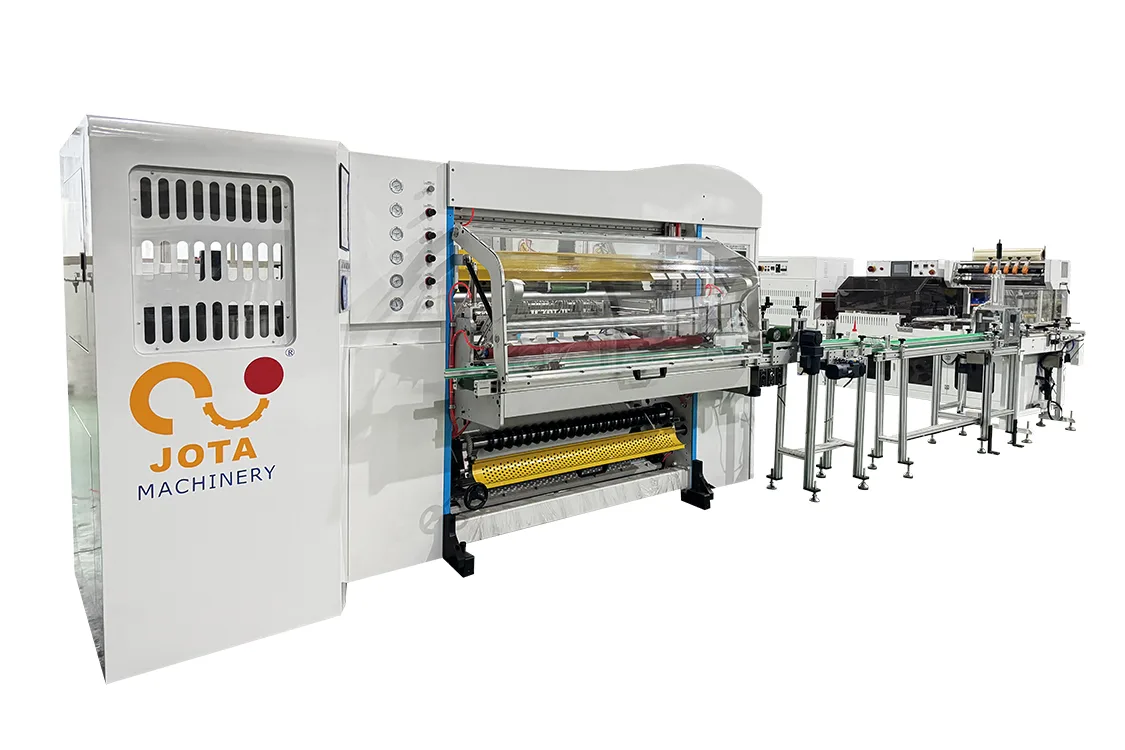
For higher production output, a fully automatic configuration can reduce manual handling and integrate additional roll finishing, packaging or palletizing processes.
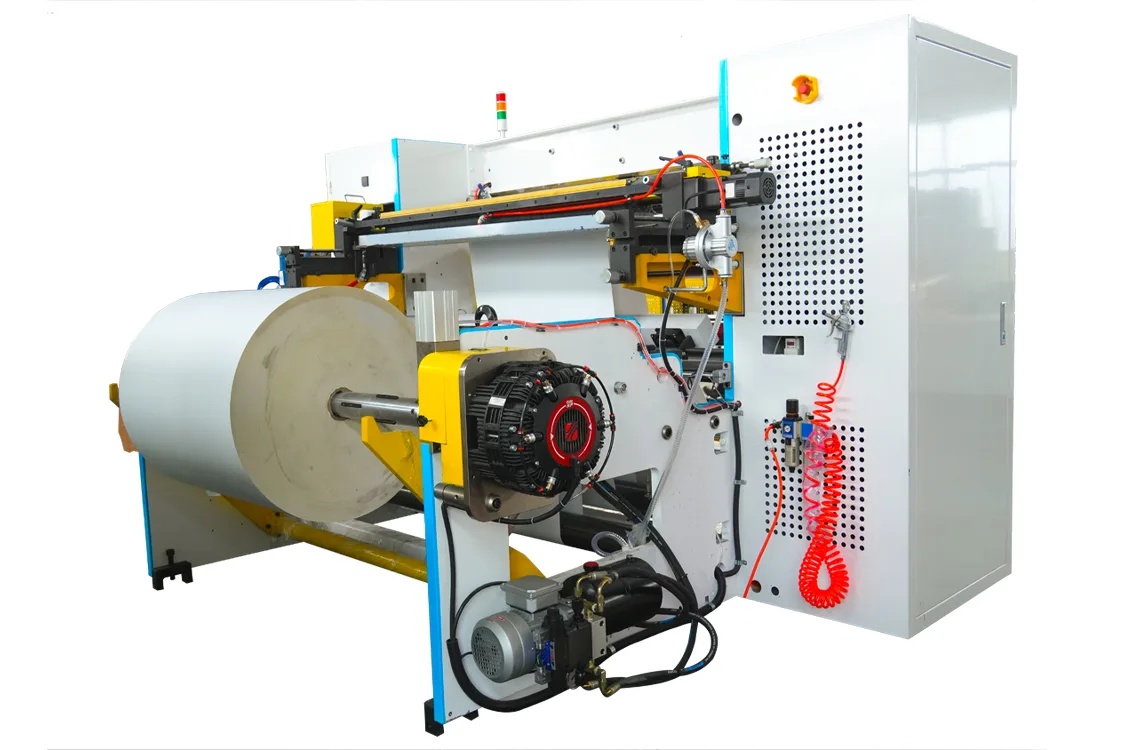
If your rolls require logos or promotional information, inline flexographic printing can be combined with slitting and rewinding in one production process.
Share your jumbo paper specifications, finished roll dimensions, packaging quantities, and expected production output with our engineering team.
Discuss Your Thermal Paper Roll Production and Packaging Requirements
Conclusion: A White Roll Leaving the Factory Should Arrive White
Thermal paper rolls are sensitive to heat and certain forms of mechanical contact.
When finished rolls are placed loosely into shipping cartons, repeated movement and rubbing can increase the risk of surface damage.
In some circumstances, frictional heating or pressure can cause the thermal-sensitive coating to develop unwanted dark marks.
However, not every black mark comes from friction. Heat exposure, chemical contact, contamination, and earlier handling damage should also be considered during an investigation.
For manufacturers and online sellers, the practical solution is to protect the finished paper throughout packing, storage, and transportation.
Suitable individual wrapping, controlled roll grouping, appropriate carton dimensions, and internal protection can help reduce direct contact and movement.
These measures should be validated through representative packaging tests rather than assumed to work.
If heat shrink wrapping is used, the packaging process must also avoid excessive heating that could darken the paper before shipment.
The goal is straightforward: thermal paper rolls should reach the customer in the same acceptable condition in which they left the production line.
Producing Thermal Paper Rolls for Wholesale or Online Distribution?
JOTA Machinery manufactures thermal paper slitting and rewinding machines for producing POS receipt rolls, card machine rolls, and thermal till rolls.
If you’re planning a new converting factory or upgrading an existing production line, our engineering team can review your finished roll specifications, production capacity, and downstream packaging requirements.
Contact JOTA Machinery About Thermal Paper Roll Production
Last Updated on 21/10/2026 by Jota Machinery