

Written by Bruce Zhou
Founder & Managing Director | JOTA Machinery
Paper converting machinery specialist since 2002.
Connect with me on LinkedIn
Published: 16,October, 2026
Last Updated: 16,October, 2026 17:20:52 PM GMT+8
If you’re planning to manufacture thermal till rolls in South Africa, one of the first decisions is which roll sizes to produce.
Walk into a supermarket, restaurant, petrol station, or small retail shop, and you’ll find different types of receipt printers. Some use compact paper rolls for card payment terminals, while others require wider rolls for POS systems.
These printers do not all use the same paper specifications.
For thermal till roll manufacturers, choosing the wrong product dimensions can lead to unsold inventory, customer complaints, and unnecessary machine changeovers.
Based on the product catalogues of established South African suppliers, 57 × 40 mm, 80 × 83 mm, and 80 × 80 mm are among the commonly offered thermal till roll sizes. Other dimensions are also available for particular receipt printers and self-service equipment.
Understanding these sizes is important before purchasing jumbo thermal paper, setting up a slitting rewinding machine, or investing in a new till roll manufacturing business.
1. Common Thermal Till Roll Sizes in South Africa
South African suppliers sell thermal paper rolls for card payment terminals, retail POS printers, cash registers, and specialised printing equipment.
The following sizes appear in local supplier catalogues.
| Thermal Roll Size | Typical Application | Product Category |
|---|---|---|
| 57 × 40 mm | Card payment terminals, portable POS devices | Card Machine Rolls |
| 80 × 83 mm | Retail POS printers, supermarkets, restaurants | Thermal Till Rolls |
| 80 × 80 mm | Compatible desktop receipt printers | POS Receipt Rolls |
| 57 × 57 mm | Selected receipt printers | Thermal Receipt Rolls |
| 57 × 76 mm | Receipt printers requiring larger rolls | Thermal Till Rolls |
| 76 × 76 mm | Compatible receipt printing equipment | Thermal Receipt Rolls |
| Custom sizes | ATM machines, kiosks, specialised printers | Custom Thermal Rolls |
These specifications can be found in supplier catalogues from companies such as GSP Industries and Libra Labels.
However, the availability of a particular size does not necessarily mean that it accounts for the largest share of the South African market.
For manufacturers, the best approach is to confirm the sizes requested by prospective customers before deciding which products to manufacture in volume.
2. What Do Thermal Till Roll Dimensions Mean?
Thermal paper rolls are commonly identified using their paper width and finished outside diameter.
For example:
57 × 40 mm Thermal Till Roll
- Paper Width: 57 mm
- Finished Roll Diameter: 40 mm
80 × 83 mm Thermal Till Roll
- Paper Width: 80 mm
- Finished Roll Diameter: 83 mm
The first measurement tells you how wide the paper is. The second indicates the outside diameter of the completed roll.
These dimensions do not tell you the exact length of paper inside the roll.
Roll length also depends on the paper thickness, core diameter, and winding conditions.
This distinction is important when comparing products from different suppliers.
For example, two manufacturers may supply 80 × 80 mm thermal receipt rolls, but the actual paper length could differ because they use different paper calipers or core dimensions.

You should also distinguish between 80 × 80 mm and 80 mm × 80 m. The former generally specifies width and diameter, while the latter specifies paper width and length.
Before accepting a manufacturing order, confirm whether the customer is referring to roll diameter or paper length.
3. 57 × 40mm Thermal Till Rolls for Card Machines
The 57 × 40 mm thermal roll is widely listed by South African suppliers for portable card payment terminals and compact receipt printers.
These smaller paper rolls are used in payment devices where the available paper compartment is limited.
For example, GSP Industries lists 57 × 40 mm thermal till rolls for card machines and indicates that variations in paper grade and custom specifications are available.

For a manufacturer supplying this market, three dimensions must be checked carefully.
Paper Width
The finished paper width must match the printer’s paper path. Incorrect widths can affect paper feeding and alignment.
Finished Roll Diameter
The completed roll needs to fit inside the payment terminal. A roll that exceeds the permitted diameter may prevent the paper compartment from closing properly.
Core Dimensions
Card machine rolls may use different core specifications. The manufacturer must confirm the core inner diameter, outer diameter, and compatibility with the customer’s device.
These specifications also influence the choice of slitting and rewinding equipment.
A manufacturer producing several card machine roll sizes should consider how the machine handles width changes, rewinding shafts, and finished roll diameters.
4. 80 × 83 mm and 80 × 80 mm Thermal Till Rolls
Wider thermal till rolls are commonly used in desktop POS receipt printers found in supermarkets, retail stores, restaurants, and other commercial businesses.
In the South African market, both 80 × 83 mm and 80 × 80 mm thermal paper rolls are available from local suppliers.
Although their paper widths are the same, the finished diameters are different.
| Specification | 80 × 80 mm | 80 × 83 mm |
|---|---|---|
| Paper Width | 80 mm | 80 mm |
| Roll Diameter | 80 mm | 83 mm |
| Typical Application | POS Receipt Printers | POS Receipt Printers |
| Paper Length | Depends on construction | Depends on construction |
| Core Diameter | Depends on specification | Depends on specification |
An 80 × 83 mm roll may contain more paper than an 80 × 80 mm roll when the paper caliper and core dimensions are otherwise identical.
However, a larger diameter is not automatically better.
The printer must be able to accommodate the completed roll.
From a manufacturing perspective, both specifications require a nominal 80 mm paper width. Their primary difference at the rewinding stage is the finished roll diameter.
The slitter rewinder must therefore support both the required cutting positions and the finished winding dimensions.
Planning to Manufacture Card Machine or POS Rolls?
If you’re preparing to supply 57 mm card machine rolls, 79 mm receipt rolls, or 80 mm thermal till rolls in South Africa, it is worth reviewing your finished roll specifications before purchasing equipment.
JOTA Machinery can help you evaluate a suitable slitting and rewinding setup based on your jumbo paper dimensions, roll sizes, and expected production capacity.
Explore Thermal Till Roll Making Machines
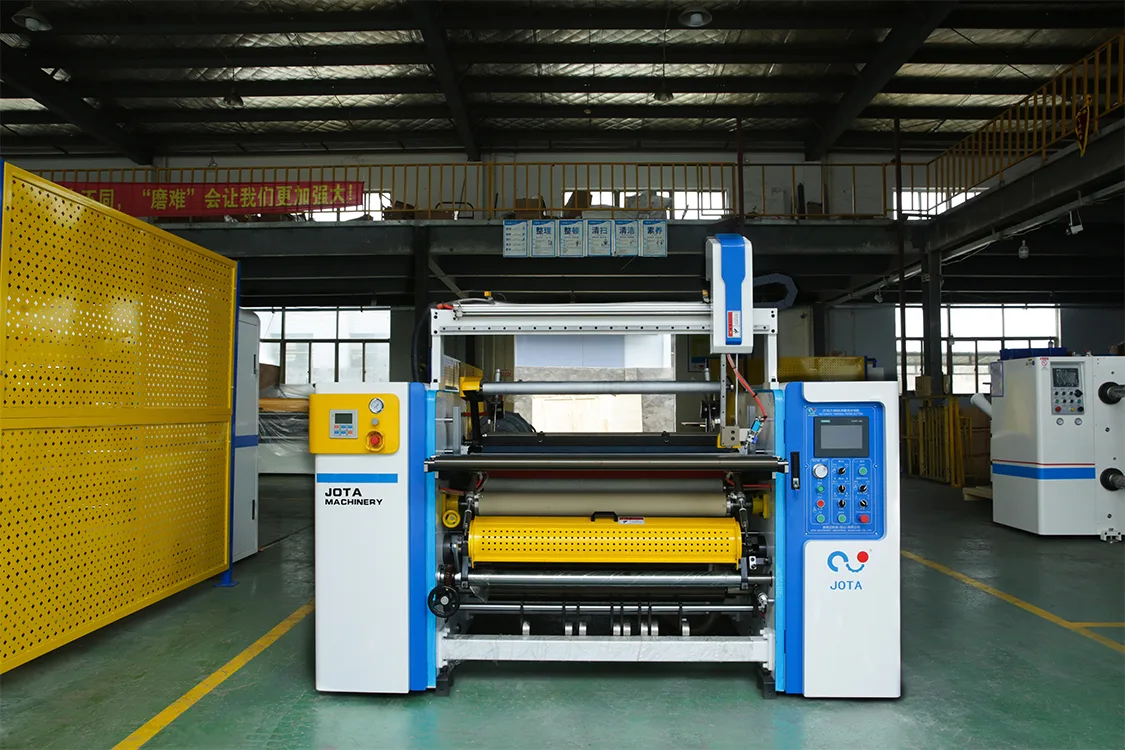
JT-SLT-900A Thermal Paper Roll Slitting Rewinding Machine
Planning to start a thermal paper roll manufacturing business? The JT-SLT-900A converts thermal paper jumbo rolls into finished POS, ATM, and cash register rolls in different sizes. It offers a practical entry point for new manufacturers looking to establish their own production facility. Whether you’re preparing a business plan or evaluating your first slitting machine, our team can help you review the equipment specifications and production requirements.

Looking to manufacture custom-printed thermal receipt rolls? The JT-SLT-1400P combines flexographic printing, slitting, and rewinding in one production line. It supports branded POS rolls with logos, advertising messages, and other printed artwork, subject to the printing configuration. For manufacturers planning to add printing capabilities to their converting operations, JOTA can help evaluate the required printing colours, finished roll dimensions, and production specifications.

Need to increase thermal paper roll production while reducing manual handling? The JT-SLT-1400FA integrates automatic core feeding, slitting, rewinding, and finished roll handling into a connected production line. During normal operation, one operator can supervise and inspect the production process. For manufacturers handling large-volume POS and receipt roll orders, our team can discuss production capacity, automation requirements, and suitable downstream packaging configurations.
5. How Do Roll Sizes Affect Thermal Paper Slitting and Rewinding?
For a thermal till roll manufacturer, the finished product size directly affects the cutting arrangement, material usage, and rewinding operation.
Thermal paper is normally purchased in large jumbo rolls. These rolls are loaded onto a slitting rewinding machine, where the material is unwound, slit into narrower widths, and rewound into finished rolls.
A factory manufacturing 57 mm card machine rolls will require a different slitting layout from one producing 79 mm or 80 mm receipt rolls.
Jumbo Roll Width and Material Usage
Suppose a manufacturer uses a 790 mm wide thermal paper jumbo roll.
The theoretical number of finished widths can be calculated by dividing the jumbo roll width by the required cutting width.
| Finished Width | Theoretical Widths | Remaining Material |
|---|---|---|
| 57 mm | 13 | 49 mm |
| 79 mm | 10 | 0 mm |
| 80 mm | 9 | 70 mm |
These figures are theoretical width calculations, not guaranteed machine outputs.
Actual production must account for usable paper width, edge trimming, cutting arrangement, and the machine’s operating requirements.
For example, a theoretical zero remainder when dividing 790 mm into ten 79 mm widths does not mean that a factory can necessarily operate without trimming waste.
A practical slitting plan must be checked against the actual paper and knife arrangement.
Lower Slitter Blade and Spacer Arrangement
The positions of the slitting knives are another important consideration.
On JOTA machines using a lower blade and spacer arrangement, operators select and install the required components to establish the cutting positions along the knife shaft.

For example, a 56 mm axial assembly can be formed using:
- One 10 mm lower slitter blade
- Two 20 mm spacers
- One 6 mm spacer
Total Assembly Width: 56 mm
A 79 mm axial assembly can be formed using:
- One 10 mm lower slitter blade
- Two 20 mm spacers
- Two 6 mm spacers
- One 7 mm spacer
- One 10 mm spacer
Total Assembly Width: 79 mm
These measurements describe the assembled component widths. The final paper cutting width must be verified against the actual blade-edge positions and knife configuration.
For manufacturers handling several finished roll sizes, understanding the blade and spacer system helps with production planning and machine changeovers.
Why Winding Tension Matters
Slitting is only one stage of thermal paper roll manufacturing.
After cutting, the narrow paper webs must be rewound into finished rolls with suitable winding tension.
If the winding tension is too high, the completed rolls may become excessively tight. If tension is too low, the rolls may have uneven edges or loose layers.
The machine must also accommodate different finished diameters, particularly when switching between compact card machine rolls and larger POS receipt rolls.
When comparing thermal paper slitting rewinding machines, manufacturers should evaluate the cutting system, winding performance, and changeover requirements together.
6. Does Thermal Paper GSM Affect Finished Roll Size?
Thermal paper grammage is generally expressed in GSM, meaning grams per square metre.
Common thermal paper grades include 48 GSM, 55 GSM, and 65 GSM, although the available products and customer requirements vary.
GSM refers to the weight of the paper per unit area. It does not directly specify the paper thickness.
Paper thickness, also known as caliper, is particularly important in thermal roll manufacturing because it affects how much paper can be wound into a given outside diameter.
For example, two thermal papers with different calipers may produce different roll lengths even when the finished outside diameter and core dimensions are identical.
This becomes important when customers purchase thermal till rolls based on both size and paper length.
Before choosing jumbo thermal paper, manufacturers should confirm:
- Paper GSM and caliper
- Thermal coating and printing performance
- Required finished roll length
- Finished roll diameter
- Core dimensions
- Customer printer compatibility
A lower GSM value should not automatically be interpreted as a thinner paper without checking the manufacturer’s technical data sheet.
For manufacturers trying to maintain consistent product specifications, sourcing the correct raw material is just as important as selecting the right converting machine.
7. What About Printed Thermal Till Rolls?
Not all thermal till rolls are supplied as plain white rolls.
Some businesses want their logos, promotional messages, store information, or return policies printed on the reverse side of their receipts.

Printed thermal till rolls are also available from South African suppliers.
For manufacturers, there are two common ways to produce these products.
Method 1: Pre-Printing Before Slitting
The jumbo thermal paper is printed using a separate flexographic printing press.
After printing, the jumbo roll is transferred to a thermal paper slitting rewinding machine, where it is converted into the required finished widths and diameters.
This approach separates printing and slitting into two production processes.
Method 2: Inline Flexo Printing and Slitting
An inline flexo printing slitting machine combines flexographic printing and roll converting within one production line.
The printing plate carries the required artwork, and the printing unit transfers the image onto the moving paper web before subsequent slitting and rewinding.

For converters receiving both plain and printed thermal till roll orders, an inline printing configuration may reduce the need to move jumbo rolls between separate machines.
However, printed thermal paper production requires attention to ink compatibility, printing position, repeat length, registration, and drying.
The printed artwork is commonly applied to the reverse side of the thermal paper, leaving the heat-sensitive side available for transaction printing in the customer’s receipt printer.
8. Choosing a Thermal Till Roll Making Machine for South Africa
Once the target roll sizes have been confirmed, manufacturers need to consider which equipment is suitable for their expected production requirements.
A small business entering the till roll market may have different priorities from an established manufacturer supplying large wholesale orders.
For example, a new business may focus on initial equipment investment, available factory space, and a manageable number of finished roll specifications.
A larger converting operation may place greater emphasis on production capacity, roll-changing time, labour requirements, and integration with packaging equipment.
There are three broad machine configurations worth considering.
Automatic Thermal Till Roll Making Machine
Suitable for manufacturers producing standard thermal till rolls and card machine rolls. Equipment selection should be based on required widths, finished diameters, production volume, and handling requirements.
Inline Flexo Printing Slitting Machine
Designed for manufacturers who need both thermal paper printing and slitting operations. It is particularly relevant for converters supplying branded or customised receipt rolls.
Fully Automatic Thermal Paper Roll Making Machine
Intended for higher-volume converting operations seeking a greater level of automation. The actual functions and production capacity depend on the specific machine configuration.
Before requesting a machine quotation, prepare the following information:
| Requirement | Details to Provide |
|---|---|
| Jumbo Paper Width | e.g. 790 mm or 900 mm |
| Jumbo Roll Diameter | Maximum outside diameter |
| Paper Grade | GSM and paper caliper |
| Finished Roll Width | 57 mm, 79 mm, 80 mm or custom |
| Finished Diameter | 40 mm, 80 mm, 83 mm or custom |
| Core Specifications | Inner and outer diameter |
| Expected Production | Rolls per day or shift |
| Printing | Plain or printed thermal rolls |
| Packaging | Required pack and carton format |
These details help equipment manufacturers determine the appropriate slitting and rewinding configuration.
View JOTA Thermal Till Roll Making Machine Solutions
Last Updated on 16/10/2026 by Jota Machinery