
Published by Bruce Zhou – Jota Machinery
Publish time: 🕙 Thursday, 10 September 2026 — 14:28:13 PM (GMT+8)
Address: No. 68, Shaojing Road, Economic Development Zone, Kunshan City, Jiangsu Province, China
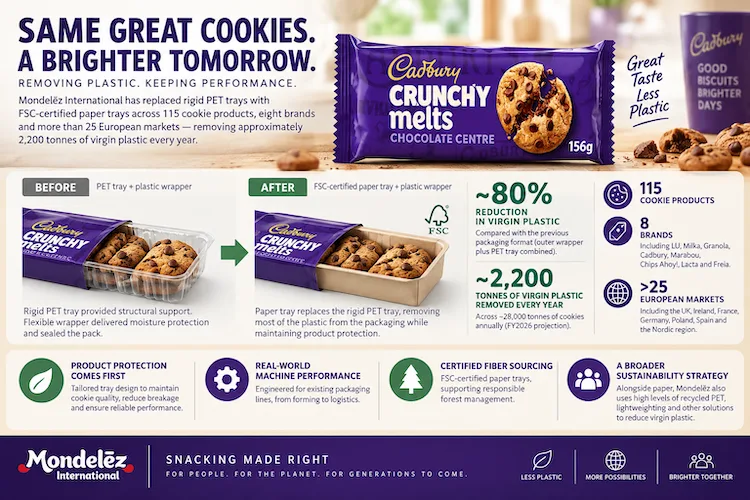
One hundred and fifteen cookie products.
Eight brands.
More than 25 European markets.
And approximately 2,200 tonnes of virgin plastic removed every year.
Mondelēz International has completed one of the larger fiber-substitution projects seen recently in European biscuit packaging, replacing rigid PET trays with FSC-certified paper trays across brands including LU, Milka, Granola, Cadbury, Marabou, Chips Ahoy!, Lacta and Freia.
The project covers around 28,000 tonnes of cookies annually and, according to Mondelēz, represents the company’s largest single packaging-sustainability initiative in its European bakery category.
The headline number is an approximately 80% reduction in virgin plastic.
But there is a detail in Mondelēz’s own footnote that makes this story considerably more interesting.
The 80% is calculated against the plastic previously used in the whole packaging format—the outer wrap plus the PET tray combined.
In other words:
Mondelēz has not eliminated plastic from these cookie packages. It has removed the component responsible for most of it.
That difference tells us something important about where paperization is working fastest in food packaging.
The first targets may not always be the most technically demanding plastic components.
They may be the components whose function fiber can already perform without taking responsibility for the entire shelf-life barrier.
First, Get the 80% Number Right
The company’s September 4 announcement says the new paper trays remove approximately 2,200 tonnes of virgin plastic annually, equivalent to an approximately 80% reduction compared with the previous packaging.
The footnote is essential.
The comparison includes plastic in both the outer wrapper and the previous rigid PET tray.
So the 80% figure should not be reported as:
“the paper tray contains 80% less plastic than the PET tray.”
Nor does it mean:
“the new cookie package is plastic-free.”
It means that replacing the rigid tray removes enough plastic to reduce the package’s previous total virgin-plastic requirement by about four-fifths, based on projected FY2026 production volumes.
That actually makes the result more useful.
It tells packaging engineers something about where the material mass was concentrated.
The rigid tray represented a large part of the plastic burden.
Remove that one component and the company can make a large reduction without necessarily redesigning every packaging function simultaneously.
The Tray and the Wrapper Do Different Jobs
This is the engineering story behind the material change.
In a typical cookie package using an internal tray and sealed outer wrapper, the two components do not perform identical functions.
The tray provides much of the:
structural support,
product separation,
stacking geometry,
and protection against cookies moving or breaking.
The sealed wrapper usually carries much more responsibility for maintaining the internal environment, particularly protection against moisture ingress that can cause crisp biscuits to lose texture.
The precise division of functions in Mondelēz’s individual packages has not been published, so it would be inappropriate to claim exactly which barrier properties each layer provides.
But the architecture explains why a rigid tray can be a logical early candidate for fiber substitution.
Paper is being asked to replace a structural plastic component—not necessarily to replace every barrier function in the package at the same time.
That is a very different technical challenge from replacing a high-barrier flexible wrapper around an oxygen- or moisture-sensitive food.
This Is Why “Paper Replaces Plastic” Can Be Misleading
When consumers see a paper tray where PET used to be, the change appears straightforward.
Plastic out.
Paper in.
For packaging engineers, the more important question is:
Which plastic function was removed?
Not all plastic in food packaging is there for the same reason.
A rigid tray may exist largely because the product needs mechanical support.
A sealed flexible film may be there because the food needs a specific moisture barrier and hermetic seal.
A coating may serve grease resistance.
A tie layer may bond incompatible materials.
A sealant layer may provide the process window required by a packaging machine.
If fiber can handle the mechanical function, replacing the tray can produce a major material reduction relatively quickly.
Replacing the wrapper may demand an entirely different level of paper engineering.
That distinction matters because it prevents a successful rigid-plastic substitution from being presented as evidence that every flexible plastic surrounding the product can now disappear.
It cannot be assumed.
Scale Is What Makes This More Than a Pilot
Paper-based packaging announcements are common.
The scale of implementation is often less impressive.
One SKU.
One country.
One limited edition.
One supermarket trial.
Mondelēz’s rollout is different.
The company says the new trays cover more than 115 products, eight brands and over 25 European markets, including the UK, Ireland, France, Germany, Poland, Spain and the Nordic region.
That makes this a commercial conversion rather than a laboratory demonstration.
And scale introduces problems that smaller pilots can hide.
A paper tray has to perform not only in one packaging plant but potentially across:
different factories,
different product dimensions,
different cookie shapes,
multiple packaging-line configurations,
different logistics routes,
and varying climatic conditions.
For a tray supplier, a few millimetres of dimensional variation can matter.
So can:
board stiffness,
moisture content,
surface friction,
dusting,
nesting behavior,
denesting reliability,
compression resistance,
and dimensional stability.
Mondelēz has not disclosed the tray supplier, board grade, basis weight or detailed converting technology.
Nor has it published packaging-line efficiency data before and after the switch.
Those are important gaps.
Still, implementing the solution across 115 products means the project has passed a much harder test than simply producing an attractive paper prototype.
“From Tray Design to Logistics” Is More Important Than It Sounds
Olivier Kintzig, Mondelēz’s Biscuits Packaging Director for Europe, said the conversion required the business to rethink packaging “from tray design to logistics.”
That final word deserves attention.
Material substitution affects more than the packaging machine.
PET and paper do not necessarily provide identical:
wall thickness,
rigidity,
nesting efficiency,
moisture response,
mass,
or pallet density.
Change the tray and you may change:
how many trays fit in a shipping case;
how they are delivered to the packing line;
warehouse space;
automatic denesting;
line feeding;
product protection;
finished-pack dimensions;
and pallet configuration.
That is why large-scale paperization projects are rarely just procurement exercises.
The material decision can propagate through the whole packaging operation.
For packaging suppliers trying to win this type of business, being able to say “we make paper trays” is not enough.
The more valuable capability is:
we can demonstrate that the paper tray behaves predictably through filling, transport and retail at your existing commercial volumes.
FSC Certification Answers Only One Question
Mondelēz repeatedly describes the replacement as an FSC-certified paper tray.
That is relevant.
But FSC certification should not be stretched beyond what it demonstrates.
FSC’s Chain of Custody system is designed to verify the sourcing and traceability of forest-based materials through the supply chain. FSC labels can identify virgin material from certified forests, recycled material or approved mixtures depending on the specific label used.
It does not, by itself, demonstrate that a particular package:
has a lower carbon footprint than PET;
is recyclable in every European market;
will actually be recycled;
contains recycled fiber;
or performs better in a life-cycle assessment.
Those are separate questions.
The announcement says the trays are FSC-certified.
It does not disclose enough information to determine from that description alone whether they use virgin fiber, recycled fiber or an FSC Mix supply.
So the accurate conclusion is:
Mondelēz has changed the tray to a fiber-based format with certified forest-material sourcing.
Anything beyond that needs more evidence.
We Still Do Not Have a Full Environmental Comparison
The 2,200-tonne virgin-plastic reduction is measurable.
A total environmental improvement is harder to calculate.
Replacing PET with paper changes more than material mass.
A complete comparison could include:
tray weight;
fiber source;
paper-machine energy;
tray-forming energy;
transport;
packaging-line waste;
food damage;
PET recycling;
paper recycling;
water use;
greenhouse-gas emissions;
and end-of-life performance in each market.
Mondelēz has not published a comparative life-cycle assessment for the 115-product conversion.
So I would avoid headlines such as:
“Paper trays cut the carbon footprint of Mondelēz cookies by X%.”
There is no published evidence for that figure.
The demonstrated achievement is virgin-plastic reduction.
That is significant enough without turning it into an unsupported carbon claim.
The More Surprising Story Happened Only Months Earlier
There is another reason this rollout deserves closer examination.
Earlier in 2026, Mondelēz was also highlighting a different strategy for rigid packaging:
put more recycled PET into the trays.
In March, the company said it had completed the transition to trays containing approximately 80% recycled PET across several European flagship brands, including Milka, Oreo, Cadbury and Chips Ahoy!, reducing virgin-plastic demand by around 1,000 tonnes annually.
Now, only months later, Mondelēz is highlighting paper trays across another broad European cookie portfolio that includes Milka, Cadbury and Chips Ahoy! among its brands.
There is brand-level overlap.
But the company has not disclosed enough SKU detail to say that the September paper project directly replaced the same rPET trays celebrated in March.
That distinction is important.
What we can say is more interesting anyway:
Mondelēz is pursuing two different routes to reduce virgin rigid plastic at the same time.
One route keeps PET and increases recycled content.
The other removes the PET tray and substitutes fiber.
That is not necessarily contradictory.
It is what a large packaging portfolio actually looks like.
There May Be No Single “Winning” Material
Packaging debates often become unnecessarily binary.
Paper versus plastic.
Recycled PET versus fiber.
Mono-material versus substitution.
The Mondelēz portfolio suggests the real decision is more application-specific.
For one product:
an 80% rPET tray may provide the best balance of protection, food-contact compliance, recycling and production performance.
For another:
a paper tray may remove more virgin plastic without compromising the packaging system.
For a third:
another structural design might eliminate the rigid tray entirely.
The correct engineering question is not:
Which material is more sustainable?
It is:
Which packaging architecture delivers the required product protection with the lowest justified material and environmental burden in this application?
That decision can produce different answers inside the same company.
PPWR Makes Both Routes Relevant
The timing is also important because Europe’s Packaging and Packaging Waste Regulation is changing how companies evaluate both plastic and paper packaging.
For plastic packaging, Article 7 introduces minimum post-consumer recycled-content requirements.
From the applicable 2030 timetable, contact-sensitive packaging made mainly from PET is subject to a 30% recycled-content requirement, subject to the regulation’s detailed calculation rules and food-contact exceptions.
That makes high-rPET trays one logical compliance and virgin-plastic-reduction route.
But replacing the plastic component with paper changes which material-specific obligations apply.
It does not remove regulatory scrutiny.
Under PPWR, all packaging must ultimately meet recyclability requirements. Design-for-recycling criteria are due to be established by the Commission, with the first performance-grade requirements applying from 2030 or according to the regulation’s implementation timetable.
Paper and cardboard are specifically identified as packaging categories within that framework.
So the long-term test for the new tray is not simply:
Is it made from paper?
It is:
Can the complete packaging unit achieve the required design-for-recycling performance?
PPWR Does Not Simply Say “Use Less Virgin Plastic”
There is also an important correction to some reporting around this announcement.
It is common to say PPWR requires brands to “reduce virgin plastic.”
That is an oversimplification.
The regulation uses several different mechanisms.
For plastic packaging, it sets minimum recycled-content requirements by packaging category.
Separately, Article 10 requires packaging weight and volume to be reduced to the minimum necessary to maintain functionality from the applicable 2030 timetable.
And Article 6 introduces recyclability requirements for packaging materials including paper and cardboard.
Those are related objectives, but they are not interchangeable.
A brand does not satisfy PPWR merely by saying:
“We replaced plastic with paper.”
The new paper structure still has to be justified in terms of weight, functionality and recyclability.
The Paper Tray Could Face Its Own Lightweighting Question
This creates an interesting future challenge for tray manufacturers.
Suppose a PET tray weighing X grams is replaced by a paper tray weighing more than X grams.
Has packaging improved?
From the perspective of virgin-plastic reduction, yes.
From the perspective of total packaging mass, perhaps not.
That does not automatically make the fiber solution worse.
Material weight is only one part of environmental performance.
But Article 10 of PPWR is deliberately material-neutral: packaging should be reduced to the minimum necessary weight and volume while preserving functionality.
The regulation also makes an important point in its technical documentation requirements:
simply substituting one packaging material for another is not, by itself, sufficient evidence of packaging minimization.
That is highly relevant to paperization.
The future question may not be merely:
How much PET did we remove?
It may become:
How efficiently did we replace its function?
For paper and board suppliers, lightweighting the fiber solution could therefore become the next competitive battleground.
The Missing Number Is Tray Weight
This is the first specification I would ask Mondelēz to publish.
How many grams did the old PET tray weigh?
How many grams does the new paper tray weigh?
Without those figures, we know the plastic reduction but cannot evaluate the material-efficiency trade.
I would also want to know:
the paper grade;
fiber composition;
forming technology;
recycled-fiber content;
whether any functional coating is present;
food-contact configuration;
tray scrap rate during manufacturing;
packaging-line efficiency;
and recycling-test methodology.
None of those details is currently available in the public announcement.
That does not undermine the project.
It simply defines the difference between a sustainability press release and an engineering case study.
Recyclability Needs More Than the Word “Paper”
Europe already recycles paper and cardboard packaging at a high aggregate rate.
Recent EU data show paper and cardboard are the largest packaging-waste stream by mass, while plastic packaging continues to have a considerably lower recycling rate; Eurostat reported 42.1% recycling of plastic packaging waste in 2023.
Those system-level numbers partly explain why brands are interested in fiber substitution.
But they cannot be applied directly to an individual package.
A paper tray still has to:
enter the correct collection stream;
be recognized and sorted appropriately;
repulp successfully;
and produce recovered fiber of usable quality.
Any coatings, food contamination, labels or other components can influence that result.
PPWR’s future design-for-recycling methodology will explicitly consider factors such as separability, sorting efficiency, recycling yield and the quality of secondary raw materials.
That makes “paper = recyclable” increasingly inadequate as a technical statement.
The Outer Wrapper May Be the Harder Material Challenge
This is where Mondelēz’s 80% reduction points toward the industry’s next problem.
If replacing the tray removes around four-fifths of the old packaging’s virgin-plastic demand, the remaining fraction is far smaller.
But it may also perform the harder job.
Flexible wrappers around biscuits frequently need to combine:
moisture protection;
sealability;
tear performance;
printability;
machinability;
and high-speed packing reliability.
Replacing those functions with paper can require coatings, barriers and new sealing technologies.
That is a different level of material substitution from exchanging one rigid support tray for another.
So this project should not be read as:
“Paper has solved cookie packaging.”
It may instead show the order in which paperization becomes practical:
replace the structural component first; tackle the barrier component only when the material and machinery are ready.
For paper producers developing flexible barrier papers, that second stage is where some of the larger technical opportunity still sits.
Food Waste Still Has the Final Word
There is another reason not to chase plastic elimination at any cost.
The cookies have to survive.
A package that uses less plastic but allows more breakage, moisture ingress or product waste would create another environmental problem.
Food production carries impacts far beyond the packaging surrounding it.
That means the packaging hierarchy should remain:
protect the product first, then minimize the resources required to do it.
Mondelēz says the paper rollout required redesign work extending from tray construction to logistics, which suggests the project had to be qualified as a complete packaging system rather than a simple material swap.
But no comparative breakage, shelf-life or product-waste data have been published.
Those would be valuable evidence in a future case study.
115 Products Changes the Supplier Qualification Problem
Scale also changes what paper and board producers need to offer.
A global food company cannot qualify packaging material the way a small artisan brand does.
It needs repeatability across enormous volumes.
For a paper-tray supplier, that means consistency in:
caliper;
stiffness;
moisture;
dimensions;
surface characteristics;
food-contact compliance;
and forming behavior.
A material that works beautifully during one trial but changes with humidity or board-machine variation can create costly packaging-line disruption.
This is where large fiber-substitution projects can influence the paper industry upstream.
Brand owners will increasingly expect paper suppliers to deliver not just sustainability credentials, but industrial statistical consistency.
That requirement becomes more demanding when one material specification is supporting 115 products in 25 markets.
Mondelēz’s Own Data Shows Why Packaging Strategy Is Getting More Complicated
The company reported that in 2025:
96% of its packaging was designed to be recyclable;
overall virgin plastic use was 11.5% below its 2020 baseline;
virgin rigid plastic was 8.4% lower;
and recycled plastic represented 3.7% of its plastic packaging.
Its target for 2030 includes an approximately 25% reduction in virgin rigid plastic compared with 2020.
The new 2,200-tonne paper-tray project should therefore be seen as one part of a broader portfolio strategy.
And that strategy already includes several different tools:
lightweighting;
recycled PET;
chemically recycled plastic under mass-balance approaches;
mono-material flexible structures;
and paper substitution.
That is probably closer to how the European packaging transition will actually happen.
Not through one miracle material.
Through hundreds of application-specific redesigns.
This Is Good News for Paper—but Not a Blank Cheque
For paperboard producers and converters, replacing 2,200 tonnes of annual virgin plastic across a multinational food portfolio is clearly significant.
It demonstrates that fiber can compete in a packaging format historically served by rigid PET.
It also gives paper another entry point into high-volume branded food packaging.
But the sector should resist declaring victory too early.
The next questions will be harder:
Can the trays be lightweighted further?
Can recycled fiber be incorporated while meeting food-contact and strength requirements?
What is their actual recycling yield?
How do they perform across different European collection systems?
What is their lifecycle footprint versus an 80%-rPET tray?
And can paper eventually replace some of the remaining flexible plastic without compromising shelf life or packing-line performance?
Those questions determine whether this is simply a large plastic-reduction project or the beginning of a broader material-system change.
The Most Interesting Part Is What Mondelēz Did Not Replace
The obvious headline is 2,200 tonnes.
The more revealing detail is the 80%.
It tells us that Mondelēz was able to remove most of the virgin plastic in this packaging architecture by changing one major component.
That is a useful lesson for packaging developers.
You do not necessarily have to redesign the hardest part of a package first.
Map the functions.
Identify which component carries the most material.
Determine which function can already be moved into paper without jeopardizing product protection.
Then attack the next problem.
In these cookie packs, the rigid PET tray was large enough to produce an 80% reduction in previous package-level plastic consumption when it was replaced by paper.
The remaining plastic problem is smaller.
It may also be technically more difficult.
That is what makes this more than another paper-versus-plastic story.
Mondelēz is showing what large-scale material transition can look like in practice:
not eliminating every polymer overnight,
but separating packaging functions and removing plastic where another material is already capable of doing the job at commercial scale.
For paper mills and packaging converters, the opportunity is clear.
But so is the next question:
If paper can already replace the rigid component responsible for most of the plastic, can the industry now develop a barrier-paper solution that tackles the remaining wrapper without giving back the gains through higher waste, slower machines or shorter cookie shelf life?
That is where the next 20% becomes much more interesting than the first 80%.
Last Updated on 10/09/2026 by Jota Machinery