






JT-SLT-1300F Label Roll Slitter Rewinder
- PLC control and HMI interface
- Yaskawa frequency inverter
- Double Siemens inverter motors
- Hydraulic jumbo roll loading
- Specification
- Operation Manual
- Video
| Max. Unwinding Width | 1300mm |
| Max. Unwinding Diameter | 800mm |
| Max. Rewinding Diameter | 800mm |
| Slit Width | 30mm-1300mm |
| Acceptable Thickness Range | 50gsm-800gsm |
| Max. Machine Speed | 300m/min |
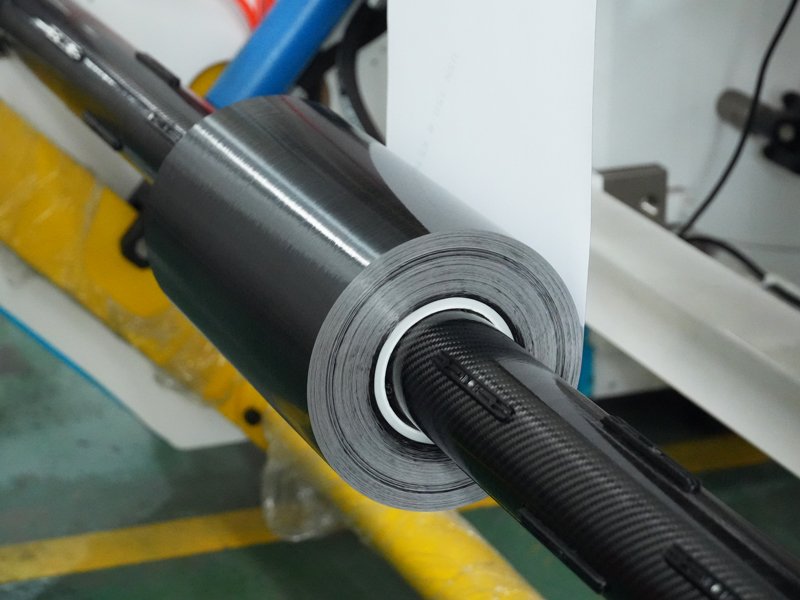
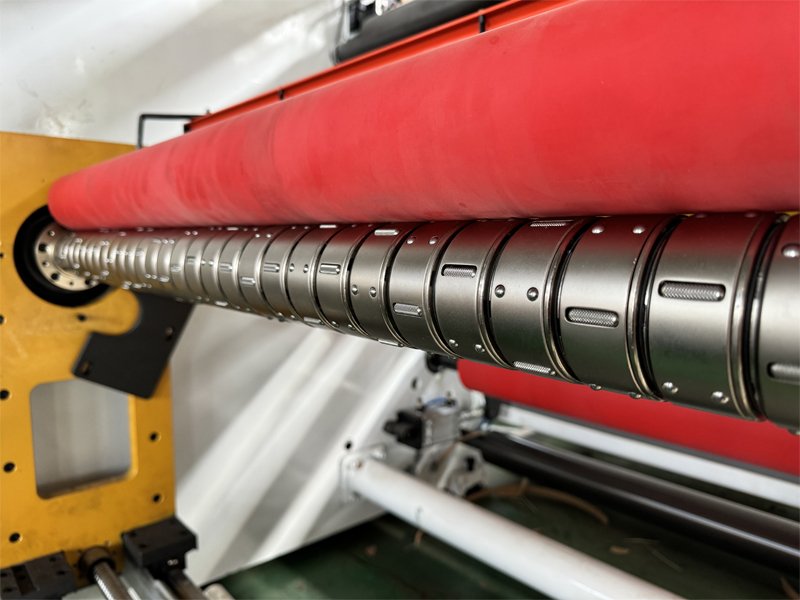
| Unwinding/Rewinding Shaft | 3’’ (76mm) air expanding shaft |
| Rated Power | 18Kw |
| Wall Thickness | 50mm |
| Unwinding Stand | Air expanding shaft or shaftless |
| Rewinding Shafts | Differential friction shaft is optional |
| Rewinding Roll Maximum Weight | 1000Kg |
| Machine Voltage | 380V, 50Hz, 3 Phase |
| Machine Weight | 3500Kg |
| Overall Dimensions | 3600mm*4700mm*2000mm |
| Applicable Materials and Specifications |
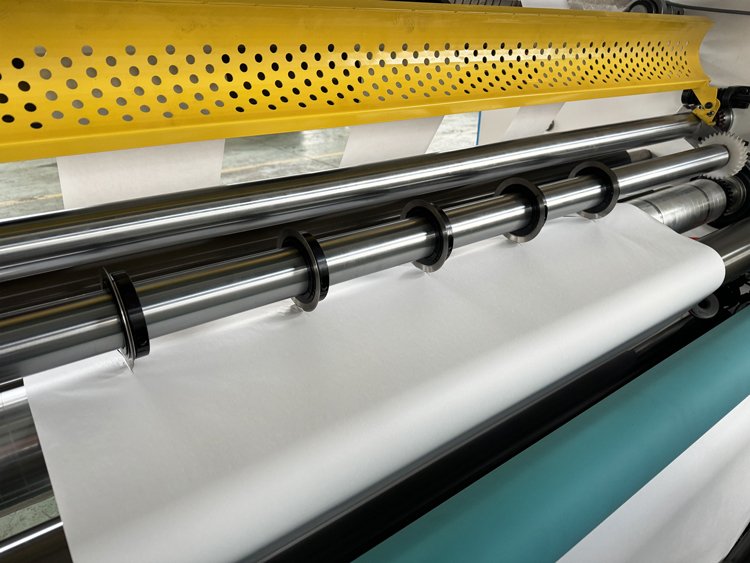
| JT-SLT-1300F label roll slitter rewinder machine suits to the slitting and rewinding of various ultra-large type coiled material, such as plastic film (PVC, OPP, PET, CPP), paper, glass paper, aluminum foil, adhesive label sticker, non-woven fabrics, etc. |
| PLC control system and color interface HMI, all the parameters are shown on the screen. You only need to setup roll diameter, material thickness and original tension etc, the machine could work automatically. |
| Frequency inverter, 3 asynchronous servomotor, one motor for material feeding, the other 2 motor controls the tension. |
| Hydraulic loading system, this part controlled by separate motor. |
| EPC (edge position controller), ultrasonic edge sensor, linear guideway, precision linear actuator), enables accurate slitting precision for printed material. |
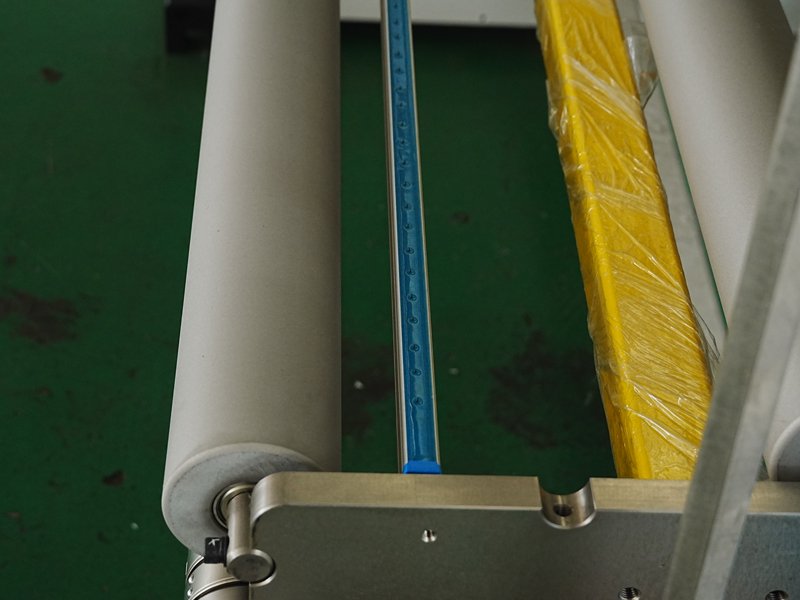
| Balance roller for controlling material tension, especially for thin materials. |
| Dynamic / static balancing transmission shafts. |
| Automatic meter counter, When reaches preset length, machine stops automatically. |
| Emergency switch. |
| Machine parts and wall processed by CNC, the wall is much stronger than other supplier’s, it’s thickness up to 45mm. And the painting adopts baking painting. |
| Electrostatic eliminator and razor blades for thin film material (optional). |
Related Machines


The Quiet Revolution of Label Roll Slitter Rewinder Machines: From Manual Checks to Intelligent Processing
📜 Introduction: A Subtle Yet Significant Shift in Label Roll Finishing
In the realm of label production, the slitter rewinder has long been perceived as a modest piece of equipment—relegated to the end of the production line and often dismissed as a low-skill, low-impact tool. Operators were expected to manually inspect finished label rolls, flag defects, and remove faulty labels before rewinding. But what once was an afterthought is now becoming the focal point of quality control and automation.

Over the past decade, this perception has undergone a quiet revolution. The modern label slitter rewinder has evolved into a highly automated, intelligent, and quality-driven system—essential to ensuring consistency, efficiency, and compliance in roll label production.
🔍 What Does “Slitter” Mean?
A slitter refers to a machine or mechanical system designed to cut large rolls of material into narrower strips. In the label converting industry, this means taking a wide jumbo roll—printed or unprinted—and slicing it into smaller, precise-width rolls suitable for downstream use, such as application on packaging lines or shipment to end-users.
It typically works alongside a rewinder, which coils the cut strips back into compact, well-aligned rolls. Hence, the term “slitter rewinder” is widely used to describe this dual-purpose system.
Whether you’re producing thermal labels, adhesive-backed media, or complex multi-layer substrates, the slitter is responsible for achieving high precision in width, clean edges, and optimal roll tension—making it critical for maintaining product quality and print registration integrity.
🧲 Label Roll Slitter Rewinder for Sale
For businesses searching for a label roll slitter rewinder for sale, the need often stems from rapid order scaling, rising quality demands, or the shift toward automated label finishing. Today’s market expects more than just a basic slitting machine — it demands intelligent systems that deliver precision, consistency, and speed.
Take the JT-SLT-1300F from Jota Machinery as a benchmark. Designed for high-speed and high-accuracy label roll conversion, this model features:
-
A hydraulic unwinding stand for effortless jumbo roll handling
-
Servo-driven tension control for smooth, wrinkle-free rewinding
-
Ultrasonic web guiding for edge alignment
-
A touch-screen PLC interface for simplified operation
-
Wide material compatibility: paper, BOPP, PET, laminated film, and more
In addition to slitting and rewinding, converters often require inline die cutting for labels and stickers. Jota Machinery offers modular solutions that integrate die cutting with slitting, enabling clients to handle everything from roll-to-roll sticker production to precision-cut label sheets—all on one platform.
For anyone actively sourcing a label roll slitter rewinder for sale, choosing a system with flexible configuration, robust automation, and future-ready expandability is the key to staying competitive in today’s fast-moving label and packaging markets.
🕰 Historical Context: From Manual to Machine-Aided Inspection
Historically, slitter rewinders were simplistic, operator-dependent devices. The process of setting slitting blades and back cutters was manual, time-consuming, and prone to error. Operators would manually adjust knife positions and tensions, often spending 10–15 minutes per job setup—significantly slowing down production.
Moreover, inspection and quality control relied entirely on human eyes. Faulty labels could be missed, creating potential downstream issues for customers and converters alike.
This was acceptable in the past. Today, it’s unthinkable.
⚙️ Automation & Digital Intelligence Redefining the Workflow
One of the most notable shifts in recent years is the automation of knife positioning. Innovations now allow for slitting and back-cutting setups to be completed in under one minute, often with data directly pulled from the print job’s PDF file via MIS (Management Information System) integration—eliminating human input altogether.
Additionally, the role of the operator has shifted from quality inspector to system coordinator. Real-time inspection systems integrated upstream during the printing process now identify and log defects as they occur. This defect map is sent to the rewinder, which “servos” its operation based on the data—automatically splicing out defective labels at the designated splice station.
Such automation dramatically improves yield, consistency, and traceability. The burden of quality assurance now rests not with the human eye but with advanced optics and data-driven systems.
🔁 The Rise of High-Precision Tension & Servo Control
Today’s servo-driven slitter rewinders are not only faster but also significantly more precise. Adaptive tension systems—supported by ultrasonic sensors, load cells, and real-time feedback loops—allow for optimal web handling, even with extremely delicate or extensible materials like polypropylene or unsupported film.
These capabilities are no longer niche. From label printers in Europe to converters in Asia, servo tension systems are now a must-have, not a luxury.
🔄 Turnkey Turret Rewinding: The Push Toward Continuous Operation
Another breakthrough is the integration of turret rewinders. By enabling seamless roll changeovers without stopping the line, turret systems minimize downtime and maximize productivity—especially important for high-speed flexo and digital label presses.
For example, AB Graphic’s Vectra turret rewinders have been successfully paired with MPS EF 430 presses, delivering uninterrupted production of multicolor adhesive labels in Dutch label plants. The configuration supports 420mm-wide web handling at speeds up to 200 m/min.
🧠 Deep Integration with Post-Press and Value-Added Processes
Modern slitter rewinders are no longer standalone units. They’re part of fully integrated finishing lines, handling everything from spot varnishing, cold foiling, lamination, rotary die-cutting, to variable data inkjet printing.
These lines, sometimes referred to as “digital web finishing systems,” represent a merging of print, embellishment, and inspection workflows. What used to take multiple machines and manual setups can now be completed inline, on a single platform, with minimal operator intervention.
Manufacturers like Brotech, Grafotronic, and Smag have embraced this modular approach, offering systems that can be scaled and reconfigured to meet evolving converter needs.
🧪 Quality Assurance: Real-Time Reporting and Data-Driven Control
Modern rewinders are also data machines. Equipped with advanced software interfaces—such as URC 2.0 from Rotoflex or RMS systems from Smag—they allow operators and plant managers to track production KPIs in real time. This includes:
-
Runtime efficiency
-
Defect logs
-
Roll quality scores
-
Splice counts
-
Operator performance metrics
Some systems even integrate biometric authentication for enhanced operator traceability, ensuring that sensitive or security-critical labels are handled correctly and safely.
🔍 Spotlight on Next-Gen Equipment
A look at recent product releases illustrates just how far slitter rewinders have advanced:
-
Accraply 438: Features ultrasonic web edge sensing, adaptive tension control, and dual rewinding shafts—ideal for labels, films, and laminated materials.
-
Karlville KSI-1000: Incorporates AVT inspection with real-time splice removal, closed-loop tension, and compact servo construction for 400 m/min operation.
-
Labeltech Eiger 430: A wide-web modular finisher with twin flexo stations, die-cut modules, and dual-direction servo-driven rewinders.
-
Smag Sirius: Built for large jumbo rolls and long-run defect mapping, integrated with vision and inkjet modules.
-
Conderflex GFSR Compact 1300: Entry-level yet robust, supports paper, board, and film with air-shaft winding and adjustable knife options.
Each system reflects a different facet of modern roll-to-roll label finishing: precision, automation, modularity, and smart diagnostics.
💡 What This Means for Label Converters
The implications are far-reaching. Slitter rewinders now sit at the heart of quality control, not the periphery. They’re a key pillar of any smart factory initiative and often define the operational efficiency of label converters.
Where once slitting was seen as a finishing formality, it’s now a competitive differentiator. A well-configured rewinder not only ensures defect-free rolls but also enables full traceability, shorter lead times, and value-added embellishment capabilities.
As job lengths shorten and SKUs multiply, the role of the slitter rewinder will only grow. The best converters already know this—and invest accordingly.
🌍 Final Thoughts: From Winder to Workflow Engine
Slitter rewinders in the label industry have matured into intelligent, adaptive, and indispensable machines. Their integration with MIS systems, inspection cameras, servo drives, and digital embellishment tools has redefined what post-press finishing means in the 21st century.
They are no longer “just a rewinder.” They are the final gatekeeper of quality, the data collector, the automated corrector, and often, the system that makes or breaks profitability in today’s fast-moving label market.
For converters and OEMs alike, the message is clear: upgrade your mindset, not just your machinery.
🔗 Need Help Choosing a Smart Label Slitter Rewinder?
If you’re exploring intelligent label roll slitting and rewinding systems—whether for digital, flexo, or hybrid workflows—our team at Jota Machinery offers customizable solutions designed to meet your exact finishing requirements. From fully automated turret systems to integrated inspection-ready machines, we’re ready to support your transformation.
👉 Get a quote from Jota Machinery
📩 Or email: sales@jotamachinery.com