
Published by Bruce Zhou – Jota Machinery
Publish time: 🕙 Friday, 12 November 2025 — 13:58:55 PM (GMT + 8)
Introduction
In every roll-to-roll converting line, there is one component that sets the rhythm for everything that follows — the unwind stand.
Before any slitting, coating, or rewinding begins, a large parent roll must first be loaded, lifted, and unwound under steady, precise tension. That controlled release of material is what allows the rest of the process to perform flawlessly.

An unwind stand is therefore far more than a mechanical holder; it’s a carefully engineered system designed to support heavy jumbo rolls, control tension as the roll diameter decreases, and keep the web aligned as it enters downstream sections. When properly designed and tuned, it prevents wrinkles, breaks, and uneven edges — saving hours of downtime and ensuring product consistency.
For manufacturers in packaging, printing, film converting, and paper processing, understanding how unwind stands work — and which design best fits their operation — is essential for achieving stable, high-speed production.
1. What Is an Unwind Stand?
An unwind stand (often called an unwinder) is the section at the beginning of a slitter rewinder or any continuous web-processing system.
Its purpose is to hold the master roll, lift it to a safe operating position, and feed the web material forward under controlled tension into the next stage of the process — such as slitting, coating, laminating, or printing.
The unwind stand consists of mechanical, electrical, and pneumatic systems that together ensure:
- Smooth and continuous web release
- Stable tension control as roll diameter decreases
- Accurate edge alignment and guidance
- Safe loading and handling of heavy rolls
In essence, the unwind stand is the foundation of web stability. If the tension is inconsistent or the alignment drifts, the entire line will struggle — no matter how advanced the downstream equipment may be.
2. Why the Unwind Stand Matters in Production
It is tempting to think of the unwind stand as a passive structure. Yet, it directly determines product quality, throughput, and safety.
Here’s why:
- Tension stability ensures the web remains flat and free of wrinkles. Inconsistent tension can cause stretching or edge wander that ruins slit accuracy.
- Alignment precision keeps material entering straight into the slitter section, preventing cross-cuts or telescoping rolls later.
- Efficient roll changeovers minimize downtime and operator fatigue, especially when production runs involve frequent roll changes.
- Proper load handling prevents accidents during lifting or chuck engagement, protecting both operators and equipment.
For converters working with thin films, foils, or coated paper, the unwind is not just the start of the process — it’s the point where product quality begins.
3. How an Unwind Stand Works
Although designs vary, most unwind stands operate through the same fundamental principles of support, tension control, and alignment.
3.1 Supporting and Securing the Roll
The parent roll can weigh anywhere from a few hundred kilograms to several tons. Depending on the stand type, it is held in place either by:
- A shaft that passes through the roll core and locks into safety chucks, or
- A shaftless mechanism, where two hydraulic chucks grip each end of the core directly.
Modern machines often feature hydraulic lifts or floor pick-up arms, allowing operators to load heavy rolls safely without manual lifting.
3.2 Regulating Tension
As the roll unwinds and its diameter decreases, the torque required to maintain constant tension also changes. This is controlled through one of two systems:
- Braked (passive) systems, which use pneumatic or magnetic powder brakes to apply resistance. The brake torque increases or decreases automatically based on feedback from a dancer roller or load cell.
- Driven (active) systems, where a servo or DC motor directly drives the unwind spindle, precisely controlling web tension during starts, stops, and accelerations.
The tension controller acts as the “brain” of the unwind. It continuously reads feedback from sensors and adjusts brake or motor output to keep the web tension stable within a narrow range.
3.3 Guiding and Splicing
To prevent the web from drifting sideways, an edge-guiding system aligns it using pneumatic or optical sensors.
Many unwind stands also include a splicing table, allowing operators to join a new roll to the old one — either manually or automatically — without stopping the machine.
These combined features enable continuous, accurate, and efficient operation throughout the production cycle.
4. Web Path Design: Over-Feed vs. Under-Feed
The orientation of the web as it leaves the unwind stand can follow one of two paths:
| Type | Description | Advantages | Considerations |
|---|---|---|---|
| Under-Feed (near floor) | The web travels forward beneath the roll. | Compact layout, fewer rollers, simple installation. | May expose the web to dust or debris near the floor; requires platforms for safe knife access. |
| Over-Feed (overhead) | The web travels upward from the top of the roll. | Clean web path, allows space for inspection, cleaning, or printing. | Slightly more complex frame and higher cost due to extra rollers. |
The choice often depends on factory layout, material cleanliness requirements, and accessibility needs.
For example, cleanroom film processing typically uses over-feed, while standard paper converting may favor under-feed for compactness.
5. Main Types of Unwind Stands
Each type of unwind stand is designed for a specific balance between cost, roll weight, changeover frequency, and automation level.
5.1 Shafted Unwind
A shafted unwind uses an air-expanding shaft inserted through the core, supported by safety chucks on both ends.
It is reliable, cost-effective, and suitable for most mid-weight rolls. However, the shaft itself can be heavy and requires mechanical assistance for loading.
Applications: Paper, film, and foil rolls up to moderate weights.
5.2 Shaftless Unwind
A shaftless unwind eliminates the central shaft. Hydraulic chucks or arms grip the roll directly from both sides, allowing quick loading from the floor.
This design significantly improves safety and reduces changeover time, especially for large, heavy rolls.
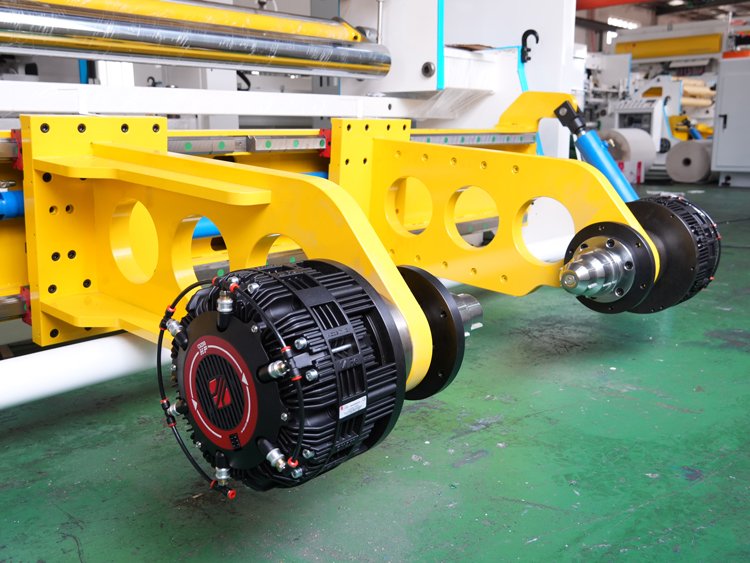
Applications: Jumbo rolls of film, coated paper, or laminates; high-volume converting operations.
5.3 Driven (Motorized) Unwind
A driven unwind uses a servo or AC motor to actively control roll rotation and maintain precise tension throughout acceleration and deceleration.
This setup offers the highest level of tension accuracy and is preferred for thin or extensible materials such as BOPP, CPP, or aluminum foil.
Applications: High-speed production lines, sensitive or high-value materials.
5.4 Braked (Passive) Unwind
A braked unwind applies resistance through pneumatic calipers or magnetic powder brakes.
It is simple, stable, and cost-efficient, suitable for less tension-sensitive materials.
Magnetic powder brakes, in particular, provide smooth torque control even at high speeds.
Applications: Paper, board, and stable films where tension variation tolerance is higher.
5.5 Turret Unwind
A turret unwind integrates two or more roll positions on a rotating frame. While one roll is running, the next is prepared on the idle side.
At roll end, the turret rotates and splices automatically, allowing continuous, non-stop operation — a major advantage for high-speed packaging lines.
Applications: Continuous production for flexible packaging, label stock, or laminating lines.
5.6 Integrated and Modular Designs
Some unwind systems are built directly into the slitter frame (integrated), while others are installed as standalone modules (modular).
Integrated designs save space, whereas modular setups offer flexibility for larger rolls or future upgrades such as turret conversion or in-line inspection.
6. Key Components and Mechanisms
Regardless of type, most unwind stands share several essential elements:
| Component | Function |
|---|---|
| Safety chucks or hydraulic chucks | Secure the roll core and prevent ejection during operation. |
| Air-expanding shafts | Expand to grip the core ID tightly and release easily during roll changes. |
| Brakes or drive motors | Apply torque for tension regulation. |
| Tension control system | Monitors and adjusts brake/motor torque using dancer or load-cell feedback. |
| Edge-guiding unit | Keeps web centered using sensors and actuated rollers. |
| Splice table | Provides a flat surface and clamps for quick roll splicing. |
| Lifting or handling devices | Hydraulic arms or chain lifts to handle heavy rolls safely. |
| Safety guarding and E-stops | Prevent accidents by stopping the machine if access points are breached. |
These features form the foundation of a stable, safe, and operator-friendly unwind system.
7. Typical Specifications
Values vary by machine size and material, but representative ranges include:
| Parameter | Typical Range |
|---|---|
| Web Width | 500 – 3,600 mm (20 – 142 in) |
| Roll Diameter | 300 – 1,800 mm (12 – 72 in) |
| Core Diameter | 76 – 305 mm (3 – 12 in) |
| Maximum Roll Weight | 500 – 1,500 kg |
| Tension Range | 10 – 105 N/cm (0.05 – 6.0 pli) |
Heavier rolls, larger diameters, or faster lines often justify shaftless or driven designs for stability and safety.
8. Safety Considerations
Handling large, rotating rolls presents inherent risks. A well-designed unwind stand includes multiple safety features and clear operating procedures:
- Guarding and interlocks: Fixed guards and light curtains prevent entry into moving areas.
- Emergency stops: Easily accessible buttons stop the roll immediately if needed.
- Mechanical locks: Prevent roll movement during loading or maintenance.
- Proper lifting devices: Avoid manual lifting; use hoists or floor pick-up systems.
- Lock-out/tag-out procedures: Ensure energy isolation during service work.
- Regular inspections: Check brake wear, bearing condition, and chuck alignment.
Operator training remains critical. Even with automation, awareness and routine checks maintain both safety and efficiency.
9. Choosing the Right Unwind Stand
Selecting the correct unwind stand depends on balancing material behavior, roll geometry, and production speed.
The following questions help narrow down the choice:
- What materials will be processed?
- Paper and board may use passive brakes.
- Films or laminates benefit from motorized tension control.
- What are the maximum roll weight and diameter?
- Shaftless designs are safer for rolls above 800–1,000 kg.
- How often are roll changes required?
- Frequent changes favor turret or quick-release shaftless stands.
- What is the required tension accuracy?
- Films and foils need tighter control with load-cell feedback.
- What is the available floor space and layout?
- Under-feed paths save space; over-feed allows cleaner operation and easier integration of inspection systems.
- How much automation is planned?
- Auto-splicing, diameter calculation, and recipe memory reduce human error and increase throughput.
10. Common Applications Across Industries
- Thermal paper and label rolls: Braked or shaftless unwinds with stable tension are ideal for consistent print quality.
- Flexible packaging films: Driven shaftless or turret systems ensure smooth handling of stretchable films.
- Metal foils and laminates: Motorized tension control prevents wrinkling or tearing of thin layers.
- Composite prepreg materials: Precision unwinds maintain fiber alignment during resin impregnation or slitting.
In every case, the unwind must match not only the material but also the machine speed profile, roll change frequency, and safety expectations.
11. Maintenance and Troubleshooting
Consistent performance relies on preventive care.
Typical maintenance routines include:
- Inspecting brake pads, powder units, and chucks for wear.
- Cleaning idler rollers to prevent slippage.
- Checking alignment of arms and safety chucks.
- Verifying load-cell calibration and controller settings.
- Ensuring dancer rollers move freely without sticking.
Common operational issues often relate to tension or alignment errors:
| Problem | Likely Cause | Remedy |
|---|---|---|
| Wrinkles or baggy edges | Unstable tension | Adjust controller tuning; inspect brake or motor torque output. |
| Web drifting | Edge guide misalignment | Calibrate sensors; square the unwind frame. |
| Web breaks during acceleration | Excessive tension | Modify acceleration profile; check tension setpoint. |
| Slower roll changeovers | Manual loading inefficiency | Add hydraulic lift or auto-splicing station. |
Routine inspection not only prevents downtime but also extends the life of critical components.
12. Industry Trends and Automation
As converting lines move toward higher speeds and lower labor dependency, unwind stands are evolving rapidly:
- Hydraulic shaftless systems reduce manual intervention.
- Servo-driven unwinds synchronize precisely with downstream drives.
- Turret unwinds enable continuous operation for 24-hour production.
- Integrated safety PLCs provide intelligent interlocks and real-time diagnostics.
- Predictive maintenance sensors monitor torque, vibration, and brake wear automatically.
Manufacturers increasingly choose modular unwinds that can later upgrade to turret or dual-roll configurations without redesigning the line.
13. The Jota Machinery Approach
At Jota Machinery, unwind stands are engineered as the foundation of each slitter rewinder system.
Our hydraulic shaftless designs support rolls up to 2,800 mm wide and several tons in weight, while magnetic powder brakes or servo-driven units provide smooth, stable tension control across a wide range of materials.
We emphasize:
- Safety and ergonomics: Easy loading, reliable guarding, and operator-friendly controls.
- Customization: Web path options (over or under feed), splicing tables, and edge guiding tailored to specific substrates.
- Integration: Compatibility with printing, inspection, or packaging modules.
- Reliability: European-standard components and 24-hour service support.
Whether you produce thermal paper, flexible packaging film, or composite laminates, we design unwind solutions that ensure stability, safety, and long-term performance.
14. Summary: A Strong Start Defines a Strong Line
The unwind stand is more than the first station of a slitter rewinder — it is the anchor of the entire process.
When it holds, aligns, and feeds the web with accuracy, every subsequent operation benefits: cleaner slits, better roll structure, reduced waste, and improved operator safety.
Selecting the correct unwind stand means balancing mechanical strength, control precision, and practicality. From shafted to shaftless, from simple brakes to advanced servo systems, the right choice sets the tone for reliable production.
If you are building or upgrading a converting line, start from the beginning — start with the unwind.
A well-engineered unwind stand turns consistent tension into consistent profit.
Call to Action
For a system matched to your materials, roll sizes, and productivity goals, ask Jota Machinery for the solution.
Visit www.jotamachinery.com or email jotamachinery@gmail.com to discuss a customized unwind design for your slitter rewinder line.
Last Updated on 12/11/2025 by Jota Machinery