
Thermoplastic Sandwich Panels Manufacturer
- Lighter than traditional sandwich structure
- Bond with the hot-melt physical feature of the UD tape
- The middle layer can be honeycomb and foam board for different applications.
- Improve surface strength by using CFRT unidirectional tape stacking technology


The history about Jota Machinery


Our Project


CFRT Composite Sandwich Panels
- Thermoplastic composites have more impact strength than short fiber
- The core material can be foam or PP/PET honeycomb
- An ideal lightweight advanced product in the 21st century
- Working for RVs, EVs and refrigerated containers

Installation and operation user manual, wire connection diagram, tension controller guide.
100% Response for offline training
One-on-one remote video call assistance.
On-site installation and operation guidance.
- Core Team
- UD Tape Slitting Machine
- Hot Melt UD Impregnation Line



The Double Belt Press Machine is a advanced compounding system designed for the efficient production of continuous fiber-reinforced laminates and composite sandwich panels.
The machine utilizes both heating and cooling processes to ensure precise material bonding and curing, facilitating the production of high-performance composites with superior mechanical properties.
Key Features and Benefits:
- Advanced Compounding Technology: The double belt press integrates advanced thermal management with uniform heat distribution, ensuring consistent material processing for complex composite structures.
- Continuous Fiber Reinforcement: By incorporating continuous fibers into the laminate or panel, this machine enhances the strength and durability of the final product, making it ideal for industries such as aerospace, automotive, and construction.
- Efficient Production Process: The double belt system allows for high-speed processing and automated handling, reducing production time and improving overall efficiency in composite manufacturing.
- Teflon Belt Application: The use of a high-quality Teflon belt is critical in maintaining the integrity of the composite material during the production process. Teflon belts offer several advantages, including high resistance to heat and chemicals, as well as a non-stick surface that prevents material from adhering to the belt. This ensures smooth, continuous operation and minimizes the risk of contamination or product defects.
In conclusion, the Double Belt Press Machine is an indispensable tool for modern composite manufacturing, offering precise control over material processing while maximizing production efficiency and product quality.
The Thermoplastic Uni-Directional Prepreg Tape is a high-performance composite material engineered from continuous carbon fibers or fiberglass, fully impregnated with a thermoplastic resin.
This advanced prepreg tape is designed to offer exceptional mechanical strength, stiffness, and durability, making it ideal for a wide range of applications in industries such as aerospace, automotive, and industrial manufacturing.
Key Features and Advantages:
- Uni-Directional Fiber Orientation: The tape is constructed with continuous fibers aligned in a single direction, optimizing the material’s strength and stiffness along the fiber axis. This configuration is particularly advantageous for load-bearing applications, where strength in specific directions is crucial.
- Thermoplastic Resin Impregnation: The resin used in the prepreg tape is fully integrated into the fibers, ensuring uniform distribution and improving the tape’s mechanical properties. The thermoplastic resin provides ease of processing, as it can be re-melted and reshaped, allowing for efficient manufacturing and the ability to modify the material after it has been cured.
- High Strength-to-Weight Ratio: The combination of continuous fibers and thermoplastic resin results in a material that boasts an outstanding strength-to-weight ratio. This makes it particularly suitable for lightweight structural components that require high tensile strength and resistance to impact.
- Superior Durability: The prepreg tape exhibits excellent resistance to wear, chemical degradation, and high-temperature environments. This makes it ideal for demanding applications where long-term performance and reliability are essential.
- Versatility in Manufacturing: Thermoplastic uni-directional prepreg tape is compatible with a variety of molding processes, such as compression molding, vacuum infusion, and autoclave processing, making it highly versatile and adaptable to different manufacturing techniques.
In summary, Thermoplastic Uni-Directional Prepreg Tape represents an advanced material solution for industries requiring high-strength, lightweight, and durable composites.
With its superior mechanical properties and ease of processing, it continues to set the standard for advanced composite materials in high-performance applications.
The Reinforced Thermoplastic Laminate is a composite material produced using advanced multi-layer UD (Uni-Directional) tape stacking technology.
This process is facilitated by the Double Belt Press Machine, which allows for precise stacking of UD tapes at varying orientations (e.g., 0° and 90°) to create high-performance laminates with tailored mechanical properties.
The multi-layer arrangement enhances the laminate’s strength, stiffness, and overall durability, making it ideal for demanding applications in aerospace, automotive, and other high-performance industries.
As of 2024, Jota Machinery is proud to have developed and refined its latest range of thermoplastic woven prepreg tapes, further enhancing our capabilities in producing state-of-the-art reinforced thermoplastic laminates.
These innovations position Jota Machinery at the forefront of advanced composite manufacturing.
Sure, if we have client in your country, we will offer.
Advancements in Thermoplastic Sandwich Panels: A Comprehensive Overview
In today’s rapidly evolving manufacturing landscape, the demand for high-performance, lightweight composites materials has surged across various industries.
Among these materials, thermoplastic sandwich panels have emerged as a top choice due to their remarkable strength, durability, and versatility. These composites panels are now widely used in applications ranging from refrigerated containers to automotive parts, sports equipment, and interior decoration.


But what makes thermoplastic composite sandwich panels so effective, and how are they manufactured? In this article, we explore the process behind the production of these advanced panels, the technology involved, and the environmental benefits they offer.
What Are Thermoplastic Sandwich Panels?
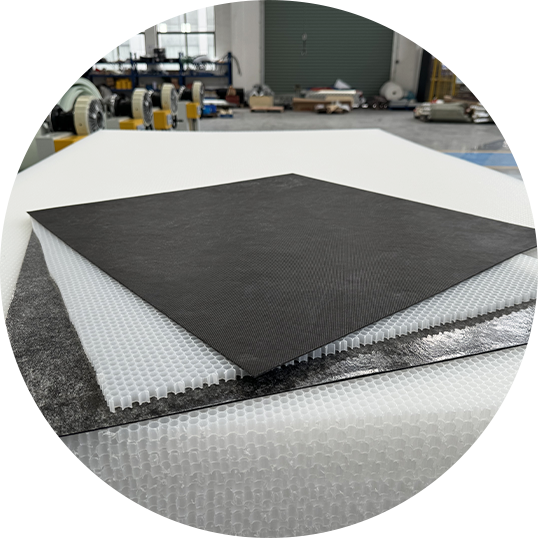
Thermoplastic composite sandwich panels consist of Continuous Fiber Reinforced Thermoplastic (CFRT) laminates as the outer layers, with a core material such as honeycomb or foam board sandwiched in between.
This construction offers an excellent combination of high strength, low weight, and superior insulation properties.
The honeycomb core not only contributes to the panel’s light weight but also enhances its structural integrity, while the thermoplastic laminates provide exceptional mechanical properties, such as resistance to impact and fatigue.

These panels offer a wide range of advantages, including:
High strength-to-weight ratio: Ideal for industries where weight reduction is crucial without compromising on performance.
Excellent sound insulation: Beneficial in applications like automotive and construction, where noise reduction is essential.
Superior thermal insulation: Perfect for energy-efficient buildings, refrigerated containers, and more.
These properties make thermoplastic composite sandwich panels an excellent choice for demanding applications in industries such as transportation, construction, aerospace, and sports.
The Manufacturing Process of Thermoplastic Sandwich Panels
The production of thermoplastic composite sandwich panels involves a series of steps that require precision and advanced machinery. Here’s a breakdown of the key stages in the manufacturing process:
Production of UD (Unidirectional) Thermoplastic Tapes
The first step in creating these panels is the production of uni-directional (UD) thermoplastic prepreg tapes, which are semi-finished materials made from continuous fibers embedded in a thermoplastic matrix.
These tapes are produced using a hot-melt UD prepreg machine.
At Jota Machinery, we employ a common extrusion impregnation method to manufacture these UD tapes, ensuring high-quality results.
Our prepreg machine system includes the following components:
- Roving unwinder stand
- Fiber spreading system
- Twin/single extruder
- Waste trimmer
- Dual working-station rewinder
Material Development for Application-Specific UD Tapes
We offer a range of matrix and fiber materials tailored for specific applications, ensuring optimal performance properties:
- Matrix Materials: PE, PP, PA, PET, PC, HDPE, PA6
- Fiber Materials: Glass fiber (GF), Carbon fiber (CF), Basalt fiber, Polymer fibers, Bio-based fibers, and others
Cutting the UD Tapes into Sheets(sheeter machine)
Once the UD tapes are produced, they are converted into sheets of the desired size.
The UD tape roll-to-sheet cutting machine plays a crucial role here, converting large rolls into fixed-length sheets.
These sheets are then ready for the next step in the process: laminating production.
Production of CFRT Laminates
CFRT laminates are created by stacking multiple layers of UD tapes, often arranged at specific angles (0° and 90°) to optimize the strength and durability of the final product.

The sheeter machine ensures that the UD tapes are arranged in the correct orientations to achieve the desired cross-ply structure. This configuration is essential for balancing the mechanical properties of the laminate.
Double-Belt Pressing for Laminate Bonding
After the UD tape sheets are prepared, the next step is bonding them to the honeycomb or foam core.
This is done using a double-belt press machine that applies heat and pressure to fuse the layers together.

The press uses an oil-electric hybrid heating system, which ensures that the layers are bonded without the need for harmful adhesives.
The heating and cooling zones in the press—each 4 meters long—regulate temperature throughout the process, ensuring optimal bonding and consistency.
Environmental Sustainability in Panel Production
One of the key benefits of thermoplastic composite sandwich panels is their alignment with environmental sustainability.
Unlike traditional adhesive bonding methods, the double-belt press machine utilizes the physical properties of the thermoplastic prepreg UD tape for bonding, eliminating the need for harmful chemical adhesives. This oil-electric hybrid heating process is both efficient and eco-friendly, reducing waste and harmful emissions typically associated with conventional manufacturing methods.
By eliminating adhesives and reducing energy consumption, the production of thermoplastic composite sandwich panels significantly lowers the environmental impact compared to alternative materials.
Why Choose Thermoplastic Sandwich Panels?
Thermoplastic sandwich panels offer several distinct advantages:
Lightweight: The combination of thermoplastic laminates and honeycomb cores provides a low-density solution that doesn’t sacrifice strength or durability.
High Mechanical Performance: With continuous fiber reinforcement, these panels offer excellent impact resistance, making them ideal for demanding applications in transportation and construction.
Superior Insulation: Both sound and thermal insulation properties make these panels a top choice for energy-efficient and noise-reduced environments.
Environmental Benefits: The use of eco-friendly manufacturing processes without adhesives ensures a more sustainable solution compared to traditional composites.
Applications of Thermoplastic Sandwich Panels
Due to their unique combination of properties, these panels find applications across a wide range of industries:
Refrigerated Containers: The excellent thermal insulation properties make these panels ideal for use in temperature-sensitive transportation and storage.

Automotive Components: Lightweight yet strong, thermoplastic composite sandwich panels are used in vehicles to reduce weight and improve fuel efficiency while maintaining structural integrity.
Sports Equipment: From lightweight kayaks to advanced bicycles, the strength-to-weight ratio of these panels makes them perfect for high-performance sports equipment.
Interior Decoration: Their aesthetic appeal and insulation properties make them a popular choice for interior applications in both residential and commercial settings.
Jota Machinery: Your One-Stop Solution for Composite Sandwich Panel Production
At Jota Machinery, we specialize in providing a comprehensive, one-stop service for the production of thermoplastic composite sandwich panels. From the manufacturing of high-quality UD tapes to the supply of raw materials and finished products, we offer end-to-end solutions tailored to your needs.
Our equipment ensures the highest standards of precision and performance, and we are committed to delivering sustainable, high-performance solutions that meet the growing demands of modern industries.
If you are looking for advanced composite materials for your next project, contact us today to learn more about how our solutions can help you achieve your goals.
