
Hot-Melt UD Impregnation Machine Line
- Thermoplastic,thermoset, towpreg
- Continuous fiber reinforced composites
- Fiber from carbon fiber to fiberglass solution
- One-stop service including slitting,double belt


The history about Jota Machinery


Prepreg Application


Machining Material
- Visible high-quality components.
- Famous brands such as Siemens, Yaskawa, Delta, Schneider, Mitsubishi.
- Self-supporting CNC processed sheet metal, precision parts.
- Assembly raw materials provided by long-term cooperation suppliers.


Installation and operation user manual, wire connection diagram, tension controller guide.
Installation and operation video tutorial.
One-on-one remote video call assistance.
On-site installation and operation guidance.
- Our Team
- Thermoplastic Carbon Fiber UD Tape Prepreg Machine
- Thermoset Prepreg Machine

Around 30-45 days, mainly depends on machine type.
Sure, it is our honor to work for you.
We will offer you some parts as backup, in case any part is broken within one year, we will sent you for free.
Sure, if we have client in your country, we will offer.
Prepreg Manufacturing Process: Advanced Composite Solutions for Multiple Industries
With the rapid advancement in materials technology, prepreg composites are increasingly replacing traditional steel components across a variety of industries, such as aerospace, automotive, defense, and more.
Prepregs, short for pre-impregnated fibers, are composite materials made from woven fabric or dry fibers that are impregnated with resin.

Depending on the type of resin used, prepregs can be classified into two primary categories: thermoplastic prepregs and thermoset prepregs. Thermoset prepregs can further be subdivided into two forms: Uni-Directional (UD) prepregs and fabric prepregs.
In this article, we will provide an in-depth look at the prepreg manufacturing process, with a particular focus on the hot-melt impregnation process used for thermoplastic composites and the two-step process for thermoset prepregs.
Thermoplastic Prepreg Manufacturing Process: Hot-Melt Impregnation
Thermoplastic prepregs are primarily manufactured using techniques such as dry or wet powder impregnation, and the widely employed hot-melt manufacturing method.

Jota Machinery specializes in the hot-melt extrusion impregnation process for producing high-performance thermoplastic prepregs, particularly for carbon fiber and fiberglass composites.
Hot-Melt Thermoplastic Uni-Directional Impregnation Method
High-temperature resistant thermoplastic resins offer excellent chemical resistance and solvent resistance, making them highly desirable for demanding applications.
These resins are generally insoluble in most solvents at temperatures below 200°C, which makes traditional solution impregnation methods unsuitable.
The most commonly used technique for producing thermoplastic prepregs is the hot-melt impregnation method. This process leverages the melt-remelting properties of thermoplastic resins to impregnate the reinforcing fibers.
The process involves guiding continuous fibers from the creel (a spool or package of fibers) into a fiber-spreading system, which uses a multi-stage traction process to control the tension of the fibers and ensure even distribution. The fibers are preheated and then introduced into a melt impregnation die system, where the thermoplastic resin is heated to its melting point and the resin fully impregnates the fibers.
The resulting prepreg is then cooled and wound onto paper tubes for further processing.
The hot-melt impregnation method offers several significant advantages:
- Simple equipment design with minimal environmental impact.
- Short production times and continuous processing capabilities.
- Reduced waste generation and high process efficiency.
However, the process does present challenges, particularly in achieving uniform fiber dispersion and effective impregnation at lower temperatures.
For optimal results, the resin must have a lower melting temperature and higher surface tension to ensure thorough impregnation of the fibers. Additionally, resin viscosity at high temperatures must be carefully managed to prevent polymer degradation during the impregnation process.
Thermoset Prepreg Manufacturing Process
Unlike thermoplastic prepregs, thermoset prepregs remain in a pliable, soft state at ambient temperatures.
Upon exposure to elevated temperatures, the resin undergoes a curing process, transitioning into a rigid, solid structure.
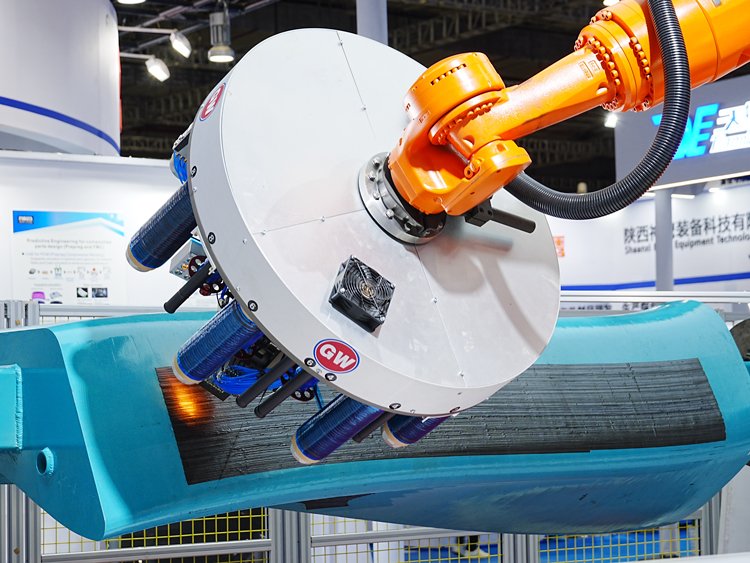
This characteristic makes thermoset prepregs ideal for high-performance applications, particularly when used with advanced manufacturing techniques like Automated Fiber Placement (AFP), which replaces traditional manual layup methods.
Click here to learn the thermoset prepreg manufacturing process.

At Jota Machinery, we utilize a two-step process for producing thermoset prepregs. The first step involves creating a resin film, which is used to encapsulate the reinforcing fibers.
The second step combines the resin film with the reinforcing materials, ensuring that the resin is optimally distributed and properly impregnates the fiber, which enhances the mechanical properties of the final composite.
Step 1: Resin Film Manufacturing
During the resin film manufacturing process, solid epoxy resin is heated and transformed into a liquid using a specialized prepreg resin coating machine. This ensures that the resin is uniformly applied to a release paper or film.
To precisely control the thickness of the resin layer, reverse coating techniques are employed. This allows for high precision in adjusting the resin thickness during application.
Reverse coating involves using a rotating drum or roller to transfer the liquid resin onto a moving substrate (such as release paper).
The “reverse” part of the term refers to the method in which the resin is applied in the opposite direction to the substrate’s movement, providing better control over the resin layer’s uniformity and thickness.

This method helps to minimize excess resin and ensures that the final prepreg material has consistent resin content and thickness, which is crucial for high-performance applications like aerospace and automotive components.
To further ensure accuracy, real-time measurement systems (such as NDC thickness gauges) continuously monitor the resin thickness, with the data displayed on an intuitive touch screen interface. This enables tight control over the resin application, ensuring the prepreg meets the strict quality standards required by industries like aerospace.
Step 2: Compounding Process
Once the resin film has been created, the compounding process begins, where the resin is combined with reinforcing fibers to produce high-quality prepregs. This step is critical to ensure uniform resin distribution and an optimal resin-to-fiber ratio. The resulting prepreg is then wound onto paper tube (diameter 300mm), ready for use in further manufacturing processes.

The compounding machine used in this process is equipped with several key components to ensure efficient and precise manufacturing:
- Unwinding Creel: Feeds the dry carbon fiber roving into the machine.
- Main Compounding Unit: Impregnates the fibers with the resin, ensuring uniform coverage and fiber saturation.
- Dual Station Rewinder: Allows continuous rewinding of the impregnated prepreg material, streamlining the production process.
The machine is designed to handle both Uni-Directional (UD) prepregs and fabric prepregs.
For UD prepregs, a spreading comb is used to spread the continuous fiber bundles evenly, optimizing the impregnation process.
For fabric prepregs, the spreading comb will be removed and the woven fabirc enter the various quantity vibration rollers.
This flexible system allows manufacturers to easily switch between different prepreg types, improving manufacturing efficiency and reducing downtime.
The impregnation process itself involves heating rollers, which apply controlled heat to the resin film, allowing the resin to melt and infiltrate the fiber. Real-time thickness measurement systems continuously monitor the prepreg thickness, ensuring high consistency and quality throughout the production process.
Specialized Prepreg Formats for Advanced Applications
Prepregs, whether designed for leisure-grade or aerospace-grade applications, are typically not used in their non-directional form directly in manufacturing.
To enable efficient processing in advanced applications such as Automated Fiber Placement (AFP), the prepreg is converted into standard spool sizes, typically 3.175 mm, 6.35 mm, or 12.7 mm, making it suitable for precise placement into complex structures.

For specialized applications, such as the production of golf clubs or fishing rods, prepregs are often cut into sheets at specific angles and orientations. These sheets are then wrapped around a mandrel to form the desired shape. The layers may be applied in a spiral configuration to optimize strength and durability of the final product.
Expanded Capabilities: Phenolic Prepreg Production
In 2024, Jota Machinery introduced a single-step epoxy carbon fiber towpreg line, complementing our existing two-step prepreg manufacturing methods and towpreg production capabilities.
We also now offer a solvent-based method for producing phenolic prepregs.
The production of phenolic prepregs involves two primary solution impregnation methods: the roller method and the continuous tape method. Both methods operate on similar principles but vary in their equipment and applications.
- Roller Method: In this method, the reinforcing material is wrapped around a metal cylinder and immersed in a phenolic formaldehyde resin solution. After impregnation, the material is dried, and the prepreg is flattened and collected. The length of the prepreg is determined by the diameter of the cylinder.
- Continuous Tape Method: The reinforcing material passes continuously through the resin solution tank, where it is impregnated with phenolic resin. After impregnation, most of the solvent is removed, and the prepreg is collected on a winding drum. This method allows for unlimited prepreg length, offering greater flexibility and scalability in production.
Both methods ensure that the resin matrix is fully impregnated into the reinforcing material, creating high-quality prepregs suitable for a wide range of applications.
Jota Machinery: One-Stop Solution for Prepreg Manufacturing Process
Jota Machinery has fully entered the hot-melt impregnation industry, offering more than just slitting machines. We now provide a comprehensive one-stop solution for all your prepreg production needs, whether you’re working with thermoplastic, thermoset, towpreg,or phenolic prepregs.
For further information or to make an inquiry, please don’t hesitate to contact us. Our team is ready to provide you with tailored solutions for your prepreg manufacturing requirements.
