
Published: November 8, 2025 · By Jota Machinery | Bruce Zhou
Introduction
When labels must survive heat, solvents, sunlight, or industrial cleaning, ordinary printing methods fall short.
That’s where resin thermal transfer ribbons come in — the highest-performance option in the world of thermal printing.
Used in industries from healthcare to petrochemicals, resin ribbons deliver exceptional print durability, resisting abrasion, chemicals, UV light, and temperature extremes.
In this guide, we’ll explore what resin ribbons are, how they work, and where they deliver unmatched results.
1. Definition
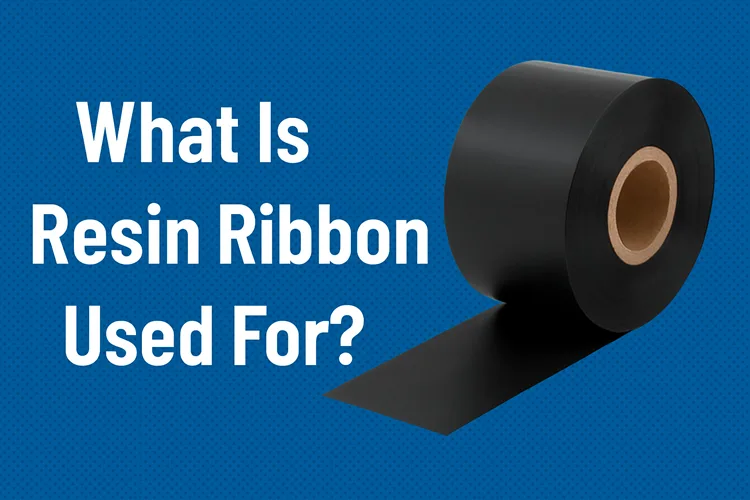
A resin ribbon is a 100 % resin-based ink film used in thermal transfer printing.
When the printer’s thermal head heats specific areas, the resin layer melts and fuses onto the label’s surface, forming a permanent bond.
Unlike direct thermal labels, which react directly to heat, thermal transfer printing uses this ribbon as an ink carrier—allowing printing on plastics, synthetics, and even textiles.
This process yields images that remain legible after long exposure to friction, chemicals, or harsh weather — something no paper-based printing can match.
2. Composition and Structure
A resin ribbon has multiple precision-engineered layers:
| Layer | Function |
|---|---|
| Backcoat | Protects the printer head from abrasion and static. |
| PET Film Base | A thin (≈ 4.5 µm) polyester film that supports the ink layer. |
| Resin Ink Layer | The active surface that melts and bonds to the label. |
| Optional Topcoat | Adds extra resistance to solvents or heat. |
Unlike wax-based ribbons, which soften easily, resin ink requires higher heat and longer dwell time to transfer properly — ensuring deep adhesion and permanence.
3. How Resin Ribbons Work
Thermal transfer printers use a simple yet precise mechanism:
- The ribbon and label feed together under a heated printhead.
- The printhead’s micro-heaters activate resin particles in selected areas.
- The melted resin penetrates the label surface (especially synthetics).
- The ribbon peels away, leaving the printed image permanently bonded.
This fusion process is what gives resin prints their extraordinary resistance — the ink effectively becomes part of the substrate.
4. Materials Compatible with Resin Ribbons
Resin ribbons are engineered for synthetic facestocks, not porous paper.
Common compatible materials include:
| Material | Property | Typical Use |
|---|---|---|
| Polyester (PET) | High heat and solvent resistance | Chemical drums, electronics |
| Polypropylene (PP) | Flexible, moisture-resistant | Food packaging, logistics |
| Polyethylene (PE) | Conformable for curved surfaces | Bottles, tubes |
| Vinyl / PVC | UV-resistant, tear-proof | Outdoor asset tags |
| Nylon & Textile | Washable | Apparel care labels |
| Teslin® / Tyvek® | Synthetic paper for ID cards | Security labeling |
Paper stocks cannot withstand the high heat or bond strength of resin ribbons and will often scorch or fail to hold ink.
5. Performance Characteristics
Resin ribbons stand apart for their extreme resilience:
- Chemical resistance: Survive exposure to alcohol, oils, acids, or cleaning agents.
- Abrasion resistance: Prints remain readable even after rubbing or scuffing.
- UV and weather protection: Ideal for outdoor labeling under sunlight.
- Temperature stability: Reliable from –60 °C to 200 °C (–76 °F – 392 °F).
- Moisture protection: Ink will not bleed or smudge in humid or wet conditions.
The result: barcode readability and compliance even in the harshest supply-chain environments.
6. Advantages of Resin Ribbons
| Advantage | Description |
|---|---|
| Unmatched Durability | Resists fading, solvents, and wear for years. |
| High Print Clarity | Delivers dense black text and precise barcodes up to 600 dpi. |
| Long-Term Cost Efficiency | Fewer reprints and maintenance interruptions. |
| Environmental Stability | Withstands extreme climates from freezers to furnaces. |
| Regulatory Compliance | Meets GHS, BS5609, and UL labeling standards. |
For safety labeling or regulatory documentation, resin ribbons are often the only acceptable choice.
7. Limitations
Resin ribbons come with a few trade-offs:
- Higher cost compared with wax or wax-resin types.
- Higher printhead temperature requirements, needing compatible printers.
- Slower print speeds for best adhesion (typically 2–10 IPS).
- Limited to synthetic substrates—unsuitable for uncoated paper.
Despite these factors, industries prioritize performance over cost in critical labeling environments.
8. Applications Across Industries
1. Chemical and Industrial Manufacturing
- GHS/BS5609 drum labels
Withstand solvent splashes, UV exposure, and marine transport. - Component identification on machinery or steel equipment.
2. Healthcare and Laboratories
- Sterilization-resistant specimen labels surviving autoclaves or disinfectants.
- Medical device tracking through cleaning cycles and chemical wipes.
3. Electronics and Automotive
- Under-hood labels enduring oil, fuel, and heat.
- Printed circuit board (PCB) tracking, requiring anti-static and solvent-proof performance.
4. Outdoor and Asset Management
- Pipe marking and pole labeling with UV-stable inks.
- Outdoor asset tracking for power utilities, telecom towers, or construction equipment.
5. Packaging and Logistics
- Flexible packaging films (PET, OPP) for high-speed lines.
- Durable warehouse and cold-chain labeling where condensation occurs.
9. Comparison with Other Ribbon Types
| Feature | Full Resin Ribbon | Wax–Resin Ribbon | Wax Ribbon |
|---|---|---|---|
| Composition | 100 % resin ink | Wax + resin blend | 100 % wax ink |
| Durability | Extreme | Moderate | Low |
| Resistance | Heat, UV, solvents, abrasion | Mild chemicals, smudge | Minimal |
| Suitable Material | Synthetics only | Coated paper & synthetics | Paper |
| Printing Speed | Medium (2–10 IPS) | High | Very high |
| Cost | Highest | Moderate | Lowest |
| Applications | Chemical drums, medical, outdoor | Logistics, retail | Shipping, receipts |
The resin ribbon’s high price tag reflects its specialization — built for endurance, not economy.
10. Common Resin Ribbon Variants
Leading manufacturers offer tailored resin ribbons, such as:
| Brand / Model | Notable Feature |
|---|---|
| DNP R510HF | Halogen-free, ultra-durable for chemical labeling |
| DNP R396 | High-speed printing on synthetic films |
| Armor AXR® 9 | Extreme resistance for outdoor and automotive use |
| Ricoh B110A | Universal resin for PET and PP labels |
| Zebra 5095 / 5100 | Broad printer compatibility and sharp imaging |
Each variant fine-tunes melt point, adhesion level, or environmental tolerance.
11. Environmental and Quality Considerations
Modern resin ribbons evolve toward eco-responsible formulations:
- Halogen-free or BPA/BPS-free coatings.
- Solvent-reduced manufacturing.
- Recyclable PET carriers to reduce waste.
Storage conditions are equally vital: keep rolls between 5 °C–35 °C (41 °F–95 °F) in dry air (< 65 % RH) to maintain print consistency.
12. Printing Recommendations
For best results:
- Set printhead temperature between 90 °C–130 °C (depending on printer).
- Use a flat, clean synthetic surface with uniform tension.
- Match ribbon width to label width for even heat distribution.
- Calibrate print speed and pressure before full production.
Regular cleaning of the printhead prolongs life and prevents static buildup — critical when running resin ribbons.
13. Cost and Long-Term Value
Although resin ribbons cost more per roll, they often reduce total expenses:
- Fewer reprints.
- Longer-lasting barcodes.
- Reduced printer maintenance due to lower abrasion.
For industries where a label failure can mean regulatory fines or safety risks, the investment pays for itself many times over.
14. Summary
So, what is resin ribbon used for?
It’s used wherever print permanence, chemical resistance, and compliance cannot be compromised.
From chemical containers and electronic components to laboratory vials and outdoor signage, resin ribbons ensure that vital information remains visible and scannable through heat, time, and exposure.
In short:
Resin ribbons are the armor of thermal printing — built for endurance, not convenience.
Call to Action
If your business produces or converts synthetic label rolls,
Jota Machinery offers advanced thermal label slitting and rewinding machines designed for resin, wax–resin, and wax ribbons.
Our solutions guarantee consistent tension, precision cutting, and production-ready performance for industrial labeling needs.
📧 Email: jotamachinery@gmail.com
🌐 Website: www.jotamachinery.com
Ready to Upgrade Your Label Line?

About Jota Machinery
Jota Machinery designs label stock converting equipment for paper, film, and linerless materials.
Our machines deliver stable operation, precise tension control, and consistent slitting results that fit seamlessly into your production line.
About our business
We focus on efficient, easy-to-run solutions that help factories reduce waste and improve workflow.
Every detail is engineered to bring reliability and clarity to modern label production.


About Me – Bruce Zhou
I’m Bruce Zhou, founder of Jota Machinery. With over twenty years in roll-to-roll converting, my focus has always been helping factories achieve stable production with reliable, easy-to-operate machines.
Each solution we deliver reflects the same belief — precision, durability, and long-term partnership matter most.
Last Updated on 08/11/2025 by Jota Machinery