
A thermal paper project can look surprisingly simple from the outside.
Install a coating line.
Produce thermal jumbo rolls.
Slit them into smaller widths.
Convert them into POS rolls, cash-register rolls and receipt paper.
But APP China’s move into large-scale thermal paper production at Gold East Paper shows how much industrial restructuring can sit behind those apparently straightforward steps.
The story involves three different pieces of the same manufacturing system.
Gold Huasheng Paper in Suzhou had decades of experience in coated and specialty papers, including thermal paper.
Gold East Paper in Zhenjiang was historically built around very large-scale coated printing paper production.
And Jota Machinery entered the project on the downstream converting side, supplying fully automatic thermal paper slitter rewinders as APP expanded its thermal paper operation.
Seen separately, these look like equipment purchases.
Seen together, they show something more interesting:
APP was not simply building another thermal paper line. It was relocating existing capability, adding new coating capacity and rebuilding the downstream converting chain around a different production base.
That distinction matters for anyone studying how large paper groups move into specialty paper.
The Background Starts in Suzhou, Not Zhenjiang
Gold Huasheng Paper, formally Jinhuasheng Paper (Suzhou Industrial Park) Co., Ltd., was established in 1996. Gold East Paper followed in Zhenjiang in 1997. APP’s own corporate history places both companies inside its China manufacturing network.
They were not simply two paper mills carrying the same group logo.
The corporate connection goes considerably deeper.
Public disclosures show Gold East directly holding 75% of Gold Huasheng, with Gold China—金光纸业(中国)投资有限公司—holding the remaining 25%. Gold China in turn holds 97.42% of Gold East. Gold East’s own 2023 financial disclosure likewise identifies Gold China as its 97.42% shareholder and APP China Group Limited as its ultimate controlling shareholder.
That ownership structure changes how the later equipment movement should be interpreted.
When machinery moved from Gold Huasheng in Suzhou to Gold East in Zhenjiang, this was not simply one independent paper mill selling used equipment to another.
It was, based on the disclosed ownership structure, principally an intra-group redeployment of manufacturing assets.
That is a much more useful way to understand what happened.
Why Gold Huasheng’s Closure Matters to the Thermal Paper Story
Gold Huasheng had long produced specialty and coated paper grades including carbonless copy paper, thermal paper, offset paper and coated grades.
Its Suzhou production base eventually became part of the industrial restructuring taking place in Suzhou Industrial Park.
Official Suzhou documentation records Gold Huasheng among the enterprises scheduled for shutdown and later states that the industrial park had completed the closure. Gold China’s 2022 financial statements also say Gold Huasheng and Gold Hongye had completed their relocation and transferred the relevant assets to the government by the end of 2022.
Industry reporting placed Gold Huasheng’s final production shutdown in April 2022.
For APP, however, closing the Suzhou site did not necessarily mean abandoning the manufacturing knowledge or all of the useful production assets built there.
Some of that capability moved.
And thermal paper is one of the clearest examples.
The 100,000-Ton Gold East Thermal Paper Project
The project can be traced back publicly to 2021.
Environmental-approval reporting described Gold East as planning an investment of RMB 978.89 million at its existing Zhenjiang site to create 100,000 tonnes per year of specialty paper, identified as thermal paper, while reducing part of its existing coated-paper capacity.
The reported configuration was particularly revealing.
One new coating line was described as approximately 2,600 mm wide with 60,000 tonnes of annual capacity.
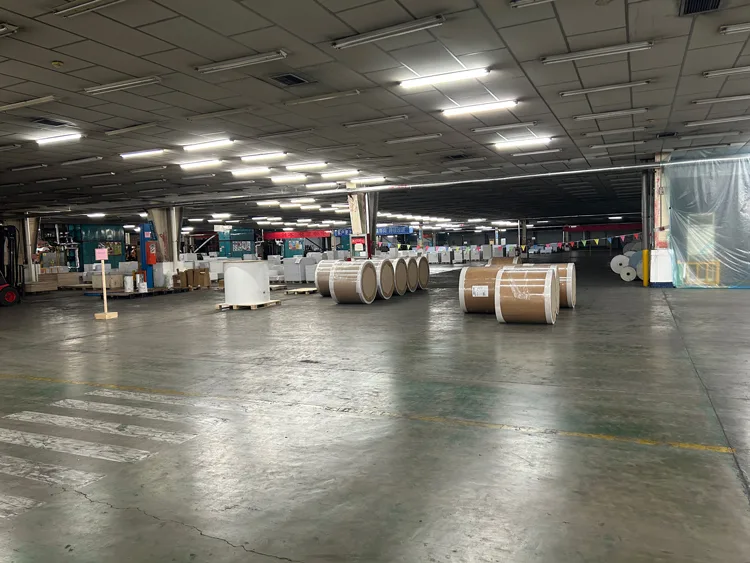
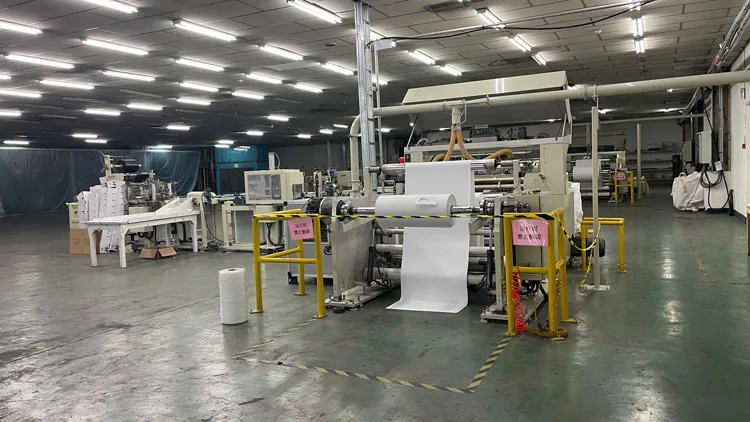
A second 2,200 mm coating line with 40,000 tonnes of capacity was described as second-hand equipment dismantled and moved from Gold Huasheng in Suzhou.
The underlying investigation you provided reaches the same conclusion while correctly treating the evidence level with some caution: the equipment-transfer relationship is well supported by multiple reports derived from the environmental filing, but the original asset-transfer contract has not been made public.
That makes the 100,000-tonne project an interesting combination of new investment and asset reuse.
APP did not take only one route.
It redeployed useful specialty-paper equipment from the closing Suzhou operation while investing in additional manufacturing capability at Zhenjiang.
Gold East’s Current Equipment List Tells the Next Part of the Story
Gold East’s own production-equipment page now lists its thermal paper coating production line as a Voith-supplied line commissioned in 2022 with annual capacity of 100,000 tonnes. The same page lists Voith paper machines commissioned in 1999 and 2005, Valmet coating equipment, BW Papersystems A4 converting equipment and other specialty-paper assets.
Its corporate timeline adds another useful date: in August 2022, the Gold East 100,000-tonne thermal paper project TML1 successfully produced its first roll. Gold East now says the thermal paper project has been successfully commissioned.
There is an important technical point here.
The 2021 project information describes the thermal paper investment as a combination of a new 2,600 mm coating line and a relocated 2,200 mm line.
Gold East’s present equipment page groups the operation as a 100,000-tonne Voith thermal paper coating production line.
Without the original machine contracts and complete project equipment schedule, it would be careless to conclude that every machine in both lines came from Voith, or that the relocated Gold Huasheng equipment was itself manufactured by Voith.
What can be established is the production architecture:
Gold East gained 100,000 tonnes of thermal paper coating capacity, part of the project used equipment relocated from Gold Huasheng, and the project entered production in 2022.
That is already enough to understand the industrial transition.
Where Jota Machinery Actually Fits Into the Project
This is where the terminology becomes important.
A thermal paper coating line and a thermal paper slitter rewinder perform completely different jobs.
The coating line creates thermal-sensitive paper at jumbo-roll scale.
The slitting and rewinding equipment converts wide parent rolls or usable narrower webs into smaller rolls and intermediate formats.
For POS paper, receipt rolls and cash-register paper, downstream converting can involve slitting, rewinding, core loading, tail cutting, gluing, roll separation and packing.
Jota Machinery’s role was in this downstream converting stage, not as the supplier of Gold East’s 100,000-tonne coating machine.
That distinction should be stated clearly.
According to Jota Machinery’s project records, APP evaluated Jota’s fully automatic thermal paper slitter rewinder solution as the group was developing its domestic thermal paper converting capability. Jota’s published project history says the evaluation process began in 2021; Jota’s internal commercial record places the supplier relationship and project execution in 2022, when Gold East’s thermal paper project was moving into production.
Jota ultimately supplied three fully automatic thermal paper slitting and rewinding machines.
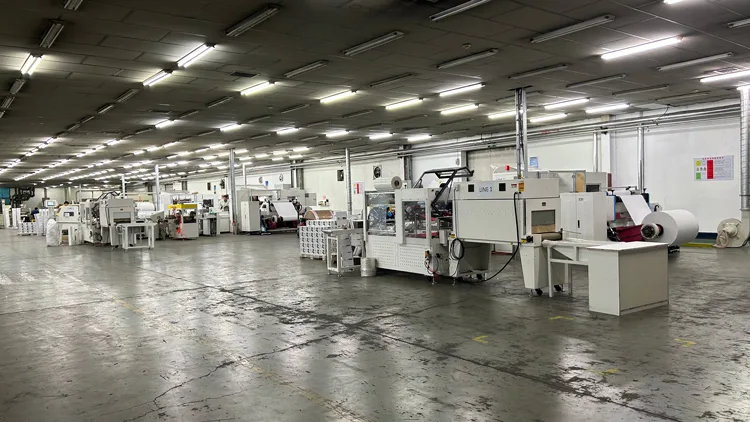
Jota’s internal project documentation also records that the commercial quotation passed review at APP’s Asia regional level before the order proceeded.
That procurement detail is first-hand Jota project information rather than a public APP procurement disclosure, and it should be identified as such.
This is precisely the kind of distinction that gives an industrial case study credibility.
The Three Slitter Rewinders Were Not a Plug-and-Play Project
Large paper groups assess converting equipment differently from a small roll converter purchasing its first machine.
The issue is not whether a machine can slit a jumbo roll once during factory acceptance testing.
The issue is whether it can repeat the same result across long shifts, multiple operators, changing parent-roll conditions and industrial production volumes.
Jota’s project account records APP’s engineering team setting demanding roll-quality requirements, including less than 2 mm total roll deviation. The equipment went through roughly three months of debugging, adjustment and optimization involving web tension, slitting stability and deviation control.
Eventually, three machines were installed for continuous production.
That development period is arguably more important than saying that three machines were sold.
Anyone who has worked around thermal paper converting knows that winding quality is rarely determined by one component.
Parent-roll tension changes as diameter falls.
Thin thermal paper responds quickly to unstable web tension.
Small errors in knife position become visible across thousands of finished rolls.
Rewinding pressure affects roll hardness.
Core positioning affects finished-roll geometry.
Acceleration and deceleration affect the first and last layers differently.
And once automatic core handling, tail cutting, gluing and roll discharge are added, the slitter is no longer an isolated machine. It becomes a production system.
The APP project forced Jota to deal with those problems at industrial scale.
That experience later became part of the engineering basis for Jota’s fully automatic thermal paper slitter rewinder platform.
The More Interesting Story Is APP’s Equipment Strategy
It would be easy to frame this project as a story about replacing imported machinery with Chinese equipment.
The evidence suggests something more sophisticated.
Look at Gold East’s current factory.
Its major paper machines include Voith equipment.
Its coating operation includes Valmet and Voith technology.
Its A4 finishing line uses BW Papersystems.
Its thermal paper project incorporated equipment transferred from Gold Huasheng.
And its downstream thermal roll converting operation added Jota equipment.
That is not an all-import strategy.
It is not an all-domestic strategy either.
It is a process-by-process supplier strategy.
A paper group can select equipment according to what matters at each manufacturing stage.
High-speed papermaking and coating may justify one supplier structure.
Slitting, rewinding and downstream roll automation may require something different: faster engineering response, easier customization, local service and the ability to modify machinery around specific roll formats.
For machinery manufacturers, that is an important lesson.
A domestic supplier does not necessarily enter a large multinational paper group by trying to replace every European machine in the plant.
It can enter by solving one narrowly defined production problem better.
Then the operating record becomes the qualification.
Gold Huasheng’s Closure Also Changed the Logic of the Supply Chain
There is another reason the timing is important.
The Gold Huasheng shutdown, the Gold East thermal paper project and Jota’s entry into APP’s thermal converting operation all converged around the same period.
That suggests the project should not be viewed as a standalone machine purchase.
It was part of a wider reorganization of where APP’s specialty-paper capability would sit in China.
Gold Huasheng had accumulated years of experience making thermal and specialty papers in Suzhou.
When that production base closed, APP could preserve selected assets and manufacturing knowledge by moving them elsewhere inside the group.
Gold East offered the scale, infrastructure and existing paper-making base to absorb that activity.
New coating investment increased the capability.
Downstream converting equipment then had to follow the new production geography.
That is why the movement from Suzhou to Zhenjiang matters.
The factory closed. The capability did not simply disappear. Parts of it were transferred, rebuilt and integrated into another APP manufacturing platform.
One Point Should Not Be Confused With Gold East’s Newer PM6 Project
Gold East is continuing to invest in specialty paper.
But its later 280,000-tonne specialty-paper technical transformation project, including the PM6 thermal base-paper machine that started up in 2026, is a separate investment from the earlier 100,000-tonne thermal paper coating project. The project dates, capacities and construction scope are different.
That distinction matters because the two projects can easily be merged in online reporting.
The 100,000-tonne project established thermal paper coating capability and entered production in 2022.
The later PM6 investment expands Gold East’s specialty base-paper manufacturing capability.
There may eventually be significant vertical integration between those assets, but there is not enough public documentation to claim a dedicated one-to-one PM6 supply relationship with the earlier coating lines.
For industrial research, keeping those project boundaries clean is important.
What This Project Means for Thermal Paper Converters
For a thermal paper converter evaluating a thermal paper slitter rewinder, receipt paper roll machine, POS roll slitting machine or cash-register roll converting line, the useful part of the APP case is not the size of the customer.
It is what happened after installation.
The machine had to be adjusted against real jumbo material.
Roll geometry had to remain stable.
Tension control had to perform through actual production cycles.
Automation had to work with factory operators rather than only with the supplier’s commissioning engineers.
And the supplier had to respond when a multinational paper manufacturer’s engineering team rejected a result.
That is where equipment development actually happens.
Jota’s three-machine project at APP was therefore more than a reference installation.
It became a production-scale test of the company’s thermal paper converting architecture.
For Jota, the value of the project was not simply being placed on an APP supplier list.
It was learning what happens when a fully automatic thermal paper slitter rewinder is expected to perform inside a large industrial paper operation rather than a demonstration workshop.
That experience continues to influence how we approach thermal paper roll production lines today.
Before discussing machine speed, we look at the parent roll.
Before discussing automation, we look at the finished roll specification.
Before discussing output, we look at how operators, cores, packing and material flow interact.
Because the APP project reinforced a lesson that applies to almost every converting plant:
a faster slitter does not automatically create a more productive thermal roll factory. The entire converting process has to work together.
Source and evidence note
The public part of this case is supported by APP and Gold East corporate information, Gold East’s equipment and project records, securities disclosures, Suzhou government material and environmental-project reporting. Jota-specific commercial details—including regional quotation approval and parts of the commissioning history—come from Jota Machinery’s own project records and should be presented as first-party operational experience rather than independent APP disclosures.
One detail I would not publish as an established external fact yet is that Gold Huasheng transferred a specific slitter rewinder to Gold East. Publicly available project material clearly identifies a 2,200 mm coating production line as being dismantled at Gold Huasheng and moved to Gold East. If you have the equipment-transfer document, machine nameplate, relocation photos or APP handover record showing a separate slitting/rewinding machine, then that claim can be strengthened in the next version.
Last Updated on 17/09/2026 by Jota Machinery