

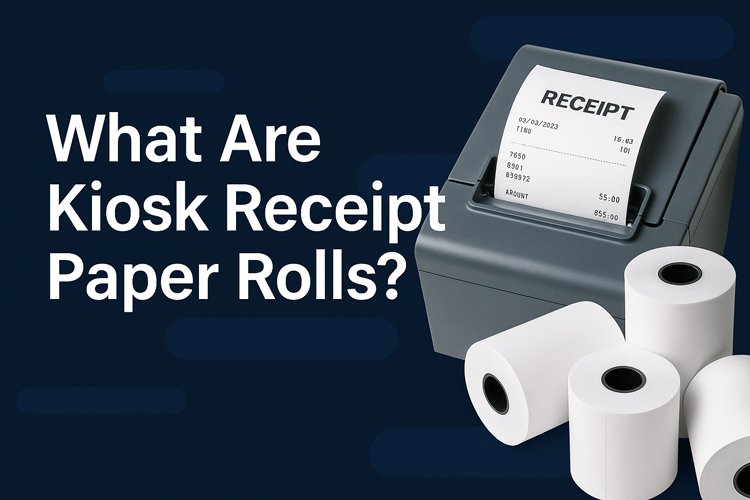
Keyphrase: What Are Kiosk Receipt Paper Rolls
In today’s digital-first environment, self-service kiosks are everywhere—from grocery store checkouts to airport terminals and hotel lobbies. But behind every printed receipt or ticket is a silent workhorse: the kiosk receipt paper roll.
These rolls may seem like simple consumables, but they are carefully engineered products with real impact on customer experience, operational efficiency, and even brand perception. This article explores what kiosk receipt paper rolls are, how they work, and why they matter—especially in the evolving 2025 retail and automation landscape.
1. What Exactly Is a Kiosk Receipt Paper Roll?
A kiosk receipt paper roll is a specialized roll of thermal paper used in self-service machines.

Unlike traditional paper that requires ink, thermal paper is coated with heat-sensitive chemicals that darken when passed under a thermal printer head—printing without ink or toner.
Key Properties:
- Made for thermal printers used in kiosks
- Commonly 80mm wide, with various core sizes (e.g., 25mm)
- Available in plain or pre-printed formats (with logos or T&Cs)
- Compatible with popular kiosk printers from Epson, Citizen, Zebra, Custom, etc.
2. Where Are They Used? Industry Applications
Kiosk receipt rolls are ubiquitous across sectors:
✅ Retail & Hospitality
- Self-checkouts in supermarkets or quick-service restaurants
- Self-order kiosks in cafes or fast food chains
- Branded receipts improve customer recall and reduce queue time
✅ Banking & Financial
- ATM receipts showing balance, withdrawals, or timestamps
- Compatible with machines from NCR, Diebold, Triton, and Hyosung
✅ Transportation & Travel
- Ticketing kiosks at train stations or airports
- Boarding passes or luggage tags in automated counters
✅ Parking & Access Control
- Entry/exit tickets from parking lots
- Integrated with license plate recognition systems
✅ Healthcare, Casinos, and Hotels
- Guest check-ins, patient self-registration, or gaming payout receipts
The versatility and reliability of these paper rolls make them essential for uninterrupted kiosk operation.
3. What Makes a Good Kiosk Receipt Paper Roll?
The performance of a kiosk paper roll isn’t just about paper. It’s about durability, precision, and printer compatibility. Below are essential features that buyers and kiosk operators should consider:
| Feature | Why It Matters |
|---|---|
| Thermal Coating Quality | Ensures crisp, fade-resistant text/images |
| BPA-Free Paper | Avoids health risks, meets EU & US regulations |
| Brand Customization | Back-side printing allows logo, terms, coupons |
| Security Inks | Prevents ticket fraud with UV or rub-reactive ink |
| High-Speed Compatibility | Designed for printers with rapid throughput |
| Paper Roll Length | Longer rolls reduce downtime and operator effort |
🧪 Example: Graphic Tickets & Systems offers 900-foot rolls with multiple color options, UV ink printing, and logo customization for Zebra-compatible kiosks.
4. Size Matters: Dimensions and Printer Compatibility
When choosing rolls, it’s critical to match:
- Width (e.g., 80mm or 58mm)
- Outer diameter (depends on printer)
- Core size (e.g., 25mm for VKP80III printer)
📌 Tip: Always verify your kiosk printer model against manufacturer recommendations before ordering. Brands like Citizen, Bixolon, Epson, Fujitsu, and Custom each have their own fitting requirements.
5. Branding, Marketing & Security Built Into a Roll
Far beyond functional printing, kiosk receipt paper has evolved into a brand touchpoint and a security feature.
📈 Branding Opportunity:
- Add promotions or QR codes on the back
- Include loyalty program info
- Print refund or return policies directly on the roll
🔐 Anti-Fraud Features:
- UV ink visible only under black light
- Thermochromic ink that reacts to heat or touch
- Coin-reactive ink that reveals hidden text
🛡️ These features are vital for gaming kiosks, ticketing, and finance-related applications where fraud risk is higher.
6. Where to Source Kiosk Receipt Rolls
Leading manufacturers and distributors include:
| Supplier | Specialties |
|---|---|
| POS Supply Solutions | BPA-free, custom pre-printing, fast delivery |
| Graphic Tickets & Systems | Full-color branded rolls, UV security ink |
| PaperRolls-N-More | ATM and parking-specific kiosk rolls |
| Panda Paper Roll | High-speed compatibility, small core options |
| The Barcode Warehouse (UK) | EU-compliant, bulk procurement available |
Each supplier offers different benefits based on your industry and printer fleet.
7. Thermal Paper vs. Bond Paper in Kiosks
Here’s why thermal paper is standard for kiosks:
| Factor | Thermal Paper | Bond Paper |
|---|---|---|
| Requires ink | ❌ No | ✅ Yes |
| Print method | Heat | Impact (ribbon) |
| Print speed | ⚡ Fast | 🐢 Slower |
| Fade resistance | Medium | High (with proper ink) |
| Eco-friendly (BPA-free) | ✅ Yes | ❌ Usually not considered |
| Cost-efficiency | ✅ High | ❌ Lower due to ribbon use |
Thermal paper simplifies maintenance and lowers long-term costs in self-service machines.
8. Jota Machinery’s Role in Kiosk Paper Production
At Jota Machinery, we don’t just supply thermal paper converting machines — we enable high-volume, customized kiosk paper production.
Our JT-SLT-900A slitting machine is purpose-built for precision cutting of thermal kiosk rolls, featuring:
- Rotary blade slitting for ultra-smooth edges
- Banana roller for wrinkle-free web alignment
- Touchscreen HMI and precise tension control
- Inline flexo printing option for branded rolls
Whether you’re supplying rolls to a supermarket chain or outfitting airport kiosks, Jota Machinery gives you the tools to scale reliably.
🌐 Visit www.jotamachinery.com or contact 📧 jotamachinery@gmail.com to explore our kiosk roll slitting solutions.
Conclusion
Kiosk receipt paper rolls might appear simple—but they’re an intersection of material science, user experience, security design, and brand strategy. In an age where speed and automation define service excellence, choosing the right roll—BPA-free, secure, and compatible—can make or break the kiosk experience.
Whether you’re sourcing rolls or manufacturing them, understanding their value is key to building better, smarter self-service systems in 2025 and beyond.

Contact Our Team!
Thank you for visiting our website and taking an interest in the our products. We’re looking forward to connecting with you and discussing more about how we can help.

Company address
No 68, Shaojing Road, Economic Development Zone, Kunshan City, Suzhou, Jiangsu Province, China

Email Address

Contact Number
+86-13868814910
