
For a plotter paper converter, a slitter rewinder can remain perfectly serviceable for years—and then become a production bottleneck almost overnight.
That was the situation faced by one of Jota Machinery’s customers in Croatia.
The company was involved in converting Navigator-branded plotter paper for the large-format paper market. Its existing slitting and rewinding equipment had a working width of approximately 900 mm.
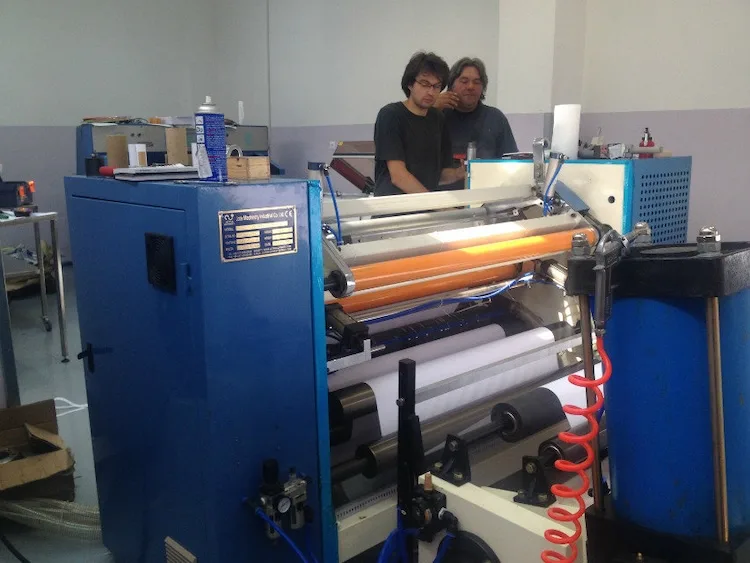
That configuration had worked for the converter’s earlier production requirements.
But the upstream material format changed.
The plotter paper jumbo rolls being supplied for conversion had increased to widths approaching 2,000 mm.
At that point, the problem was no longer simply machine speed.
It was width mismatch.
A 900 mm slitter rewinder could not directly convert a 2,000 mm parent roll. The converter therefore needed a machine architecture that matched the width of the incoming jumbo reel rather than continuing to structure production around a narrower machine installed for an earlier generation of orders.
In August 2023, Jota Machinery delivered a 2,100 mm plotter paper slitter rewinder to the Croatian customer as part of that production upgrade.
The project is a useful example of something paper converters sometimes overlook:
When the upstream jumbo-roll format changes, downstream converting capacity has to be reconsidered as a system—not simply measured in metres per minute.
The Background Starts With Navigator’s UWF Paper Business
The Navigator Company is a Portuguese integrated pulp-and-paper producer with a particularly strong position in uncoated woodfree, or UWF printing and writing paper.
Its Figueira da Foz industrial complex alone has annual capacity of around 800,000 tonnes of UWF paper and approximately 570,000 tonnes of bleached eucalyptus pulp. Navigator describes the site as the birthplace of its Navigator premium office-paper brand.
The company’s paper characteristics are closely connected with Eucalyptus globulus fibre. Navigator states that its paper production uses this eucalyptus species and highlights its suitability for printing and writing applications.
That matters when discussing plotter and CAD paper.
Large-format technical printing places considerable emphasis on properties such as:
dimensional stability, surface uniformity, whiteness, opacity and reliable feeding through inkjet or reprographic equipment.
Navigator-branded plotter paper can be found in the European distribution market in these applications. Current distributor listings, for example, show 80 g/m² Navigator plotter rolls in 610 mm and 914 mm widths, while other listings include 1,067 mm CAD/reprographic formats.
This distinction is important.
Public sources verify that Navigator-branded plotter rolls are sold in the European market. The identity and supply arrangement of the Croatian converter discussed in this case comes from Jota Machinery’s own project records, rather than a public Navigator supplier disclosure.
Plotter Paper Looks Simple Until You Look at the Converting Process
An 80 g/m² plotter roll may look like a relatively straightforward finished product.
The converting process is not.
Paper arrives as a much wider parent reel or jumbo roll. That web then has to be slit longitudinally and rewound into narrower rolls corresponding to commercial formats.
Depending on the market, these may include widths such as:
297 mm, 420 mm, 610 mm, 625 mm, 841 mm, 914 mm or 1,067 mm.
The exact assortment varies by customer and application, but the manufacturing principle remains the same.
A wide parent roll has to be divided into saleable widths while maintaining:
stable web tension, accurate slit position, clean edges, consistent roll hardness and acceptable trim loss.
That means the width of the slitter rewinder has a direct relationship with the economics of the converting operation.
And this was where the Croatian customer reached its limit.
The Old 900mm Slitter Was No Longer Matched to the Raw Material
The customer’s previous slitter rewinder had an approximately 900 mm working width.
There was nothing inherently wrong with operating a 900 mm machine when the incoming reel and finished-product program were designed around that width.
The problem appeared when parent reels increased toward 2,000 mm.
A machine capable of handling only around 900 mm cannot accept a 2,000 mm jumbo reel directly.
That creates an awkward production question:
What happens to the material before it reaches the 900 mm slitter?
A converter may have to introduce an additional width-reduction stage, obtain narrower parent reels from the upstream supplier, subcontract pre-slitting or restructure purchasing around the limitations of the existing converter.
Every additional handling step has consequences.
It can add material movement.
It can increase work-in-process.
It creates another setup.
It may introduce additional trim.
And most importantly, it prevents the converting line from taking advantage of the wider jumbo reel supplied upstream.
The old machine had therefore become a bottleneck even if its mechanical condition remained acceptable.
Why Jota Recommended 2,100mm Rather Than Simply Buying Another 900mm Machine
Adding another narrow machine could have increased nominal machine capacity.
It would not have solved the fundamental problem.
The incoming material was almost 2,000 mm wide.

The converting platform needed to accommodate that width directly.
Jota therefore supplied a 2,100 mm wide plotter paper slitter rewinder.
The extra working-width margin is important because machine specification should not normally be designed at exactly the nominal parent-roll width with no operating allowance.
The result was a much closer match between:
upstream jumbo-roll width → slitting width → finished-roll production.
That changes the production logic.
Instead of adapting the parent reel to the slitter, the slitter is configured around the parent reel.
For a converter moving into higher-volume production, that is a much more scalable approach.
A Wider Slitter Also Changes Trim and Slitting-Pattern Economics
Width is not only about whether the roll physically fits into the machine.
It also affects how many finished rolls can be arranged across the web.
Consider a simplified example.
A converter producing 914 mm plotter rolls from a roughly 2,000 mm parent web could potentially arrange two 914 mm lanes across the reel, subject to actual usable width, edge trimming and production specifications.
A 610 mm product creates another possible width combination.
Mixed-width orders can create still more slitting patterns.
These are only examples—not the actual Croatian customer’s production recipes—but they illustrate the broader point.
Once a converter can process the full parent reel, production planning can focus on optimising finished-width combinations and trim loss.
With a narrow slitter, that optimisation opportunity is restricted before production even starts.
That is why buying a wider machine should not be viewed simply as purchasing “more millimetres.”
It changes the material-yield calculation.
Why Shaftless Winding Became Part of the Project
The 2,100 mm Jota machine supplied for this project also incorporated a shaftless winding configuration, according to Jota’s project record.
This becomes increasingly relevant as working width increases.
A conventional shaft-based system can be practical on smaller converting equipment, but handling becomes more demanding as roll width, shaft length and production scale increase.
A shaftless arrangement changes how the roll is supported and handled at the winding station, reducing dependence on repeatedly inserting and removing a long winding shaft through the roll.
For a wide-format plotter paper line, that is not simply a mechanical detail.
Roll changeover, operator handling and production ergonomics become more important as reel dimensions increase.
This is one reason a 2,100 mm machine should not simply be understood as a 900 mm slitter made wider.
The mechanical architecture has to evolve with the web width.
The Real Upgrade Was From a Narrow-Machine Workflow to a Jumbo-Roll Workflow
This is the most useful lesson from the Croatian project.
The customer did not upgrade because a 900 mm slitter suddenly stopped cutting paper.
It upgraded because its production architecture had moved beyond what a 900 mm platform was designed to support.
The incoming jumbo roll became wider.
The volume requirement increased.
The converter wanted to process approximately 2,000 mm parent reels directly.
Those changes altered the correct machine specification.
This is common in paper converting.
Companies often begin with relatively narrow machines because they require less investment and suit the material supply available at the time.
As the business develops, however, upstream suppliers may offer wider reels.
Orders become larger.
More finished widths have to be produced.
Changeovers become more important.
Material utilisation starts to matter more.
At that point, continuing to add narrow equipment can create a factory full of machines without creating an efficient production flow.
For Plotter Paper, Width Can Matter More Than Advertised Speed
Machine buyers naturally ask:
“How fast can the slitter run?”
It is a valid question.
But it should rarely be the first one.
A machine rated for high speed provides limited value if the converter first has to reduce a 2,000 mm jumbo reel somewhere else before feeding it into the slitter.
For this project, the more important specification was the 2,100 mm working width.
Only after the machine can accept the actual parent reel do other variables become meaningful:
tension stability, slitting accuracy, winding quality, changeover time and operating speed.
This is particularly relevant to plotter paper because the finished product is visible over a large printed area.
Poor winding can create telescoping or deformation.
Poor slit quality can leave rough edges.
Unstable tension can affect roll geometry.
Excessive winding pressure can influence the finished reel.
A wide-format slitter therefore has to combine width capacity with controlled web handling.
Navigator’s Market Position Makes Consistency Especially Important
Navigator operates at industrial scale.
In 2025, the company reported approximately 1.297 million tonnes of UWF and packaging paper sales, while increasing its share of European UWF deliveries.
The company’s Figueira da Foz and Setúbal operations illustrate the scale behind those volumes. Setúbal alone has close to 775,000 tonnes per year of UWF paper production capacity, while its largest paper machine produces reels 10.4 metres wide.
Those figures should not be interpreted as evidence that Navigator itself supplied the specific 2,000 mm jumbo reel used by the Croatian converter; the commercial supply chain in this project is based on Jota’s customer information.
But they provide useful context.
Modern UWF manufacturing happens at widths far beyond the dimensions of the final paper roll.
That makes converting an essential bridge between industrial-scale papermaking and the narrower formats purchased by architects, engineering offices, reprographic businesses and large-format printing users.
August 2023 Was therefore More Than a Machine Delivery
Jota delivered the 2,100 mm plotter paper slitter rewinder to Croatia in August 2023.
From a sales perspective, that can be described as one machine shipment.
From an engineering perspective, the project represented something more useful.
The converter had reached the point where its existing machine width no longer corresponded to its raw-material format.
The solution was therefore not primarily about replacing an old machine.
It was about removing a width bottleneck from the production chain.
That distinction matters to anyone planning a new plotter paper converting line.
Before selecting a slitter rewinder, we normally want to understand four things:
the maximum incoming jumbo-roll width, the finished-roll width mix, the expected production volume and the way rolls will be handled before and after rewinding.
Only then does it make sense to discuss the machine.
Because the Croatian project demonstrated a simple principle:
Your slitter rewinder should be designed around the paper you plan to process tomorrow—not only the rolls you were processing yesterday.
For this customer, moving from 900 mm to 2,100 mm was the point where the converting line caught up with the size of the jumbo roll.
And that was the real production upgrade.
Last Updated on 18/09/2026 by Jota Machinery