
Published on MARCH 18, 2026 by Jota Machinery | 10:52:39 | Bruce Zhou
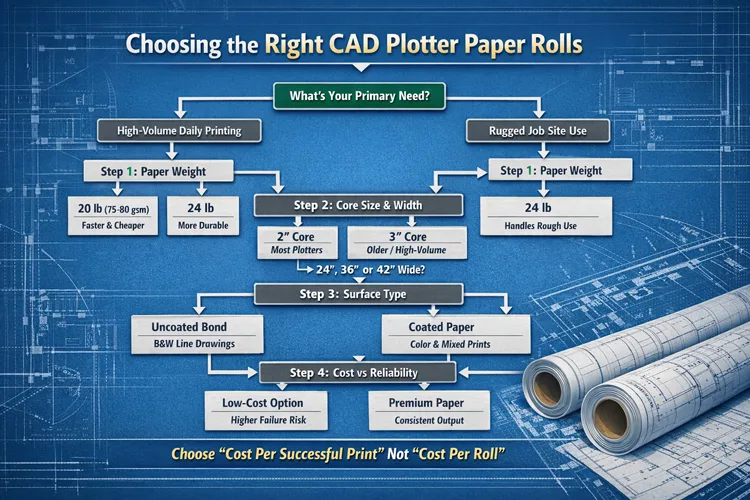
If you’ve ever printed a CAD drawing that looked perfect on screen—but came out faint, curled, or misaligned—you’ve already seen the hidden variable:
Your CAD plotter paper roll.
Not the printer.
Not the software.
Not even the ink.
The paper.
And in real engineering workflows, this is not a minor detail. It directly affects:
- Drawing readability on-site
- Printer reliability during long runs
- Cost per usable print
- Delivery speed under pressure
Let’s break this down from a production and application perspective—not a catalog description.
What Are CAD Plotter Paper Rolls?
CAD plotter paper rolls are precision-controlled bond paper rolls designed for line accuracy, fast ink absorption, and stable feeding in wide-format inkjet plotters.
They are the backbone of industries like:
- Architecture (floor plans, elevations)
- Engineering (technical drawings)
- Construction (site plans, revisions)
- GIS mapping and infrastructure planning
What makes them different from regular paper:
- Controlled thickness (GSM consistency across the roll)
- Engineered surface for inkjet line clarity
- Tight winding structure for stable feeding
👉 This is not office paper scaled up.
It is process-critical media.
The Core Specification That Actually Defines CAD Paper
Most buyers look at price per roll.
Professionals look at three control parameters:
1. Paper Weight (GSM / lb)
Industry standard:
- 20 lb (75–80 gsm) → daily CAD work
- 24 lb → improved durability and stiffness
Real difference:
- 20 lb → faster, cheaper, high-volume
- 24 lb → better handling, less curl
👉 Field insight:
On construction sites, 24 lb often survives handling better—even if it costs more.
2. Brightness (92–96+)
Brightness is not cosmetic—it affects line visibility.
Higher brightness:
- Improves contrast
- Makes fine lines readable
- Enhances scanning and copying
👉 In engineering drawings, clarity = accuracy.
3. Core Size (2″ vs 3″)
This is where many buyers make costly mistakes.
Standard:
- 2-inch core → most modern plotters (HP, Canon, Epson)
- 3-inch core → high-volume or older industrial systems
👉 Wrong core size = cannot install the roll
Not a quality issue—an operational failure.
The Most Used CAD Plotter Paper Roll Sizes
These sizes are not random. They match global drawing standards.
Widths:
| Width | Typical Use |
|---|---|
| 17″ | Small engineering drawings |
| 24″ | Most common (ARCH D, A1) |
| 30″ | Intermediate plans |
| 36″ | Large architectural drawings |
| 42″ | Oversized plans / GIS |
Lengths:
- 150 ft → standard office use
- 300 ft / 500 ft → high-volume printing
👉 Professional reality:
24″ × 150 ft and 36″ × 150 ft dominate global consumption.
Why CAD Plotter Paper Rolls Fail
When problems occur, people blame the printer.
But in most cases, the root cause is the paper.
Common failure modes:
1. Edge Curl
- Caused by poor moisture balance
- Leads to feeding errors
2. Ink Feathering
- Low-quality surface → lines spread
- Critical drawings become unreadable
3. Telescoping Rolls
- Poor rewinding during manufacturing
- Rolls shift during use
4. Paper Jams
- Inconsistent thickness or tension
👉 Key insight:
A plotter is only as stable as the roll it feeds.
How Professionals Actually Choose CAD Plotter Paper Rolls
Forget brand names for a moment.
Use this logic instead:
Step 1 — Define usage intensity
- Daily printing → 20 lb bond
- Heavy handling → 24 lb
Step 2 — Match printer system
- Confirm core size (2″ vs 3″)
- Check width compatibility
Step 3 — Evaluate output requirement
- Line drawings → uncoated bond
- Mixed color → consider improved surface
Step 4 — Balance cost vs failure risk
- Cheap paper → higher defect rate
- Stable paper → consistent workflow
👉 Real decision rule:
Choose based on cost per successful print, not cost per roll.
Where Most Buyers Go Wrong (Industry Truth)
The biggest misconception:
“All CAD paper is the same.”
It is not.
What actually varies:
- Base paper density
- Surface uniformity
- Moisture content
- Winding quality
Two rolls with identical specs on paper can behave completely differently in production.
👉 That difference shows up as:
- Machine downtime
- Reprints
- Operator frustration
What Should You Buy
If you want a reliable baseline:
- 24″ × 150 ft, 20 lb bond (2″ core) → daily CAD
- 36″ × 150 ft, 20 lb bond → large drawings
- 24 lb version → when durability matters
This is the starting point used by most engineering offices worldwide.
Final Perspective: CAD Paper Is a Production Tool, Not a Commodity
After decades in this field, one thing is clear:
CAD plotter paper rolls are not just consumables—they are part of your production system.
When chosen correctly:
- Your printer runs smoother
- Your drawings stay accurate
- Your workflow becomes predictable
When chosen incorrectly:
- Every print becomes a risk
If You’re Not Just Buying, But Planning to Produce
If your goal is to move beyond buying and start:
- Trading CAD plotter paper
- Or manufacturing / converting from jumbo rolls
Then your real challenge is not paper specs—it is:
- Slitting precision
- Roll tension control
- Edge quality consistency
👉 If you want, I can help you:
- Build a CAD plotter paper converting setup
- Or define high-demand SKUs for your market
Tell me your target market and scale—I’ll map the structure for you.

paper converting machinery manufacturer based in China.
We specialize in flexible packaging and paper converting machinery, delivering reliable slitting, rewinding, and coating solutions for global clients.
Our mission is to help manufacturers improve productivity, quality, and sustainability through advanced roll-to-roll technology.

Subtitle for This Block
Title for This Block
Text for This Block


About Me – Bruce Zhou
Bruce Zhou is the founder and strategic leader of Jota Machinery, a global innovator in the thermal paper slitting machine industry. With over 23 years of experience in precision machinery and industrial automation, Bruce has grown Jota into a high-performance, export-driven enterprise serving markets across Europe, the Middle East, and beyond.
Since establishing the company in 2008 and relocating its factory to Kunshan in 2015, Bruce has consistently driven 30% annual growth by combining engineering excellence, customer-centric product development, and intelligent manufacturing. Under his leadership, Jota Machinery has become known for its advanced CNC production capabilities, robust quality control systems, and commitment to customized solutions.
Beyond his role as an industrialist, Bruce is a lifelong learner, deeply engaged in the YTT Decision-Making Executive Training Program. He applies the strategic wisdom of thinkers like Drucker, Inamori, and Wang Yangming in guiding Jota’s growth, while also nurturing a high-trust, results-oriented organizational culture.
A passionate marathoner, global traveler, and advocate for holistic leadership, Bruce brings a mind-body-spirit philosophy to entrepreneurship—building not only machines, but people, systems, and enduring value.