
Table of Contents

time: 29/09/2025 13:11:35 PM
Written by Jota Machinery | Bruce Zhou
Paper Converter Machine Manufacturer
Introduction: Why Receipts Still Matter in a Digital Age
Walk into any supermarket, restaurant, or café, and the ritual is the same: once payment is completed, the printer whirs and a receipt emerges. Despite the global push toward digitization, thermal paper receipts remain an irreplaceable tool in retail and hospitality. They confirm payments, document tax records, print loyalty codes, and even serve as mini marketing channels with QR codes and promotions.
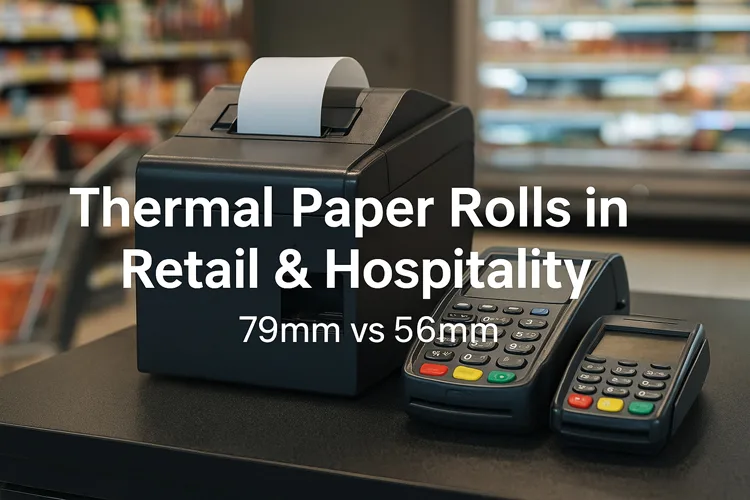
At the heart of this ecosystem are two roll sizes — 79 mm (3⅛”) and 56 mm (2¼”). These two widths dominate the global thermal paper market, with retail and hospitality accounting for over half of total consumption worldwide. In other words, every time a customer checks out at a store or pays at a café table, chances are the printer is running on one of these two roll formats.
This article unpacks why these roll sizes are so critical, the differences in their applications, how retailers use them strategically, and where future opportunities lie. Most importantly, we will explore how manufacturers like Jota Machinery enable converters and suppliers to keep pace with this relentless demand.
Understanding the Two Core Sizes: 79mm vs 56mm
79 mm Rolls – The Retail Standard
- Primary use: Full-size POS printers at supermarkets, department stores, and restaurants.
- Format advantage: Wider paper allows detailed receipts, barcodes, QR codes, and branded logos.
- Common format: 80 × 80 mm rolls (approx. 50–90 m length), often with 12.7 mm cores.
- Extended use: High-capacity versions (up to 180 mm diameter) are used in kiosks and ATMs, but in retail, the 80 × 80 remains the workhorse.
56 mm Rolls – The Compact Performer
- Primary use: Credit card terminals, handheld POS devices, and tableside payment machines.
- Format advantage: Narrow paper fits small, portable devices where space is limited.
- Common format: 57 × 40 mm (approx. 17 m length) and 57 × 50 mm (approx. 50 m length).
- Flexibility: Ideal for restaurants offering mobile payment at the table or small stores using handheld readers.
Why Retail & Hospitality Dominate Thermal Paper Demand
1. Sheer Transaction Volume
Retail is transaction-intensive. A single supermarket can process tens of thousands of receipts per day. Multiply that across global grocery chains, department stores, convenience stores, and restaurants, and the daily consumption of thermal paper becomes staggering.
2. Regulatory Requirements
In many countries, printed receipts are still mandatory for tax compliance and record-keeping. Even where e-receipts are gaining ground, retailers often issue paper receipts alongside digital confirmations.
3. Customer Trust & Marketing Value
Consumers often prefer paper receipts for returns, warranties, or simply peace of mind. Meanwhile, retailers use receipts as marketing tools — printing loyalty offers, QR codes linking to apps, or discount vouchers directly onto the roll.
4. Hospitality’s Unique Demands
Restaurants and cafés not only issue receipts but also kitchen orders and tableside bills. Thermal rolls are crucial for speed and accuracy, ensuring smooth service flow.
Impact: Retail + hospitality accounts for 50–55% of global thermal paper roll usage. This makes it the single largest end-use sector, bigger than banking, transport, or healthcare combined.
Printer Models That Define the Market
- Epson TM-T88 Series: The global POS workhorse, standardizing on 79/80 mm rolls.
- Star Micronics TSP100/TSP143: Popular in North America and Europe for retail chains.
- Bixolon SRP-350 Series: Widely adopted in Asian markets.
- Ingenico & Verifone Terminals: Compact handheld devices using 56–57 mm rolls.
- Clover Station & Clover Mini: A blend of full-size (79 mm) and compact (56 mm) formats.
For hospitality, the balance between 79 mm printers at counters and 56 mm handheld printers at tables reflects the growing trend of mobility and customer convenience.
Technical Insights: What Makes These Rolls Reliable?
- Paper Weight (GSM):
- Standard rolls: 48–55 gsm for retail receipts.
- Heavier grades: 65–70 gsm for durability in hospitality kitchens.
- Core Sizes:
- 12.7 mm is standard, but compact devices sometimes use 11 mm or coreless rolls.
- Print Lifespan:
- Receipts typically remain legible for 3–7 years, depending on coating quality.
- Retailers using lower-grade paper may face fading issues — a major pain point for warranties and returns.
- Inline Branding:
- Retailers increasingly demand pre-printed logos, coupon frames, or security marks directly on thermal rolls.
- This requires slitting + flexographic printing integration, which Jota Machinery already builds into some of its machines.
Market Outlook: Where Demand Is Headed
- Asia-Pacific: The largest growth region due to urbanization and retail expansion in China, India, and Southeast Asia.
- Europe: Stable demand, with rising pressure for BPA-free and phenol-free rolls under EU regulations.
- North America: Increasing adoption of eco-friendly paper and digital-printed logos.
- Middle East & Africa: Fast adoption of POS systems in supermarkets and hospitality chains, boosting thermal roll imports.
Trend Alert: Mobile POS systems (mPOS) are growing at double-digit CAGR, especially in hospitality. This will push demand for 56 mm rolls in portable devices alongside traditional 79 mm rolls.
Sustainability Challenges in Retail & Hospitality
While demand is strong, the industry faces scrutiny over BPA/BPS in coatings, recyclability, and environmental footprint.
- BPA-free thermal paper is already a requirement in the EU.
- Phenol-free papers are gaining adoption worldwide.
- Retailers are also experimenting with eco-labels on receipts, marketing themselves as “green businesses.”
For converters, this means investing in machines that can handle new grades of paper, often slightly different in thickness or coating.
Jota Machinery’s Role in the Retail & Hospitality Supply Chain
Retail and hospitality converters need machines that can switch quickly between 79 mm and 56 mm roll production, handle inline flexo printing, and manage high-speed slitting without sacrificing quality.
Jota Machinery provides exactly this solution:
- JT-SLT-900A: Compact, semi-automatic slitter rewinder ideal for small converters entering POS roll markets.
- JT-SLT-1400C: Advanced slitter rewinder with inline flexographic printing for branded receipt rolls.
- JT-SLT-1400FA: Fully automatic line, from jumbo roll loading to shrink packaging, optimized for mass retail roll production.
By working with Jota, converters can:
- Produce both 79 mm and 56 mm rolls on one machine.
- Add inline branding for retail & hospitality customers.
- Scale production for supermarket chains, banks, or fast-food giants.
Conclusion
Retail and hospitality are not just sectors — they are the engine of the thermal paper industry, driving more than half of global demand. With every café receipt, supermarket bill, or restaurant order slip, 79 mm and 56 mm rolls remain indispensable.
But demand comes with expectations: faster production, flexible roll sizes, eco-compliance, and customized branding. That’s where Jota Machinery steps in.
👉 Ask Jota Machinery for your slitter rewinder solution — whether you’re entering the POS roll business or scaling for international retail chains. Visit www.jotamachinery.com or email jotamachinery@gmail.com to start your journey today.

Contact Our Team!
Thank you for visiting our website and taking an interest in the our products. We’re looking forward to connecting with you and discussing more about how we can help.

Company address
No 68, Shaojing Road, Economic Development Zone, Kunshan City, Suzhou, Jiangsu Province, China

Email Address

Contact Number
+86-13868814910
